
UPCEA’s Corporate Member Blog Series #4 | From Data to Action: Helping Institutions Close the Gap Between Ambition and Infrastructure

By Dave Jarrat
The 2026 State of Continuing Education report makes one thing unmistakably clear: UPCEA member institutions know where they want to go. What they need is help getting there.
The findings from this year’s study read less like a progress report and more like a stress test. Microcredential adoption has hit an all-time high (88%). Workforce Pell looms large. Adult learner enrollment continues ticking upward. Institutions are energized and ambitious. They are also increasingly strained.
Sixty-two percent of respondents say their unit lacks the staffing to execute on institutional goals. Marketing support gaps nearly doubled year-over-year, from 14% to 30%. Fewer than one in three institutions report seamless technology integration between their continuing education systems and main campus. Administrative burden and market uncertainty outrank faculty resistance as the top barriers to expansion, a striking reversal from earlier years that signals the bottlenecks have shifted from academic to operational.
This all points to significant opportunity for UPCEA corporate partners to support institutional members.
UPCEA institutions are not short on vision. They are short on infrastructure, staff, data visibility, and time. The partners who will thrive in this environment are the ones who show up as genuine problem-solvers, willing to meet institutions where they are and help them move forward.
Here are five suggestions on where to start.
1. Lead With the Data Gap, Not the Product Demo
The report reveals a quiet crisis in institutional data confidence. Only 39% of respondents agree it is easy to access real-time enrollment data. While slightly above the average of the last 5 years, this still means that most institutions are partially flying blind.
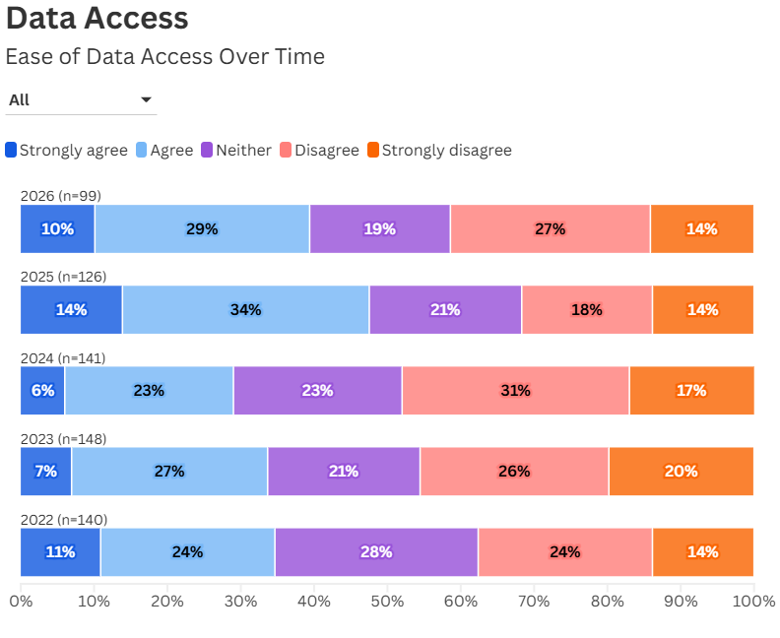 Meanwhile, demand for dashboards and reporting tools jumped from 52% in 2025 to 69% in 2026, the sharpest increase from last year of any capability tracked in the survey.
Institutions are not asking for more data. They are asking for data they can actually use. They need data that is visible in real time, accessible across units, and connected to the outcomes that matter. Workforce Pell will sharpen this need dramatically, with 65% of respondents citing the ability to connect learner data to state longitudinal systems as their top implementation concern.
What this means for you: If your solution touches data in any form, lead with what your platform makes visible, not just what it captures. Show institutional leaders specifically how your tools reduce the number of steps between a question (“Are our microcredential completers finding jobs?”) and a reliable answer.
2. Make Workforce Pell Readiness Part of Your Value Proposition
Workforce Pell is the most significant new policy development in the 2026 report, and institutions are split. Sixty-seven percent say they are at least somewhat likely to expand programs in response to it. Forty-two percent say they are not ready to meet the associated reporting requirements.
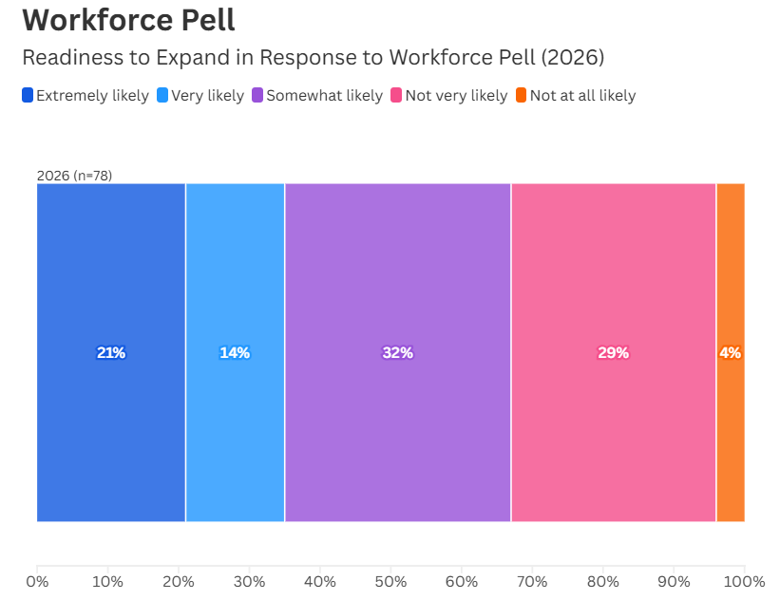
This is a rare moment where institutional need and partner opportunity are almost perfectly aligned. The compliance and data infrastructure that Workforce Pell demands (credential outcome tracking, program CIP code identification, connection to state longitudinal data systems, external credential attainment capture) is exactly the kind of unglamorous but mission-critical work that UPCEA corporate partners are well positioned to deploy.
What this means for you: Do not wait for your institutional contacts to bring up Workforce Pell. Bring it to them, with a clear point of view of how best to capture the opportunity. Audit your platform or service against the four implementation challenges identified in the report (data connectivity, eligibility determination, learner data capture, credential attainment tracking) and develop an honest map of where you add value and where you do not. Then help your contacts build the internal case for investment.
3. Help Fill the Marketing and Instructional Design Staffing Void
The 2026 report documents something that many institutional leaders will privately confirm but rarely say out loud: they don’t have the right skill sets in house. The marketing support gap widened from 14% to 30% in a single year. Instructional design vacancy reports nearly tripled, from 9% to 22%.
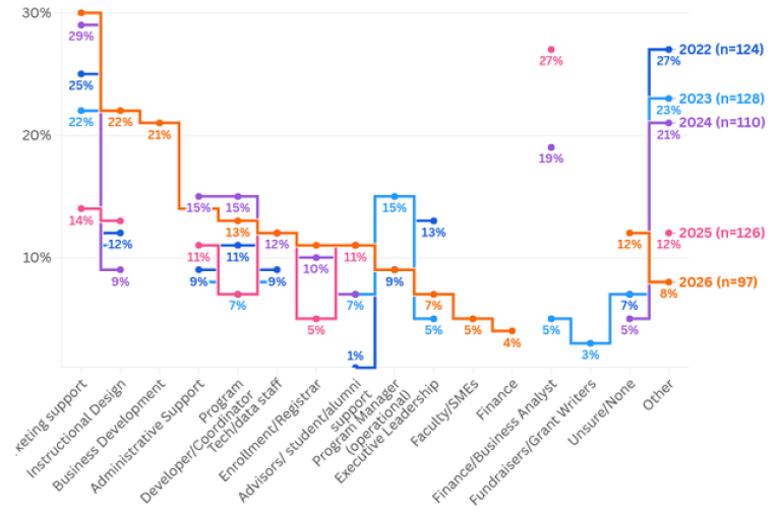
These gaps are not primarily about compensation or hiring pipelines. They reflect the reality that PCE units are being asked to do more programs, more modalities, more employer partnerships, and more short-form credentials without a proportional increase in the people who make those things work.
What this means for you: If your company offers services, this finding should be a central theme in your pitch. Use it to reframe the conversation from cost to capacity. You are not an expense; you are a substitute for headcount that institutions cannot hire fast enough. Make the case in terms that institutional leaders can take to a provost: “We free up your team to focus on strategy while we handle execution.”
4. Reduce Time-to-Market, Not Just Time-to-Launch
Fifty-six percent of 2026 respondents cite time-to-market as a significant barrier to expanding credentials. Governance bottlenecks, approval processes, and cross-unit coordination are the culprits. This is where institutions consistently lose ground to nimble private providers.
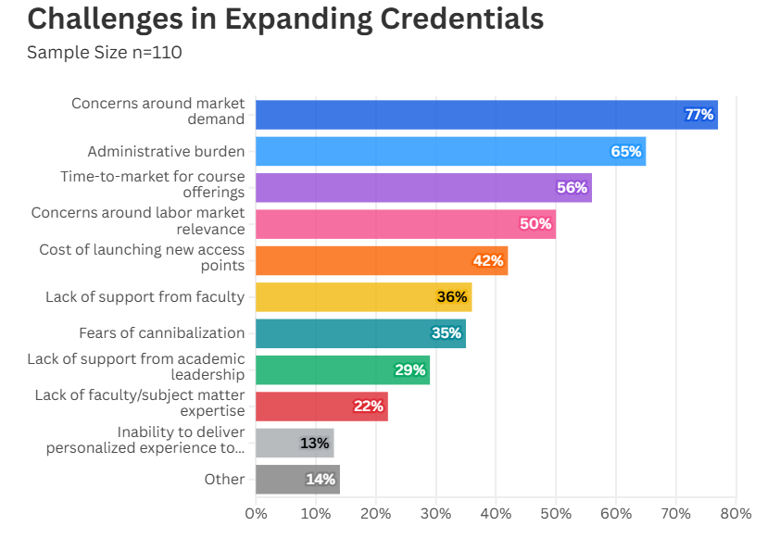
This is also an area where well-designed partner solutions can create genuine competitive advantage. For example, a registration system that cuts three weeks out of program setup is not a feature, it is a strategic answer to one of the most persistent frustrations among UPCEA member institutions.
What this means for you: Identify relevant points in the program development and launch process where time is lost and your solutions can help. Build your demonstration around those moments. If your platform enables non-credit certificate setup in hours rather than weeks, show that. If your content catalog lets institutions launch a new workforce program without starting from scratch, lead with the timeline. The key is making the time-to-market narrative explicit, not assumed.
5. Become a Collaborator in Cross-Campus Coordination, Not Just a Vendor to One Unit
One of the more subtle but significant findings in this year’s report is the decline in perceived cross-campus collaboration. Agreement that other units collaborate with online and PCE on continuing education development dropped from 71% in 2025 to 62% in 2026. Only 13% say their continuing education offerings are well integrated into the broader institutional portfolio. Siloing remains stubbornly at 41%.
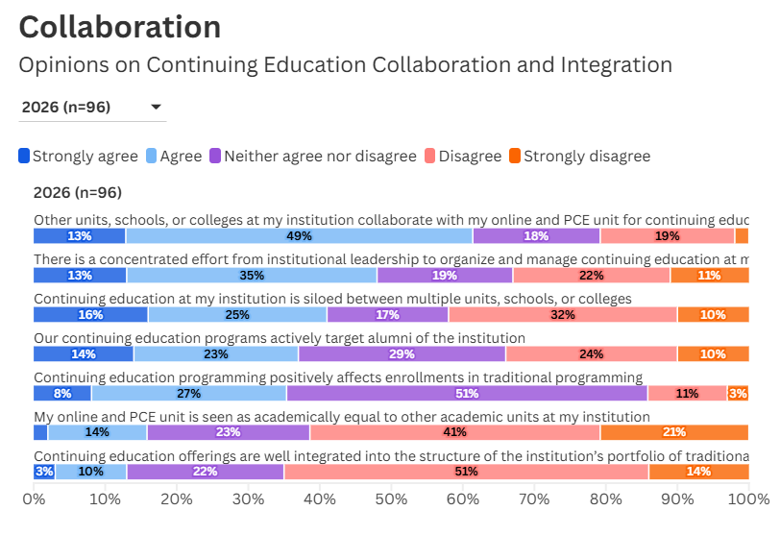
Institutions are not just struggling to build programs. They are struggling to get the right people in the same room, or at least the same workflow. This creates an unusual opportunity for corporate partners who are willing to operate beyond their traditional lane.
What this means for you: Think about who else at the institution should be in the conversation you are already having. The partners who distinguish themselves in 2026 will be the ones who help institutions see across their own silos, not by overstepping, but by asking the connective questions no one else is asking.
The Bottom Line
The 2026 State of Continuing Education report is, at its core, a document about institutional will running ahead of institutional capacity. UPCEA member institutions have made a decisive commitment to workforce-aligned, short-form, outcomes-focused learning. They have the leadership buy-in (79% report strong senior support), the learner demand (adult enrollment up 29% since 2022), and in many cases the strategic clarity.
What they lack are the systems, staff, and operational structures to execute at scale.
That is not a gap that institutions can close alone. The UPCEA corporate partner community exists precisely to help institutions do things they cannot do as effectively on their own. The question is not whether you have a role to play. The question is whether you are playing it in a way that meets this particular moment.
Dave Jarrat serves as a Senior Fellow for UPCEA and as a Strategic Advisor to a broad range of higher education institutions and organizations, including the University of Cambridge, Edquity and Scholarships360. He is a social impact executive focused on improving educational opportunities and outcomes for historically underrepresented populations.
Content for this resource was developed with the assistance of AI. All text has been thoroughly reviewed, edited, and approved by UPCEA staff with subject matter expertise. References and links have been verified for accuracy and reliability.
Learn more about UPCEA's expert consultants.
Do you need help with your PCO unit or campus? We can help. Contact UPCEA Research and Consulting for a brief consult. Email [email protected] or call us at 202-659-3130.
Trusted by the nation's top colleges and universities, UPCEA Research and Consulting provides the best value in the industry today. UPCEA's industry experts have years of experience in Online and Professional Continuing education - put them to work for you!
UPCEA Research and Consulting offers a variety of custom research and consulting options through an outcomes-focused pricing model. Find the option(s) that best suit your institution.
Learn more about UPCEA Research & Consulting
The UPCEA Difference
Unmatched Experience: For more than 100 years, UPCEA consultants have exclusively served the needs of online and professional continuing education programs. UPCEA consultants leverage their extensive industry expertise to expedite solutions, anticipate upcoming shifts, and offer distinct best practices, effectively aiding clients in achieving their goals.
Cost Effectiveness: As a nonprofit, member-serving organization, we provide unmatched value, allowing you to maximize limited research and consulting budgets.
Action in Motion: Our cadre of experienced, skilled authorities and expert practitioners propels you forward, translating research and consulting into impactful implementation, a distinctive hallmark of UPCEA. Our team of current and former institutional leaders will support you, turning research and consulting into action.
Mission Alignment: Like you, our mission is to enhance and expand educational opportunities and outcomes for adult and other non-traditional learners. We share your values and work in partnership with you to advance access and excellence in education.