
Department of Education Issues Final Rule for New Accountability Standards | Policy Matters (July 2026)
Major Updates
Department of Education Issues Final Rule for New Accountability Standards
On June 29, the U.S. Department of Education issued its final rule establishing the Student Tuition and Transparency System (STATS) and Earnings Accountability framework, a sweeping new standard that applies to nearly all programs and sectors regardless of tax status or credential level. Under the rule, undergraduate programs must show that graduates earn more than the typical high school diploma holder, and graduate programs must show graduates earn more than the typical bachelor’s degree holder. Programs that fail this earnings-premium test in two out of three consecutive years lose eligibility for the federal Direct Loan program. And those with consistent failure of programs with at least half of their Title IV funds or at least half of their Title IV recipients associated with low-earning outcome programs could then have those programs lose eligibility to participate in all federal financial aid eligibility (including Pell Grants). The rule also harmonizes this new earnings standard, created under the OBBBA, with the Department’s existing Financial Value Transparency and Gainful Employment regulations.
Notably, the Department made several changes to the final rule in response to nearly 10,000 public comments. It will delay eligibility consequences by at least one year for programs preparing students for tipped-income occupations, so that earnings data reflects tax years when the “No Tax on Tips” policy is in effect (which begins in 2026). The final rule also adds new exemptions from automatic loss of Title IV eligibility: for institutions that don’t currently participate (and haven’t for the last five award years) in the Direct Loan program; for programs where the institution agrees to bar Direct Loan borrowing for at least five years; and for institutions that exclusively serve individuals with documented disabilities. Administrators should review how their programs measure up now, before the accountability consequences take effect. Read the Department’s full press release.
Professional Degree Determinations Impacted by Lawsuits, Department Issues Updated Guidance on Which Degrees Count
On June 24, a federal judge in the District of Columbia preliminarily blocked the Department of Education’s definition of “professional degree” under the RISE Final Rule, which had been set to take effect July 1 and would have determined which graduate program’s students can access higher federal loan limits following the implementation in OBBBA. The ruling came in response to a lawsuit filed by the American Association of Colleges of Nursing, the American Association of Nurse Practitioners, and an interprofessional coalition of organizations representing nurses, teachers, therapists, and public health practitioners, with the court finding the Department’s definition “likely contrary to law.” In response, the Department issued a June 29 Electronic Announcement via Federal Student Aid (FSA) which was updated July 10 listing the CIP codes it will treat as professional degree programs for the duration of the stay. The interim list restores several fields the rule had excluded (including MSN and DNP nursing programs, physician assistant, occupational and physical therapy, audiology, and speech-language pathology) while noting that the rest of the RISE rule, including the new graduate loan limits and repayment plans, took effect July 1 as planned.
Institutions should expect this interim guidance to govern loan processing for months to come. The court has since set a briefing schedule running through December, with both parties agreeing to resolve the case by summary judgment, meaning a final ruling could come any time after that date absent an appeal or other action by the Department. Notably, plaintiffs have signaled they may amend their complaint by July 30 to ask the court to also review the Department’s interim guidance itself, and the Department has not clarified whether its CIP code list is exhaustive, leaving open the possibility of further updates. In the meantime, financial aid offices can rely on the FSA announcement when originating loans at professional-level limits, though the Department has suggested institutions may want to consider using the new program-level loan limit authority to cap borrowing at graduate levels for temporarily reclassified programs, mitigating potential disruption to borrowers if classifications change as the litigation proceeds. Read more.
Other News
- White House to Redirect Billions in Research Funds Toward AI, Away From Colleges (Wall Street Journal)
- Education Department layoffs hindered congressionally mandated activities, inspector general reports (Government Executive)
- Trump administration caps student visa stays at 4 years under final rule (Higher Ed Dive)
- Bipartisan Senate duo wants to help students get federal aid for learning outside college (The Hill)
- Federal Court Vacates PSLF Final Rule on Employer Eligibility, Hours Before July 1 Effective Date (NASFAA)
Authored by

Policy Matters: Primers and Insights
Helping you navigate policy frameworks critical to higher education in the United States.
Access our resources providing an introduction to foundational topics in federal legislation and regulations impacting online and professional continuing education for universities and colleges. Read more.
UPCEA is a proud founding and steering committee member of the Today's Students Coalition.
UPCEA 2026-2027 Policy Committee
Corina Caraccioli, Loyola University New Orleans, Co-Chair
Abram Hedtke, Co-Chair
Holly Anderson
Curtis Brant, Bowling Green State University
Amy Collier, Middlebury College
Johnna Denning-Smith, Marian University
Sean Doyle, Purdue Global
Luke Dowden, Alamo Colleges District
Michele Gribbins, University of Illinois Springfield
Ilona Marie Hajdu, Indiana University
Laura Hendley, Stevenson University
Gloria Niles, University of Hawaii System
Kelly Otter, Georgetown University
Michelle Singh, University of North Texas
Erika Swain, University of Colorado Boulder
Ryan Torma, University of Minnesota

Get Involved with UPCEA
Professional development isn't just about attending sessions. Get involved with UPCEA to meet members from other institutions, share the great work your institution is doing, and hone your own skills. From submitting a session proposal for a conference or an article for a publication to serving as a volunteer on a conference planning committee, there are as many ways to engage with us!
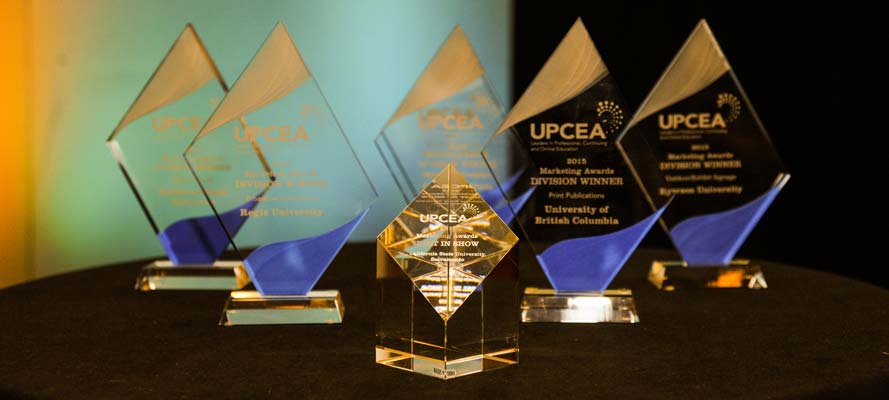
Awards of Excellence
Since 1953, UPCEA has recognized its members' outstanding contributions to the Association and the field, as well as their achievements in innovative programming, marketing and promotion, community development and services, research and publications, and many other areas.