Our New AI Search Research Study Shows Why the Shortlist Has Room for 3
AI tools now play a big role in which online and continuing education programs make a prospect’s shortlist, and that shortlist has room for only three. Search Influence and UPCEA’s 2026 AI Search Research Study shows what it takes to earn one of those spots.
Key Insights
- 56% of prospective online and continuing education students seriously consider three programs or fewer before applying.
- 54% of prospects now use AI tools like ChatGPT and Gemini for program research, up from 35% last year, alongside the 80% who still use traditional search engines.
- 64% of prospects say being cited as a source in an AI Overview makes them trust that institution more, up from 56% last year.
Search Influence is a digital marketing agency specializing in AI and organic search engine optimization (SEO), digital advertising, and analytics for higher education, hospitality, and healthcare.
Search behavior has changed again, and it’s changing faster than most enrollment teams have had time to react to. Prospective students are turning to ChatGPT and Gemini right alongside Google, to compare programs. Institutions that don’t implement strategies to show up in both are striking out before they even get to the batter’s box.
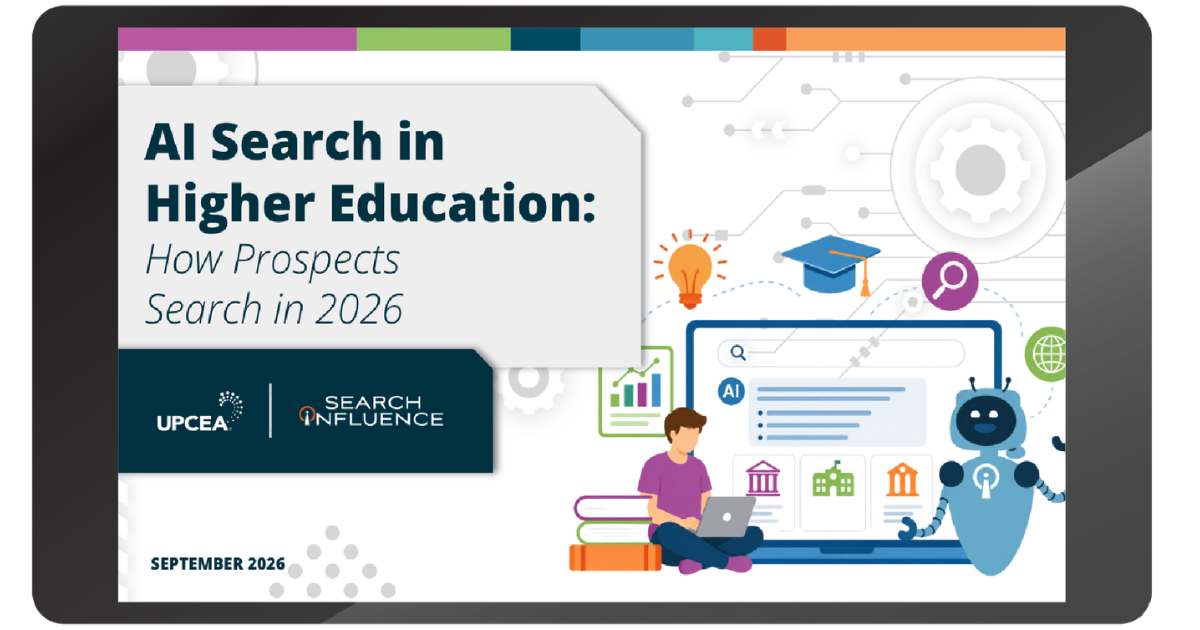
How Prospects Search in 2026 is our updated research study with UPCEA that lifts the lid on how prospective students discover and choose programs, so that institutions can build home run strategies to enroll more students.
This is the second year Search Influence and UPCEA have tracked how prospective students use AI tools, search engines, and social platforms to research programs. This year’s data shows just how rapidly that behavior is changing, and what it means for enrollment marketing.
We surveyed 1,057 qualified prospective adult learners interested in online and continuing education programs, and the data points to a hard truth.
Most prospects build their shortlist before your institution ever gets a chance to make its case.
The Shortlist Is Smaller Than You Think
We found that 56% of prospects seriously consider three programs or fewer before applying. Miss that cut, and there usually isn’t a fourth chance. Prospects don’t keep researching once they’ve found three options that answer their questions.
If your program isn’t one of the three, you’re not in second place. You’re not in the running at all.
Programs that show up prominently in AI-generated results, right alongside the ones still winning through traditional search, are far more likely to land on that shortlist.
If a prospect doesn’t see your program mentioned by name when they ask an AI tool about their options, you may already be out of contention before they ever type your institution’s name into Google.
For enrollment marketers, that means getting your program found early enough, and credibly enough, to earn one of those three spots. Early no longer means “when they visit your website.” It means when they first ask a traditional or AI search engine a question about programs like yours.
Prospects Are Searching Everywhere at Once
Traditional search is still where most online and continuing education research starts. Eighty percent of prospects are extremely or very likely to use a traditional search engine when researching programs.
But AI tools have closed in fast. Fifty-four percent say they’re extremely or very likely to turn to a dedicated AI tool for that same research, up from just 35% last year. Daily AI search use jumped to 39% this year, up from 24% in 2025. Fifty-eight percent now say they use AI tools the same way they’d use a traditional search engine, up from 50% last year.
Prospects use Google and AI in the same session, and they expect both to hold up.
If your program ranks well organically but has no presence in AI-generated answers, you’re missing half the conversation, and you’ll likely never know it happened. You’ll likely never see it happen, since that prospect has no reason to click through and tell you.
Treating traditional search and AI as a single visibility strategy, rather than two competing budgets, is quickly becoming the only way to get your program in front of prospective students. We break down what that looks like in practice in The AI SEO Guide: From Concepts to Application.
AI Overviews Are Building Real Trust With Prospects
Eighty-three percent of prospects read AI-generated overviews when they show up in search results, and 59% of those readers click through to the sources cited. The number that matters most is 64%. That’s the share who say being cited as a source in an AI Overview makes them trust that institution more, up from 56% last year.
A citation is doing something a click can’t do. It’s building credibility with a prospect who may never visit your site.
For an institution competing for one of three shortlist spots, that’s a second, quieter form of influence running alongside your organic rankings. If your program page is well-optimized for traditional SEO but absent from AI-generated answers, you’re handing that trust-building moment to whichever competitor does show up instead.
Our seven-foundation checklist for AI search readiness walks through what makes a program page easy for AI tools to find, understand, and cite. Once you’re being cited, tracking that traffic in GA4 tells you whether it’s actually turning into program inquiries, information requests, and applications, not just visits.
What Prospects Actually Want AI to Do for Them
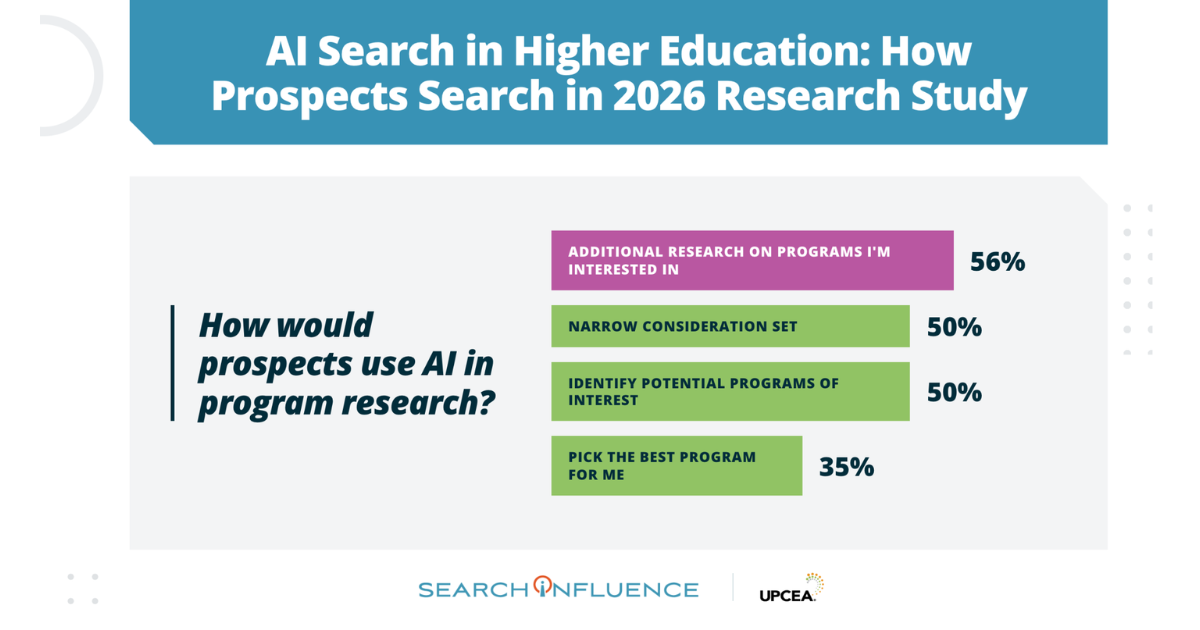
Among prospects likely to use AI tools for program research, 56% say they’d use it to dig deeper into programs already on their radar. Half say they’d use it to find new programs they hadn’t considered, and half say they’d use it to narrow their list down.
Prospects are asking AI to do the elimination round for them.
I keep coming back to this finding. If half of AI users are actively asking a tool to help them cut their list down, your program page needs to give AI something specific and citable to work with. Not the same brochure copy as ten other institutions. A tool can’t recommend your program by name if it can’t tell your program apart from the others it’s comparing.
Give AI Something Worth Recommending
AI tools can only recommend what they can clearly understand. If your program page reads like a brochure, general and aspirational, an AI tool has nothing concrete to point to.
A page that’s easy for AI to recommend usually spells out:
- The outcome. What credential or role does this program actually lead to? “Prepares graduates for a career as an X” tells AI and prospects more than “advances your career” ever will.
- The format. Online, hybrid, evening, cohort-based, whatever it is, say so plainly and early.
- The timeline. How long does it actually take? “12 months” or “18-24 months, part-time” is something an AI tool can compare across programs. “Flexible pacing” isn’t.
- The cost. Prospects are already asking AI tools to compare programs on price. A page that won’t say what something costs gets skipped in favor of one that will.
The good news is that none of this requires new content. Most of it, you’re already sharing in an admissions conversation or a program brochure. It just needs to live in the text of the page itself, in plain language, where an AI tool, and a prospect scanning quickly, can find it in the first few lines. It’s the same specificity that helps your traditional SEO, too, so this work does double duty.
Consistently Optimizing for AI and Traditional Search Is the Winning Strategy
The two channels don’t always line up with each other. A program can be the one ChatGPT recommends by name and still be missing from Google’s results entirely, or the reverse.
Foundational SEO is the base that everything else builds on, including AI visibility. It underpins how well AI tools can find, understand, and recommend a program. Because the shortlist is this small, showing up in only one channel, search or AI, is enough to knock you out of contention. A program that’s strong in just one area is still a program that can get left off the list.
Consistency matters more than dominance in any single channel. You don’t need to be the top Google result and the only ChatGPT recommendation. You need to show up credibly in both, because prospects are checking both.
Frequently Asked Questions About AI Search in Higher Education
How do students use AI to choose a college or program?
Our data shows AI plays a role at every stage. Among prospects likely to use AI tools, 56% use them to dig deeper into programs already on their radar, half use them to find new programs they hadn’t considered, and half use them to narrow their list down to the three or fewer they’ll seriously apply to.
How can my institution get recommended by ChatGPT and other AI tools?
The same way you’d earn a page-one Google ranking, with a program page that spells out the outcome, format, timeline, and cost in plain language. AI tools can only recommend what they can clearly understand, so specific, structured content beats brochure copy every time.
Is AI search replacing traditional SEO for higher ed marketing?
No. Eighty percent of prospects still use traditional search engines, and that number hasn’t dropped. Foundational SEO and AI visibility reinforce each other. Institutions that treat them as one strategy, rather than two separate line items competing for budget, are the ones showing up consistently in both.
Download the Full Study
How Prospects Search in 2026, our higher education marketing research study with UPCEA, has the complete data set behind these findings. It covers how AI use breaks down by age group, which platforms prospects trust most, and where institutions are still leaving visibility on the table.
Download the full study to see where your programs might already be falling off someone’s shortlist.
This is the work we do every day for higher education clients. We audit program pages against these signals, build out the entities and structured content that AI tools need to recommend a program by name, and ensure a strong AI Overview citation and a strong organic ranking are pulling in the same direction rather than competing for budget.
Managing both organic and search strategy takes more bandwidth than most marketing teams have to spare. It’s what our AI SEO and higher education marketing teams do every day, freeing up our clients to focus on other priorities, while ensuring they’re visible where prospects are searching.
Ready to learn more about how we can support your programs’ search visibility? Reach out to our team to discuss how we help higher ed institutions make the shortlist.
Paula French is a higher education digital marketing expert who helps universities attract prospective students through SEO, AI search, and digital advertising.
As Director of Sales and Marketing at Search Influence, she partners with institutions to shape enrollment strategies around how students discover programs today—especially as AI search reshapes that journey.
She has worked with universities including Harvard, Tulane School of Professional Advancement, and Tufts University, and has spoken at UPCEA conferences and the AMA Symposium for the Marketing of Higher Education.