
Generating So Many Leads and Losing Them in a Blink of an Eye
Higher education marketers are faced with significant challenges in attracting new adult students into their professional, continuing, and online (PCO) programs. The target market is now primarily spread across four generations of adult learners, recent Generation Z graduates (those 22 or younger) and Gen Zers not going to college, Millennials (those 23 to 37 years of age) who are becoming managers and parents, Generation X (those 38 to 53) who are new organizational and societal leaders, and Baby Boomers who are slowly looking for the employment exit to spend more time with the multigenerational grandchildren.
PCO marketers are also faced with a shifting portfolio of programs. They market online degrees, noncredit certificates, pre-college programs, programs for those in retirement, technology bootcamps, and Massive Online Open Courses (MOOCs), among other credentials. In addition to the diverse credentials and programs, content is also changing as the economy shifts with artificial intelligence, digital currency, healthcare technology, evolving transportation, transportation science, and new retailing.
A recent UPCEA survey of 90 marketing departments show that PCO units spend on average just over a million dollars ($1.1M) on 7.8 marketing staff and advertising and media expenditures. Of this amount, just over a half ($560K) is spent on media or advertising. The $1.1M spent on marketing contributes to generating $18.6M for the PCO unit and institution. With marketing being such a strategic piece of the revenue and success puzzle, why are we failing or not optimizing the conversion of the expensive inquirer?
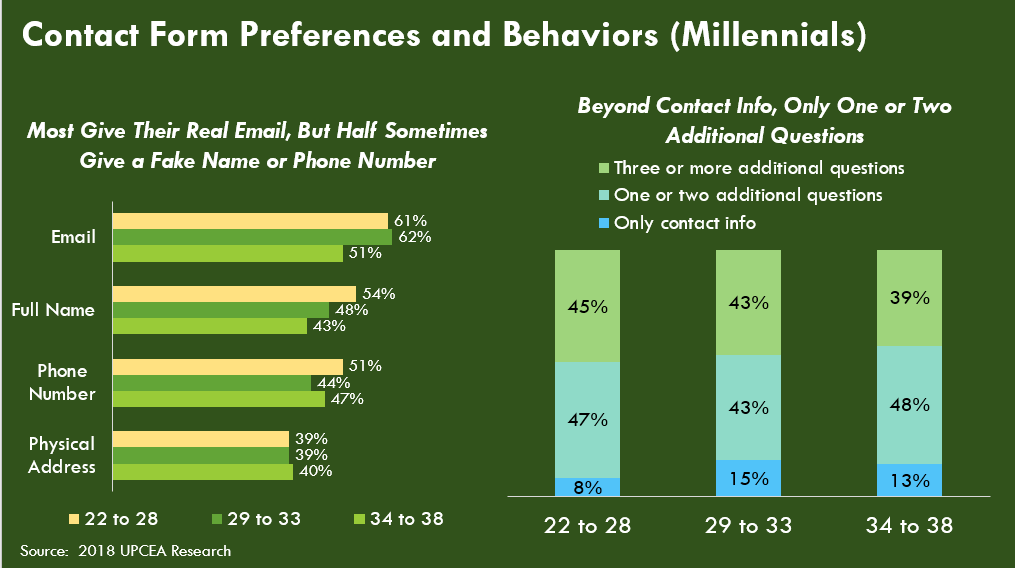
Another recent UPCEA study showed that six-in-ten Millennials will give a correct email during an inquiry and half provide a true name. Half provide an accurate telephone number while the majority provide a false physical address if it is required, but not perceived as essential. After contact information is provided, most will tolerate another question or two.
However, a review of twenty PCO websites and forms shows that many ask for too much and may risk losing the relationship. On average, a PCO institution will ask the inquirer to complete a dozen questions, on their digital form. Units also make many of these questions and fields required. Instead of building the relationship through multiple points of contacts, PCO units try and force the young Millennial or older Gen Z’er to complete the form to get the information they ultimately desire.
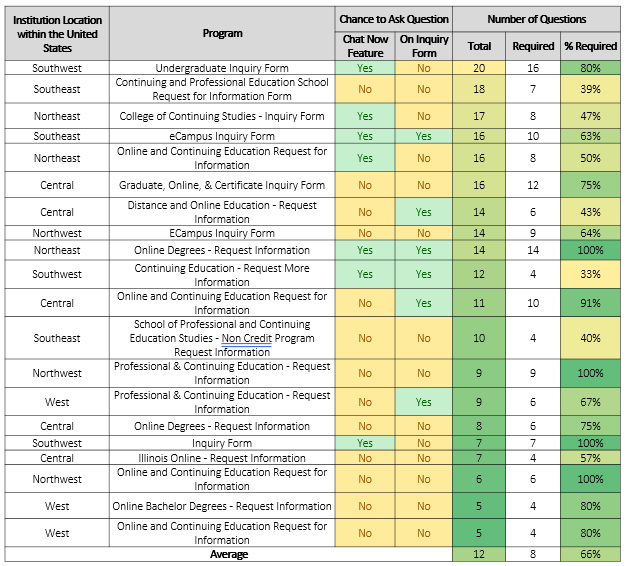
As a result, the likelihood of leads providing false information or abandoning the form is almost certain to increase. PCO units have also forced new adults to answer more questions than they prefer, as well as ask what they may perceive as irrelevant questions. Lastly, almost half (9 out of 20) the PCO forms we reviewed provide no opportunity for inquirers to ask a freeform question nor do they provide a real-time assistant or live chat function. So, why have many PCO units failed here?
- They are working with legacy systems and processes designed around the Boomer or Generation X adult learner.
- They have refused to challenge the defaults of third-party systems or that of the central IT unit of the higher education institution to redesign the form around the Gen Z’er or young Millennial. Some state that “We can’t change the variables. It’s part of XYZ and the system doesn’t allow it.”
- Some marketers, enrollment managers or IT staff are under-resourced and try to squeeze too much information from one engagement. In doing so, they are losing out on many potentially qualified leads, filtering them out unnecessarily.
- Some units lack a proper CRM or have not automated steps to break down information needs into multiple engagements, thus forcing the relationship into a single 12+ required question form.
- Some maintain a subtle arrogance that their higher education product is in high demand and if the potential learner wants it, it must be on the institution’s or unit’s terms.
- An occasional few use the process as a way to screen or qualify the lead. One institution interviewed stated that if the potential adult learner cannot provide the information to the unit, then they aren’t a good candidate for them. This is a very dangerous ideology for a PCO unit, as it is likely to use false or biased assumptions.
As PCO units move into a new year, investing significant budgets on generating leads, they need to challenge their processes for centricity around the new learner, as well as generate transparent conversion metrics to leaders and program managers to avoid simple, but costly mistakes.
Learn more about UPCEA's expert consultants.
Do you need help with your PCO unit or campus? We can help. Contact UPCEA Research and Consulting for a brief consult. Email [email protected] or call us at 202-659-3130.
Trusted by the nation's top colleges and universities, UPCEA Research and Consulting provides the best value in the industry today. UPCEA's industry experts have years of experience in Online and Professional Continuing education - put them to work for you!
UPCEA Research and Consulting offers a variety of custom research and consulting options through an outcomes-focused pricing model. Find the option(s) that best suit your institution.
Learn more about UPCEA Research & Consulting
The UPCEA Difference
Unmatched Experience: For more than 100 years, UPCEA consultants have exclusively served the needs of online and professional continuing education programs. UPCEA consultants leverage their extensive industry expertise to expedite solutions, anticipate upcoming shifts, and offer distinct best practices, effectively aiding clients in achieving their goals.
Cost Effectiveness: As a nonprofit, member-serving organization, we provide unmatched value, allowing you to maximize limited research and consulting budgets.
Action in Motion: Our cadre of experienced, skilled authorities and expert practitioners propels you forward, translating research and consulting into impactful implementation, a distinctive hallmark of UPCEA. Our team of current and former institutional leaders will support you, turning research and consulting into action.
Mission Alignment: Like you, our mission is to enhance and expand educational opportunities and outcomes for adult and other non-traditional learners. We share your values and work in partnership with you to advance access and excellence in education.