
What is a “Professional” Degree? Lawsuits and Legislators Push Back against Trump Admin | Policy Matters (June 2026)
Major Updates
What is a “Professional” Degree? Lawsuits and Legislators Push Back against Trump Admin Determinations
The definition of a “professional” degree has quietly become one of the most consequential terms in federal financial aid, and it lands squarely on the graduate and professional programs many continuing education units operate. Under the One Big Beautiful Bill Act, Grad PLUS is eliminated and new federal loan borrowing caps take effect July 1: students in professional programs may borrow $50,000 per year up to a $200,000 lifetime cap, while other graduate students are limited to $20,500 annually and $100,000 over a lifetime. The Department of Education’s final rule, published in early May, limits the “professional” designation to eleven fields: chiropractic, clinical psychology, dentistry, law, medicine, optometry, osteopathic medicine, pharmacy, podiatry, theology, and veterinary medicine; leaving nursing, physical therapy, physician assistant programs, social work, counseling, and others in the lower-cap “graduate” tier. This is one of several big changes coming to higher education July 1: the new loan limits sit alongside the rollout of Workforce Pell, the wind-down of SAVE loan repayment plan, revised Public Service Loan Forgiveness terms, and new Parent PLUS limits. For administrators, the practical takeaway is that program classification now directly drives how much a student can borrow, and advising, net-price conversations, and enrollment projections for affected programs should be built around that distinction.
The determinations have drawn broad pushback via lawsuits and bipartisan lawmakers. A coalition of two dozen states and the District of Columbia has sued over the narrowed definition, and the regulations have spurred at least three major lawsuits, none yet decided. In Congress, Democrats led by Reps. Mannion, Bonamici, and Underwood and Sens. Merkley and Alsobrooks introduced a Congressional Review Act resolution to repeal the rule, though a measure requiring the President’s signature faces long odds. The more notable movement came on the appropriations side: the House Appropriations Committee advanced its FY 2027 Education funding bill with a bipartisan amendment that would reclassify advanced nursing programs (nurse practitioner, clinical nurse specialist, certified nurse midwife, CRNA, and other APRN programs) as professional degrees. Broader fixes are also in play, including Rep. Lawler’s Professional Student Degree Act (with a Gillibrand companion bill introduced in the Senate) and Rep. Kennedy’s LEAP Act, which would extend professional limits more widely. The timing is the catch: none of this is likely to become law before July 1, and policy analysts caution that even a court order or new law would take time to operationalize, so institutions should plan for the caps to apply this summer while tracking changes that may follow.
Fraudulent Students and Federal Financial Aid – An Increasing Threat to Institutions: How Congress May Act
“Ghost student” fraud (criminals using stolen or fabricated identities to enroll, collect federal aid, and disappear) has become a serious operational and compliance risk, and it concentrates in exactly the open-enrollment and online environments that define much of the UPCEA community. The scale is real: in the first quarter of 2026, California’s 116 community colleges disbursed more than $1.9 million in aid to fake students. The U.S. Department of Education has spent the past year building defenses, beginning with new identity-validation processes announced in June 2025, flagging tens of thousands of applicants for verification, and launching a formal real-time FAFSA fraud-detection system in April 2026 that requires high-risk applicants to verify their identity through a live ID and camera check (or in person at their institution). The Department says these efforts have prevented more than $1 billion in fraudulent aid. On June 10, the House moved to make this permanent, passing the No Aid for Ghost Students Act of 2026 by a 249–172 vote, with 36 Democrats joining Republicans; the bill combines H.R. 7892 and H.R. 7891, would require ED to screen every FAFSA for identity fraud beginning October 1, 2026, mandate in-person or live audiovisual verification before flagged applicants receive aid, and target institutions that show a pattern of disbursing to suspicious applicants. The measure, which the Department supports, now heads to the Senate.
Critics including the financial aid community and student-success advocates warn that the cure may burden the students aid is meant to reach. House Education ranking member Bobby Scott objected on grounds of administrative burden on institutions and data-privacy concerns, and the Hope Center’s analysis (“The Hidden Power Grab in ‘Fraud Prevention’”) argues these legislative packages would hand the Department sweeping new authority to audit schools and withhold aid even as it says existing tools are already working, inject immigration politics into the FAFSA, and risk reversing a decade of bipartisan progress reducing verification burdens that fell hardest on Pell-eligible students. For online and continuing education administrators, the tension is direct: stronger fraud screening protects programs and legitimate students, but added verification steps could slow enrollment and disproportionately affect the working adults these programs serve. UPCEA’s recent snap poll on fraudulent applications shows how widespread the problem has become for members: 93% had encountered suspected or confirmed fraudulent applications in the past year, including 70% with confirmed cases, and only 8% reported no known cases or were unsure. The UPCEA Policy Committee plans to host a Coffee Chat on this topic in October; stay tuned for details to come.
Other News
Policy Matters: Primers and Insights
Helping you navigate policy frameworks critical to higher education in the United States.
Access our resources providing an introduction to foundational topics in federal legislation and regulations impacting online and professional continuing education for universities and colleges. Read more.
UPCEA is a proud founding and steering committee member of the Today's Students Coalition.
UPCEA 2026-2027 Policy Committee
Corina Caraccioli, Loyola University New Orleans, Co-Chair
Abram Hedtke, St. Cloud State University, Co-Chair
Holly Anderson
Curtis Brant, Bowling Green State University
Amy Collier, Middlebury College
Johnna Denning-Smith, Marian University
Sean Doyle, Purdue Global
Luke Dowden, Alamo Colleges District
Michele Gribbins, University of Illinois Springfield
Ilona Marie Hajdu, Indiana University
Laura Hendley, Stevenson University
Gloria Niles, University of Hawaii System
Kelly Otter, Georgetown University
Michelle Singh, University of North Texas
Erika Swain, University of Colorado Boulder
Ryan Torma, University of Minnesota
Get Involved with UPCEA
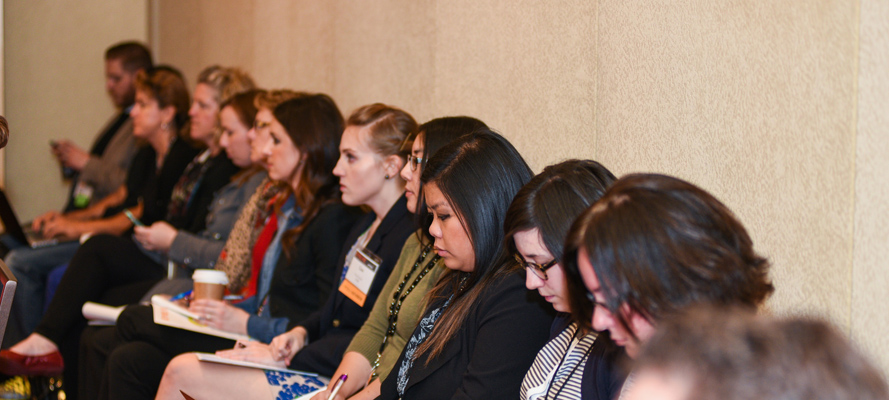
Professional development isn't just about attending sessions. Get involved with UPCEA to meet members from other institutions, share the great work your institution is doing, and hone your own skills. From submitting a session proposal for a conference or an article for a publication to serving as a volunteer on a conference planning committee, there are as many ways to engage with us!
Awards of Excellence
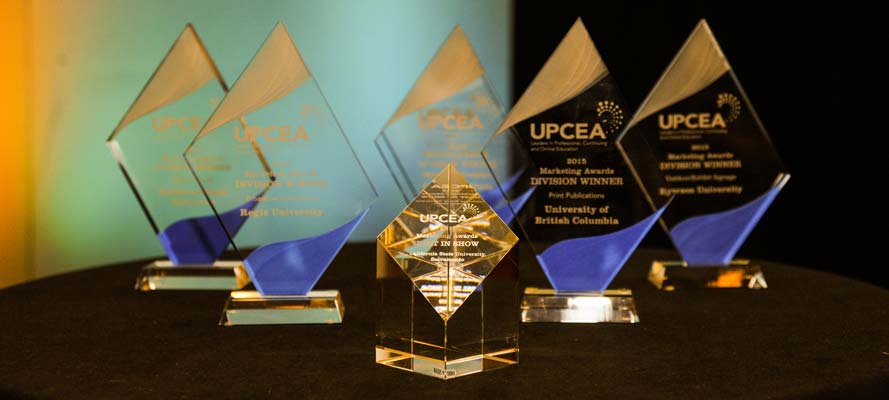
Since 1953, UPCEA has recognized its members' outstanding contributions to the Association and the field, as well as their achievements in innovative programming, marketing and promotion, community development and services, research and publications, and many other areas.