The 41 Million SCNC: Why Higher Ed’s Greatest Failure is the Refusal to Recognize Real Life
There has been much discussion about the more than 41 million US learners with “Some College No Credential” (SCNC) over the past several years. Despite a strategic focus by higher education institutions to re-enroll these learners, and with some success, the population has continued to grow. UPCEA hosted a strategic conversation with the Council for Credential Innovation and higher education leaders in March 2026 to explore one of the potential solutions to this issue, learning mobility.
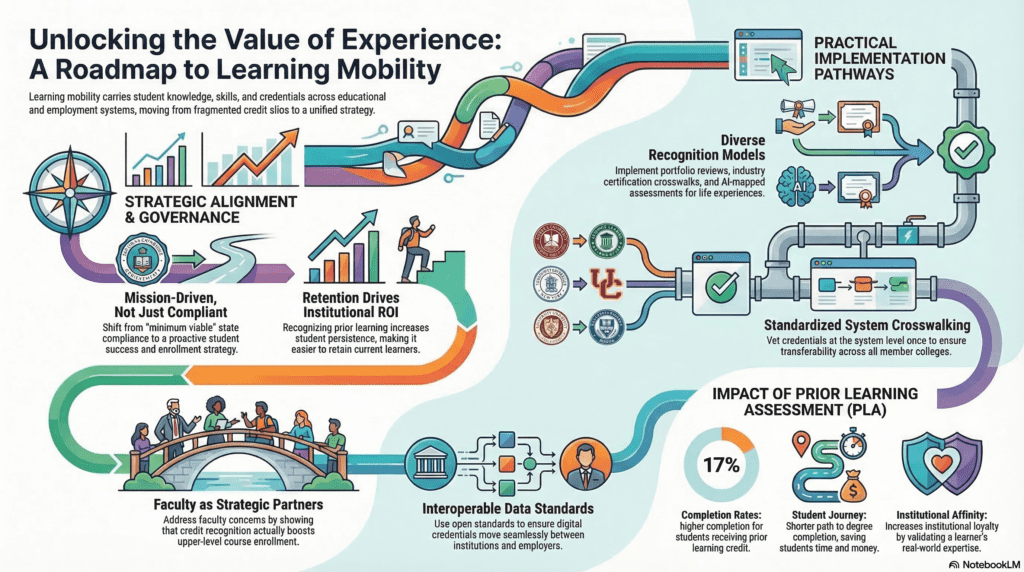
As defined by AACRAO and endorsed by UPCEA, learning mobility is a learner-centered framework where systems and policies are designed around the needs of modern learners, facilitating the seamless recognition, transfer, and portability of credits, competencies, and credentials across institutions, workplaces, and life experiences. It is a fundamental shift: moving from the degree as a static, terminal destination to viewing learning as a portable, liquid asset that belongs to the human being, not the institution.
For decades, the American higher education narrative has followed a rigid, linear script: enroll at eighteen, spend four years in a lecture hall, and emerge with a parchment passport to the middle class. But the reality on the ground has moved on, leaving a staggering 41.9 million adults in the United States with “some college, no degree.” These individuals are not empty vessels waiting to be filled; they are the backbone of the modern workforce, managing complex logistical chains, leading teams through crises, and navigating the profound ethical demands of caregiving. Yet, when they try to return to the academy, they find their accumulated expertise treated as invisible, a ghost in the machine.
This represents more than just a bureaucratic hurdle; it is a systemic “tax” on the lives of adult learners. By treating education as a closed loop where credit is granted only for “seat time” under faculty supervision, institutions force students to repeat content they have already mastered. This friction-filled journey extends the time-to-degree exactly when the cost of tuition is at an all-time high, effectively penalizing those who have spent time gaining real-world wisdom.
The “Seat Stealer” Myth vs. the Persistence Reality
The biggest barrier to this mobility isn’t technology; it’s a zero-sum mindset in higher education. There is a persistent “seat stealer” myth; the fear that if a university grants Credit for Prior Learning (CPL) for a student’s ten years of military logistics experience, a chair in a traditional introductory course will sit empty, and a department’s budget will dwindle.
However, data from CAEL (the Council for Adult and Experiential Learning) and WICHE (the Western Interstate Commission for Higher Education), as well as from many of the senior leaders in the strategic conversation, suggests the opposite. CPL doesn’t cannibalize enrollment; it fuels it. When an adult student sees their lived experience validated on a transcript, they gain “skin in the game” almost immediately. According to CAEL and WICHE research, adult students who receive Credit for Prior Learning (CPL) are 17% more likely to graduate, with some studies indicating even higher completion rates (49% for CPL students vs. 27% for non-CPL students). By removing redundant hurdles, institutions allow students to reach the advanced, specialized coursework where they are most likely to stay engaged and eventually graduate.
From Parenting to “Ethical Judgment”: The Radical Trust in Life Experience
Moving beyond the data requires a form of “radical trust”; trusting that the learning occurring in the home or the community is as rigorous as the learning in the lab. Consider the “Parenting Portfolio” pilot, a program developed by one of the leaders in the UPCEA Council for Credential Innovation. Using the Kolb assessment model—a framework for experiential learning—and AI-driven role-play scenarios, the program maps the high-stakes decision-making of parenting to professional skill sets.
The brilliance of this pilot lies in its translation. The institution was intentional about creating a “shared language” with the workforce. They didn’t issue a “Parenting Badge,” which a recruiter might overlook; instead, they titled the micro-credential “Ethical Judgment.” By mapping parenting challenges to three unique professional skills, they created a credential that speaks the employer’s dialect while honoring the learner exactly where they are.
The Faculty Survival Strategy: Innovation in a Frozen Economy
Institutional change often stalls because faculty incentives are trapped in outdated structures. Another UPCEA Council for Credential Innovation leader shared that their workforce development unit has reframed itself as a lifeline rather than a competitor to degree programs.
In an era of budget freezes, position freezes, and system-level max-salary policies that make raises impossible, the university’s workforce unit uses a “cost-sharing” model. Faculty are paid to develop and deliver non-credit, workforce-aligned programs, essentially allowing them to supplement their income by doing what they do best—building workforce aligned curriculum—without seeking external “side hustles” or consulting gigs. This aligns the personal financial survival of the faculty with the university’s innovation goals, turning potential resistors into the loudest advocates for change.
The Active Military Member: Digital Learning as Existential Strategy
To succeed today, an institution must embrace “swirling”; a student-centered model where the rules regarding delivery modes are demolished. Students take a mix of online, on-campus, and branch-campus courses in a single term based on the shifting demands of their lives.
This is best illustrated by active military enrolled in courses. At any given time, the active military member may need to flex their modality. By providing a fully online path for that term, the institution ensures these students don’t fall behind or fail out. This isn’t a perk; it is a critical strategy for institutional survival. As one leader noted, “We’d be a much smaller institution if we were only in-person.” In a world of rising costs, flexibility is no longer a convenience, it is a requirement for graduation.
The Cost of Strategy Whiplash: A Cautionary Tale
The most dangerous threat to learning mobility is “strategy whiplash,” the cycle where a leadership transition leads to the dismantling of essential units. Leaders in the credential innovation space offered a stark warning of the waste involved in this turnover.
One institutional leader shared that during an interim presidency, a decision was made to shut down a successful online enrollment management unit to save costs. The “savings” proved catastrophic: while graduate enrollment stayed stable, the gains in undergraduate enrollment were lost entirely. A subsequent president eventually had to spend significant resources to rebuild the exact same unit from scratch.
This irony highlights the human and financial waste inherent in short-term thinking. Learning mobility requires a long-term commitment that transcends the tenure of a single interim leader.
Conclusion: Practice Over Polish
Learning mobility is not a final destination, nor is it a piece of software you can buy off a shelf. It is an institutional practice, a constant exercise in building trust and shared language between the academy and the workforce. National initiatives like UPCEA’s “Synchronizing Pathways,” supported by a Strada Education Foundation grant, are currently working to improve data quality for non-degree credentials, ensuring that these pathways are transparent and valuable for the millions who need them.
As higher education faces an inflection point, leaders must decide which side of history they want to be on. The question is no longer whether we can recognize life experience, but whether we will. Are your current policies built for the preservation of institutional silos, or for the mobility of the human beings you serve? The future of work, and the 41 million, is waiting for the answer.
Special thanks to UPCEA CCI co-chairs Doris Savron (University of Phoenix), Sheila LeBlanc (University of Calgary), and Melissa Jimenez (Colorado Community College System) for their contributions to this report.
Julie Uranis, Ph.D., is UPCEA’s Senior Vice President for Online and Strategic Initiatives.Amy Heitzman, Ph.D., is UPCEA’s Deputy CEO and Chief Learning Officer.Melissa Peraino is UPCEA’s Director of Content Development and Volunteer Leader Management.Stacy Chiaramonte is UPCEA’s Senior Vice President of Strategy and Operations for Research and Consulting.
Content for this resource was refined with the assistance of ChatGPT, an AI language model. All text has been thoroughly reviewed, edited, and approved by UPCEA staff with subject matter expertise. References and links have been verified for accuracy and reliability.
Other UPCEA Updates + Blogs
Helix Education and UPCEA Publish New Research Showing the Extent to Which Data Analytics are Underutilized throughout Higher Education (PRWeb)
According to new research published by UPCEA and Helix Education, 83 percent of higher education professionals surveyed have no knowledge…
Media Expenditures Budgeting Among Higher Education Providers
Marketing department media expenditures have been an important topic in student recruitment operations for more than 20 years. During the…
Get Involved with UPCEA
Professional development isn't just about attending sessions. Get involved with UPCEA to meet members from other institutions, share the great work your institution is doing, and hone your own skills. From submitting a session proposal for a conference or an article for a publication to serving as a volunteer on a conference planning committee, there are as many ways to engage with us!