
What a Single Program Page Reveals About Your AI Search Visibility
Your next prospective student has already formed an impression of your program. They just haven’t visited your website yet.
Half of prospective students now use AI tools at least weekly. 79% read Google’s AI Overviews. Before a student fills out an RFI form, an AI tool has likely already answered their questions about your program, including your cost, format, and program outcomes.
AI tools provide answers based on patterns that the large language models (LLMs) recognize in the volumes of content that they ingest.
Universities have more control over those patterns than they realize. Influencing those patterns happens through an AI search strategy that combines website content updates, technical finesse, and off-site content publication.
Most enrollment teams know they need an AI search strategy. What’s holding institutions back from building one? Competing priorities (70%), lack of in-house expertise (37%), and not knowing where to start (27%). The gap between ”’we know this matters” and “we’ve actually done something about it” is where visibility is lost.
Here’s the good news: you don’t need to solve everything at once to get started. One program page (your highest priority program) can tell you more about your AI search readiness than most institutions realize. This post breaks down exactly what AI is evaluating, what one page tells you, and how to turn that into a strategy that moves the needle on your visibility.
Why the Program Page Is Where AI Search Begins
The highest-intent page on your site is now a data source
Program pages sit at the highest-intent moment in the prospect journey, where evaluation happens and decisions get made. According to UPCEA x Search Influence research, 63% of prospects rely on university websites during their research, and 77% trust university-owned content over third-party sources. That trust is concentrated on the program page.
Generative AI tools like ChatGPT, Perplexity, Gemini, and Google AI Overviews heavily draw on program pages because they contain the facts students are actually asking about: cost, duration, modality, outcomes, and prerequisites. When a student asks, “how long is the online MBA at [University]?” an AI answer is assembled from whichever source presents that information most clearly and credibly, ideally the program page.
AI search changes what a program page needs to do
Your program page is doing double duty: selling to students and feeding data to AI. If the page is unclear, under-optimized, or technically inaccessible, AI may surface a competitor instead, give you a passing mention, or leave you out entirely.
Unlike traditional search engines, there is no second page of AI results. If you’re not in the first AI response, you may not exist in that student’s consideration set at all.
What AI Is Actually Evaluating on Your Program Page
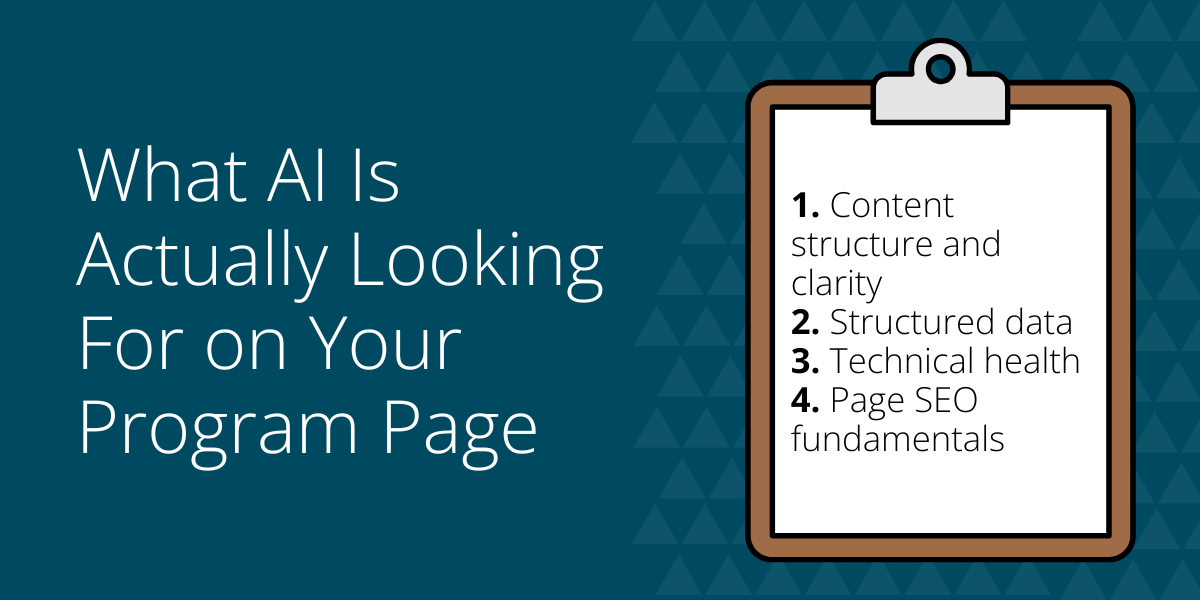
AI systems read your program page differently from how a prospective student would. AI extracts structured facts. You can control whether it’s easy or hard for AI systems to pull out those facts. Here are four sets of factors that make your program pages easy to ingest for AI:
1. Content structure and clarity
Clear structure produces reliable citations. Buried information produces silence. AI extracts content in chunks, which means self-contained, labeled sections outperform dense marketing copy every time. The specific signals that matter:
- Heading hierarchy: Clean H1 → H2 → H3 paths with real semantic structure, not div tags styled to look like headings
- Labeled, self-contained sections: Cost, duration, and modality each in their own clearly marked area, not buried mid-paragraph in brand copy
- FAQ blocks: Written to mirror how real students ask questions, not how your team describes the program internally
- Plain-language facts: “18-month program, 36 credits, fully online” is citable. “Embark on a transformative journey” is not.
2. Structured data
Schema markup is the label that tells AI what your content means. Without it, AI is largely guessing. The implementations that matter most for program pages:
- JSON-LD schema: Especially EducationalOccupationalProgram and FAQPage, which directly signal program facts to AI systems
- Open Graph and social meta tags: Secondary signals AI tools and aggregators use to cross-reference and validate on-page content
- Knowledge Graph alignment: Consistent entity representation so AI systems recognize and trust your institution across sources
3. Technical health
Accessibility to AI starts with accessibility to crawlers. Even a well-written, well-structured page can be invisible if it has technical issues:
- Crawlability and indexing: If search crawlers can’t reach the page reliably, AI likely can’t either
- Core Web Vitals: Slow pages may be partially indexed, meaning AI only sees part of your content, often not the most important part
- Canonical tags: Without them, AI has to choose between multiple versions of your page, and it may not choose your best one
4. Page SEO fundamentals
The signals that have always mattered in traditional SEO (or foundational SEO) still apply. AI uses them to understand what a page covers and decide how much weight to give it:
- Title and meta description: Written to match how students phrase college search queries (program name + intent + audience), not internal nomenclature
- A clear H1, descriptive URL, and image alt text: These signal content coherence to both crawlers and AI systems evaluating page credibility
- Internal links: Connections to outcomes data, faculty profiles, and admissions pages that signal depth and authority beyond the program page itself
Want to see how your program page scores across all four? Search Influence’s free AI Website Grader evaluates any URL and returns a prioritized list of fixes. Run your page at ai-grader.searchinfluence.com.
What a Single Page Reveals
Evaluating one page’s AI visibility and readiness is a smart entry point, as it serves as a proxy for how well your broader site is optimized. Take a look at one program page, and here’s what you can walk away with:
- A baseline: whether your most important program is legible to AI at all. This is a starting point that most institutions don’t currently have
- Your primary optimization challenge: content (unclear or buried facts), technical (crawlability, schema gaps), or both, which determines where effort goes first
- Reusable patterns: heading frameworks, schema templates, and FAQ structures you validate once and roll out across your full catalog
- Confidence to move: a tested approach on one page means you scale with evidence, not guesswork
One page can reveal a lot, but it can’t show how AI interprets your institution as a whole. That requires looking at how AI systems process your broader program ecosystem.
AI Search Understands Programs Through Connected Signals
Your program page is the foundation of a larger AI profile
AI search engines build a synthesized understanding of your program by connecting information from multiple sources. Your program page acts as the foundation, supported by signals from your course catalog, faculty profiles, PDFs, social presence, third-party ranking sites, and news mentions. Together, those sources shape how AI systems understand what your program is, how long it takes, what it costs, and who it serves.
The page is one input. The entity is what AI search engines surface.
A well-optimized page can still underperform
Here’s what that means in practice: a well-optimized program page can still lose ground if the rest of your digital presence is working against it. Let’s say your program page says the degree takes 18 months, but an older catalog still lists it as a 24-month program. AI defaults to whichever source it considers most stable, and that may not be your marketing page. The result is a student who gets an incomplete picture or skips your institution entirely before ever reaching your site.
The compounding effect is real. The longer your entity signals are fragmented or weak, the more AI learns to favor competitors whose programs are better optimized and more consistently represented. You may not notice the gap until a competitor shows up in AI-generated answers where you used to be present.
That’s why the question to ask isn’t just “Is my program page well-structured?” It’s “is everything AI can find about my program working together to surface it?”
What a Single Page Can’t Tell You
With the entity model in mind, the limits of single-page analysis become clear. A page audit tells you how well one input is optimized. It can’t tell you how AI is synthesizing everything else:
- Whether you’re actually being cited: AI may evaluate your page and still not surface your institution in answers. You need to test AI outputs directly, across platforms, to know.
- Cross-platform consistency: how AI describes your programs on ChatGPT versus Perplexity versus Google’s AI Overviews may vary in ways a page audit alone won’t catch
- Ecosystem coherence: whether your catalog entries, PDFs, department pages, and faculty profiles are reinforcing your program page or diluting its signal
- Off-site signals: what third-party sources (rankings sites, news mentions, directories) are telling AI about your institution, and whether that picture supports how you want to be positioned
- Topical authority: whether your site’s internal link structure reinforces subject-matter expertise across your program area, which is a signal AI uses to assess how much weight to give your content
Start with the program page, and then work your way to these broader signals.
A Practical Path for Resource-Constrained Teams
Knowing what one page can and can’t tell you shapes how you sequence the work. Start focused, validate fast, then expand:
- Pick one program page. Your highest-revenue or highest-strategic-priority program. This is your test case.
- Score it. Run it through our free AI Website Grader or walk it manually against the four categories above.
- Fix the obvious. Heading structure, schema, FAQs, plain-language facts. Most are CMS-level edits that don’t require developer time.
- Test how AI describes your program. Ask ChatGPT, Perplexity, Gemini, and Google AI Overviews about your program by name, attribute, and outcome. Note where you appear, where you’re missing, and where competitors are showing up instead.
- Apply the template across your portfolio. Once validated on one page, scale the pattern to your full catalog.
- Move to ecosystem-level work. Entity consistency, authority signals, off-site presence, internal linking architecture (A.K.A., the things a single page can’t surface.)
This sequence moves from “boil the ocean” to “ship something this quarter” and gives you the evidence to justify deeper investment when the time comes.
When to Go Deeper With an AI SEO Audit
Page-level work gives you a strong foundation. But at a certain point, the questions it surfaces can’t be answered by looking at one page… or even ten. Here’s when you’ve hit that point:
Signs you need comprehensive AI SEO support
- You’ve fixed your top program pages, and AI platforms still aren’t surfacing you reliably
- Your institution appears inconsistently across platforms (ex, cited by Perplexity, absent from ChatGPT, described differently in Google AI Overviews)
- AI is describing your programs in ways that don’t reflect how you want to be positioned (or surfacing outdated details that undercut your offering)
- You can’t identify which third-party sources AI is drawing from, or whether they reflect your current programs
- You manage multiple campuses, schools, or program lines, and need to understand how they reinforce or compete with each other in AI summaries
- You’re planning a website redesign or content migration and want AI readiness built in from the start, not bolted on after launch
Staying at the page level while these signals are present means ceding ground to competitors who are optimizing at the ecosystem level.
What an AI SEO audit offers
Most higher education marketers come to an audit knowing something is off. They’re just not sure where. At Search Influence, our AI & Organic SEO Audit gives you a clear answer and a clear path forward.
It evaluates how your institution is interpreted, surfaced, and referenced across both traditional and AI-driven search, then delivers a prioritized set of written recommendations your team can actually act on. You get near-term fixes and longer-term initiatives, mapped to your goals and resources.
It answers three questions no single page can address:
- Content & relevance: How should content be structured, written, and connected to better reach and engage users across organic and AI-generated search results? Are programs, services, and brand entities defined and named consistently? Do your FAQs match how prospects actually ask?
- Authority: How can entity clarity, trust signals, and citations be strengthened to improve your visibility? Where is your institution mentioned and linked across the web, and are those signals reinforcing or fragmenting how AI understands you?
- Technical: How can site structure, accessibility, and technical foundations be improved to support visibility across search engines and AI-driven experiences? This covers sitemaps, internal linking architecture, schema relationships, indexing health, and accessibility across high-priority program pages.
What you walk away with isn’t a report that sits in a folder. Following delivery, Search Influence meets with your team to walk through the findings, answer questions, and align on priorities.
FAQs About AI Search Visibility in Higher Education
How is an AI SEO audit different from a traditional SEO audit?
Traditional search surfaces pages. AI search surfaces entities. A traditional audit evaluates how well individual pages rank: keyword targeting, backlinks, on-page signals, and technical crawlability. An AI SEO, or Generative Engine Optimization (GEO), audit evaluates entity consistency across your entire digital presence, whether everything AI can find about your institution is working together to surface you.
How is an AI SEO audit different from an AEO audit?
Answer Engine Optimization (AEO) typically focuses on increasing visibility within AI-generated answers. Our AI SEO audit takes a broader approach, evaluating the factors that influence both AI-generated answers and organic search visibility. That matters because many AI systems use retrieval-augmented generation (RAG), meaning their responses are grounded in traditional search results and authoritative web content.
In practice, that means the audit examines how your institution appears across AI-generated responses, organic search, technical infrastructure, content structure, and broader signals that shape how AI systems understand and surface your programs.
How often should we audit our program pages for AI search?
It may be enough to conduct an AI search audit once if you can put a strong AI SEO/GEO strategy in place. However, it also makes sense to do a higher-level review of your website every couple of years to identify what might be missed in the ongoing strategy. AI models update continuously, and the sources they draw from shift over time. AI SEO tracking tools can help monitor visibility trends as program content, search results, and AI systems evolve. The audit establishes the baseline, and ongoing tracking helps you measure progress against it.
Will optimizing for AI-driven search hurt our traditional SEO?
No, AI search optimization and traditional SEO are largely additive. The signals that make program pages perform well in AI search (clear structure, accurate schema, strong authority signals, consistent entity presence) are the same signals that help pages rank in conventional search. The difference is emphasis: AI search places more weight on entity coherence and cross-site consistency than traditional SEO historically has.
Stop Guessing How AI Sees Your Programs
A single program page won’t win you AI search on its own. But it shows you what you’re working with, and that’s where every real strategy starts. The institutions that lead in higher education AI search visibility tomorrow will be the ones that started measuring and adapting today.
Where do you stand right now?
The AI Website Grader is a free, no-frills way to get a read on one program page. You can run it in under a minute, and you’ll know more than most of your peers. No demo, no form, no sales call.
If the results raise bigger questions about your overarching strategy, that’s what the AI & Organic SEO Audit is designed to answer. Book a 25-minute call with us, and we’ll map out what we can do for your team.
Either path beats waiting another semester to find out you’ve been invisible the whole time.
About the Author
Paula French is a higher education digital marketing expert who helps universities attract prospective students through SEO, AI search, and digital advertising.
As Director of Sales and Marketing at Search Influence, she partners with institutions to shape enrollment strategies around how students discover programs today—especially as AI search reshapes that journey.
She has worked with universities including Harvard, Tulane School of Professional Advancement, and Tufts University, and has spoken at UPCEA conferences and the AMA Symposium for the Marketing of Higher Education.