
DOJ Extends Accessibility Deadline to April 2027 | Policy Matters (April 2026)
Major Updates
DOJ Extends ADA Title II Web Accessibility Deadline to April 2027
On April 20, 2026, the Department of Justice issued an Interim Final Rule extending the ADA Title II digital accessibility compliance deadlines by one year for all state and local government entities, including public colleges and universities. Public institutions serving populations of 50,000 or more (which, because population is calculated at the state level, effectively includes nearly all public universities) now have until April 26, 2027, to bring their websites, mobile applications, and digital course materials into conformance with Web Content Accessibility Guidelines (WCAG) 2.1, Level AA. Institutions in jurisdictions under 50,000, such as some community colleges or smaller special districts, have until April 26, 2028. The DOJ cited overestimated institutional capacity, particularly in staffing and technology, as the primary rationale for the extension.
Importantly, the extension changes only to the compliance date, all underlying obligations remain fully in force, and the DOJ has signaled it may pursue additional rulemaking to revisit the technical standards themselves. Disability advocates sharply criticized the delay, and a 60-day public comment period on the Interim Final Rule is open through June 22, 2026. Institutions should resist the temptation to pause their accessibility work, and administrators are encouraged to maintain their WCAG 2.1 remediation plans, prioritizing high-traffic pages and student-facing systems, and document ongoing efforts as a compliance record. Read more.
The Department of Education’s Accreditation, Innovation, and Modernization (AIM) negotiated rulemaking committee held its first of two scheduled sessions April 13–17, 2026, in Washington, D.C. Negotiators representing institutions, students, accreditors, and taxpayers worked through a draft regulatory proposal that represents one of the most significant proposed overhauls to the federal accreditation framework in decades. The draft reflects priorities outlined in Executive Order 14279 and includes provisions to simplify recognition of new and existing accreditors, require program-level student outcome metrics to define “minimum student expectations,” tie accreditation review to institutional cost and affordability, prohibit institutional representatives from sitting on accreditor decision-making bodies such as commissions, among other changes including items like confirming institutions have policies for transferability of credits to other institutions.
No consensus was reached during the first session. A revised, red-lined draft is expected ahead of the second and final session scheduled for May 18–22, 2026, at which a formal vote on the proposed regulations will occur. If the committee does not reach consensus, the Department may move forward with final regulations independently. Should rules be finalized by November 1, 2026, they could take effect as early as July 2027. The scope of the proposals: touching accreditor recognition, academic freedom, First Amendment compliance, and credit transfer warrants close attention from institutions. Read more.
AHEAD Earnings Accountability NPRM Open for Public Comment Through May 20
A Notice of Proposed Rulemaking (NPRM) implementing the earnings accountability framework established under the One Big Beautiful Bill Act (OBBBA) was published in the Federal Register on April 20, 2026, with public comments due by May 20, 2026. The proposed rules were developed by the Accountability in Higher Education and Access through Demand-Driven Workforce Pell (AHEAD) negotiated rulemaking committee, which reached consensus in January 2026. The framework would apply a uniform earnings-based accountability metric to virtually all Title IV-eligible programs, from short-term certificates to graduate degrees, regardless of institutional sector. Programs whose graduates do not earn more than working adults with only a high school diploma (for undergraduate programs) or more than bachelor’s degree holders (for graduate programs) in two of three measured years would lose access to the federal Direct Loan program.
The proposed rules also establish the Student Tuition and Transparency System (STATS), require institutions to provide direct warnings to students enrolled in programs at risk of losing aid eligibility, and introduce a voluntary “orderly program closure” pathway for programs that fail initial benchmarks. The Department has indicated final rules are expected in late spring 2026, with an effective date targeted for July 1, 2026, and initial earnings calculations and notifications expected to begin in 2027. Institutions should proactively analyze their program portfolio using the Department’s publicly available AHEAD performance data to identify at-risk programs before the framework goes into effect. Read more and submit your public comments.
Other News
Trump order directs federal contractors to dump DEI — or risk canceled contracts (Higher Ed Dive)
AI Governance Takes Shape: Breaking Down Washington’s Latest AI Frameworks (Brownstein)
Authored by

Policy Matters: Primers and Insights
Helping you navigate policy frameworks critical to higher education in the United States.
Access our resources providing an introduction to foundational topics in federal legislation and regulations impacting online and professional continuing education for universities and colleges. Read more.
UPCEA is a proud founding and steering committee member of the Today's Students Coalition.
UPCEA 2026-2027 Policy Committee
Corina Caraccioli, Loyola University New Orleans, Co-Chair
Abram Hedtke, Co-Chair
Holly Anderson
Curtis Brant, Bowling Green State University
Amy Collier, Middlebury College
Johnna Denning-Smith, Marian University
Sean Doyle, Purdue Global
Luke Dowden, Alamo Colleges District
Michele Gribbins, University of Illinois Springfield
Ilona Marie Hajdu, Indiana University
Laura Hendley, Stevenson University
Gloria Niles, University of Hawaii System
Kelly Otter, Georgetown University
Michelle Singh, University of North Texas
Erika Swain, University of Colorado Boulder
Ryan Torma, University of Minnesota

Get Involved with UPCEA
Professional development isn't just about attending sessions. Get involved with UPCEA to meet members from other institutions, share the great work your institution is doing, and hone your own skills. From submitting a session proposal for a conference or an article for a publication to serving as a volunteer on a conference planning committee, there are as many ways to engage with us!
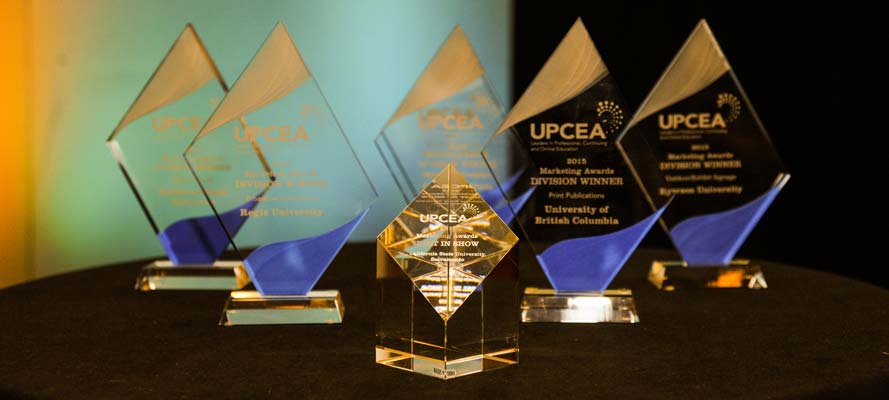
Awards of Excellence
Since 1953, UPCEA has recognized its members' outstanding contributions to the Association and the field, as well as their achievements in innovative programming, marketing and promotion, community development and services, research and publications, and many other areas.