
Workforce Pell and New Federal Accountability Measures Put Data Readiness in the Spotlight, New UPCEA Report Finds
New guidance from UPCEA highlights the growing urgency of data quality, learner mobility, and outcomes reporting for four-year institutions
WASHINGTON, D.C., May 14, 2026 — As Workforce Pell and new federal accountability measures reshape expectations for postsecondary outcomes reporting, colleges and universities must rethink how they track, verify, and communicate learner success, according to a new report from UPCEA, the online and professional education association.
The report, Synchronizing Pathways: Advancing the National Dialogue on Data Quality and Learning Mobility, examines the growing pressure on institutions to build more unified, transparent, and interoperable systems for non-degree credential data. Focused specifically on four-year institutions, the report outlines the operational, policy, and governance challenges institutions face as federal scrutiny around workforce outcomes intensifies.
The report synthesizes recent UPCEA member discussions, emerging federal requirements, and field-tested institutional practices into a practical framework institutions can adapt to their local and state contexts.
Data Quality Has Become a Strategic Imperative
The report argues that Workforce Pell and the One Big Beautiful Bill Act (OBBBA) have moved non-degree data from the margins of academic operations into a campus-wide strategic priority. Institutions are now expected not only to measure completion, but also to be accountable for placement, earnings, and workforce value.
According to the report, many colleges and universities are still operating with disconnected credit and non-degree systems, inconsistent credential definitions, and limited access to verified employment and wage data.
“Higher education is entering a new accountability era where data quality is directly tied to institutional credibility, learner mobility, and access to federal funding,” said Amy Heitzman, Ph.D., Deputy CEO and Chief Learning Officer at UPCEA. “Institutions cannot treat non-degree data as a side issue anymore. Having unified learner records and trustworthy outcomes reporting is becoming foundational to the future of credential innovation.”
Key Challenges Identified in the Report Include:
- Disconnected systems and fragmented learner records that make it difficult to track stackable and non-degree pathways
- Limited access to verified wage and employment data, especially as self-reported outcomes become insufficient for federal accountability
- Privacy and consent concerns related to sensitive learner data and wage record matching
- Inconsistent terminology and credential taxonomies across institutions and systems
- Cross-state and third-party reporting complexities that complicate workforce outcomes tracking for multi-state learners and external credential providers
The report notes that these challenges are particularly significant for four-year institutions, many of which operate robust non-degree portfolios that serve as entry points for adult learners and workforce-aligned education.
Opportunities for Institutional Alignment and Learner Mobility
While the report outlines substantial barriers, it also emphasizes that this moment presents an opportunity for institutions to align systems, improve learner experiences, and strengthen workforce storytelling.
Among the report’s recommendations are:
- Developing institution-wide governance and taxonomy frameworks for non-degree credentials
- Creating comprehensive learner records that connect credit and non-credit learning
- Implementing privacy-protective and interoperable digital credential systems
- Building partnerships with employers, workforce boards, and state longitudinal data systems
- Establishing cross-functional task forces that include registrars, institutional research, IT, financial aid, and online and professional continuing education leaders
“Online and professional education units have long operated at the intersection of workforce responsiveness and institutional innovation,” said Julie Uranis, Ph.D., Senior Vice President for Online and Strategic Initiatives at UPCEA. “What this report demonstrates is that institutions now need infrastructure and governance models that match the pace and complexity of modern learning pathways.”
The report also spotlights UPCEA’s Workforce Pell Resources, including our Workforce Pell Readiness Checklist, designed to help institutions assess preparedness across governance, technology, financial aid, compliance, and student support systems.
Grant-Funded National Initiative
The report is part of a broader national initiative launched by UPCEA to advance credential transparency and learner mobility through improved data quality and institutional capacity-building. The project, titled “Synchronizing Pathways: Expanding Institutional Capacity for Improving Credential Data Quality and Learning Mobility,” is funded through an incubator grant from Strada Education Foundation.
The initiative focuses on helping institutions build clearer, more transferable, and career-relevant non-degree credential pathways for adult learners navigating evolving educational and workforce landscapes.
To read the full report and access UPCEA’s Workforce Pell Resources, visit https://upcea.edu/synchronizing-pathways-advancing-the-national-dialogue-on-data-quality-and-learning-mobility/.
About UPCEA
UPCEA is the online and professional education association. Our members continuously reinvent higher education, positively impacting millions of lives. We proudly lead and support them through innovative research, professional development, networking and mentorship, conferences and seminars, and stakeholder advocacy. Our collaborative, entrepreneurial community brings together decision makers and influencers in education, industry, research, and policy interested in improving educational access and outcomes. Learn more at upcea.edu.

Get Involved with UPCEA
Professional development isn't just about attending sessions. Get involved with UPCEA to meet members from other institutions, share the great work your institution is doing, and hone your own skills. From submitting a session proposal for a conference or an article for a publication to serving as a volunteer on a conference planning committee, there are as many ways to engage with us!
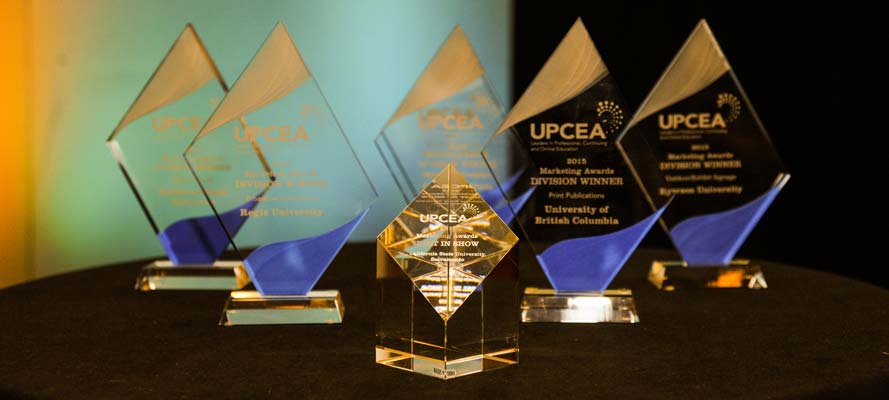
Awards of Excellence
Since 1953, UPCEA has recognized its members' outstanding contributions to the Association and the field, as well as their achievements in innovative programming, marketing and promotion, community development and services, research and publications, and many other areas.