
The Smart City and Crime: Can the Criminology Degree Rehabilitated?
Crime in the United States is projected to decline. Hollywood gives us many dramatic scenarios of what the future could be, although over the next few decades, it is unlikely to be that depicted in the Sylvester Stallone movie Judge Dredd, where crimes are judged and punished on the spot. However, with the adoption of greater technologies and the use of predictive analytics, the scenario illustrated in Tom Cruise’s Minority Report is more likely, although crime will be predicted in advance by supercomputers rather than by mythical beings called “pre-cogs.” This is more realistic given the power of computing at hand coupled with vast amounts of data being collected.
While the public perception is that crime rates have not improved or have gotten worse[i], they have actually been on the decline in the United States for quite some time. The reasons include a variety of factors and possibilities. Some attribute the rise or decline of crime to crackdowns or influences of illegal drugs, the economy, alcohol usage or even gun control. Another possibility would be the decriminalization of certain crimes, such as the use of marijuana in some states.
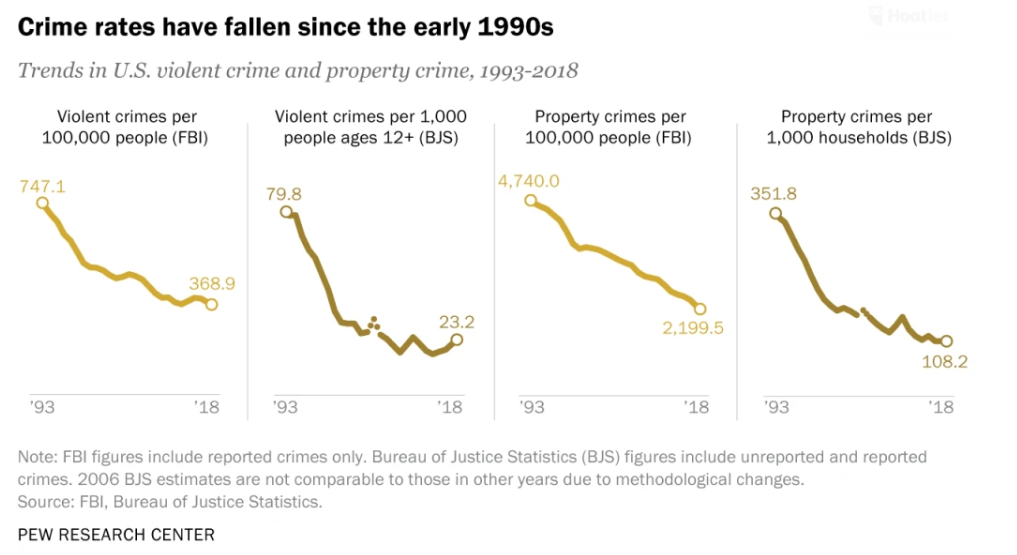
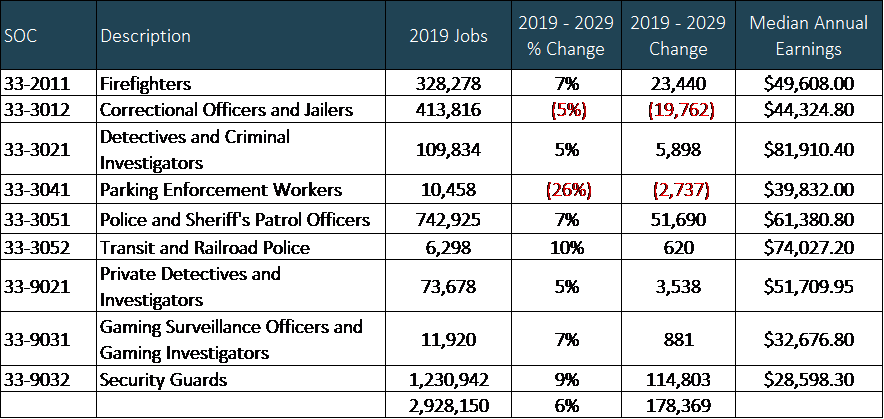
However, one argument as a deterrent to crime is advances in technology such as the use of cell phones to report or record a crime. New technologies including the use of surveillance cameras, analytics and predictive methods, DNA testing and smart building technologies are having an impact. As a result, it is expected that new technologies will improve enforcement and prevention which most likely will result in greater efficiencies and labor changes which are forecasted to increase over the next decade. Table 1 shows a predicted 6% increase in detectives and criminal investigators, police and sheriff’s patrol officers and other professions. However, forecasts show that given the demographics of the country coupled with decreased immigration, the United States is expected to see historically low population growth over the next decade[ii].
Table 1 – Occupational Statistics (Emsi 2019)
Using Emsi data, the table below shows an analysis of job postings as they relate to the “law enforcement” category. The table shows the posting intensity to be high for those in the analyst community. This coupled with a high median posting duration suggests higher demand or an inability to fill open positions.
Table 2 – Job Analytics for Law Enforcement Workers (SOC 33-3000)
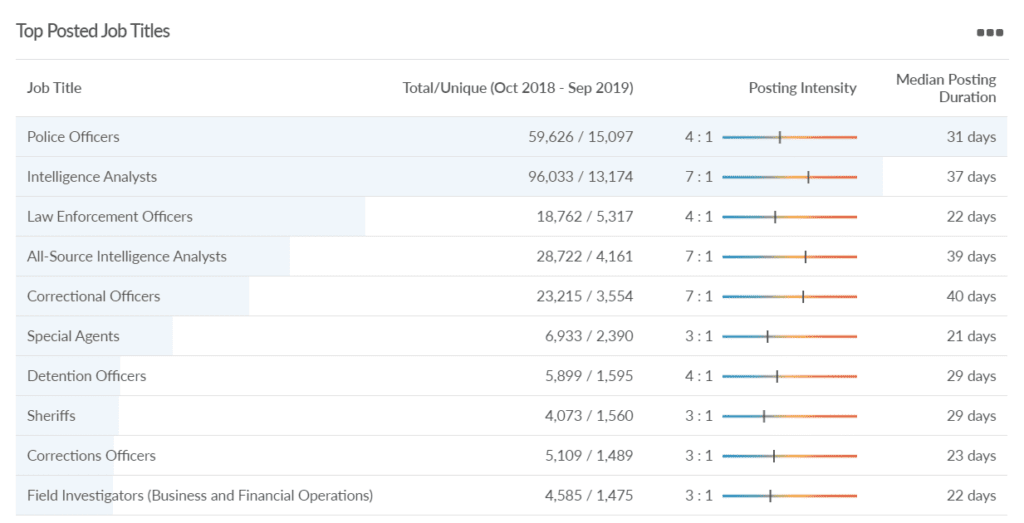
Source: Emsi
With law enforcement jobs and the landscape of crime changing, it is also likely that the criminal justice degree is in need of an overhaul. Many degree programs have classic courses in juvenile delinquency, drug abuse, the corrections system and the court and justice systems. Some even have courses specific to gender or race. However, few curricula that the UPCEA Center for Research and Strategy reviewed had topics related to new technologies or current issues.
Figure 1 – Snapshot of One Institution’s Curriculum
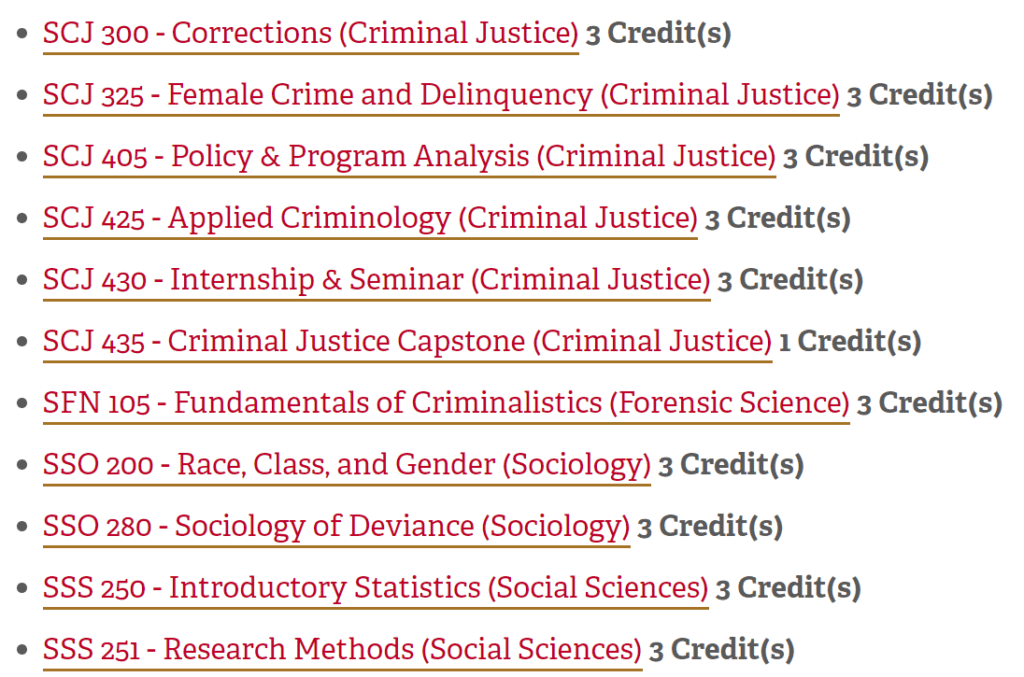
With the advancement of new technologies, is the attractiveness of a degree in criminal justice or criminal studies less? Do institutions need to consider a revision to curricula to address the use and deploying of new technologies, cybercrime, crimes of today, identity theft, conflict between law enforcement and society, new approaches to race relations, new approaches to community policing, the impact of DNA or forensics, or the use of analytics to prevent crime?
With the approach of a new economy fueled by automation and improved communication, it is likely that crime in monitored places will decrease. Quantum-computing accessing enormous data sets coupled with a video-driven society will likely prevent, predict or identify crime. A traditional response to a crime has been a show of human force. A future response could take the form of drones and other mechanized devices. New training will also be needed, as will new curriculum. Law enforcement, like the military, often uses simulations and other preparatory exercises. The use of virtual or augmented reality technologies could also improve law enforcement approaches in a new economy. New weapons, lethal and non-lethal, are certain to enter the law enforcement community. Improvements to facial recognition and other identifying technologies will also improve to the point of adoption.
With all of these developments impacting law enforcement, policies and laws will change. How law enforcement personnel and technologies are managed, used, and deployed will also be subject to change. The courts and legal system will change, thus opening up new avenues of training and education.
Higher education will need to re-evaluate its existing curriculum for relevancy. Institutions will also have an opportunity to provide new training to those with existing criminal justice credentials. They will also have opportunities to deploy new certificates or badges in evolving content areas. To sit back and do nothing and continue using dated curriculum while promising graduates jobs and good salaries in a new economy would be a crime in itself.
[i] Pew Research Center and Gallup research
[ii] Brookings Institute
Authored by

Learn more about UPCEA's expert consultants.
Do you need help with your PCO unit or campus? We can help. Contact UPCEA Research and Consulting for a brief consult. Email [email protected] or call us at 202-659-3130.
Trusted by the nation's top colleges and universities, UPCEA Research and Consulting provides the best value in the industry today. UPCEA's industry experts have years of experience in Online and Professional Continuing education - put them to work for you!
UPCEA Research and Consulting offers a variety of custom research and consulting options through an outcomes-focused pricing model. Find the option(s) that best suit your institution.
Learn more about UPCEA Research & Consulting
The UPCEA Difference
Unmatched Experience: For more than 100 years, UPCEA consultants have exclusively served the needs of online and professional continuing education programs. UPCEA consultants leverage their extensive industry expertise to expedite solutions, anticipate upcoming shifts, and offer distinct best practices, effectively aiding clients in achieving their goals.
Cost Effectiveness: As a nonprofit, member-serving organization, we provide unmatched value, allowing you to maximize limited research and consulting budgets.
Action in Motion: Our cadre of experienced, skilled authorities and expert practitioners propels you forward, translating research and consulting into impactful implementation, a distinctive hallmark of UPCEA. Our team of current and former institutional leaders will support you, turning research and consulting into action.
Mission Alignment: Like you, our mission is to enhance and expand educational opportunities and outcomes for adult and other non-traditional learners. We share your values and work in partnership with you to advance access and excellence in education.