
Putting AI into Action for Higher Education
UPCEA is the hands-on partner for leaders who need to translate AI from idea to implementation. We bring together practitioners, publish applied research on artificial intelligence in higher education, and deliver cohort-based learning so members can move from piloting AI tools to measurable results through strategic implementation. While postsecondary leaders gravitate to frameworks, innovators operationalize and pilot new initiatives, like AI.
This hub centralizes our primers, research briefs, training, and member spotlights on AI resources, with an emphasis on marketing and enrollment, learner support, credential innovation, and workforce alignment.
The Capstone Framework
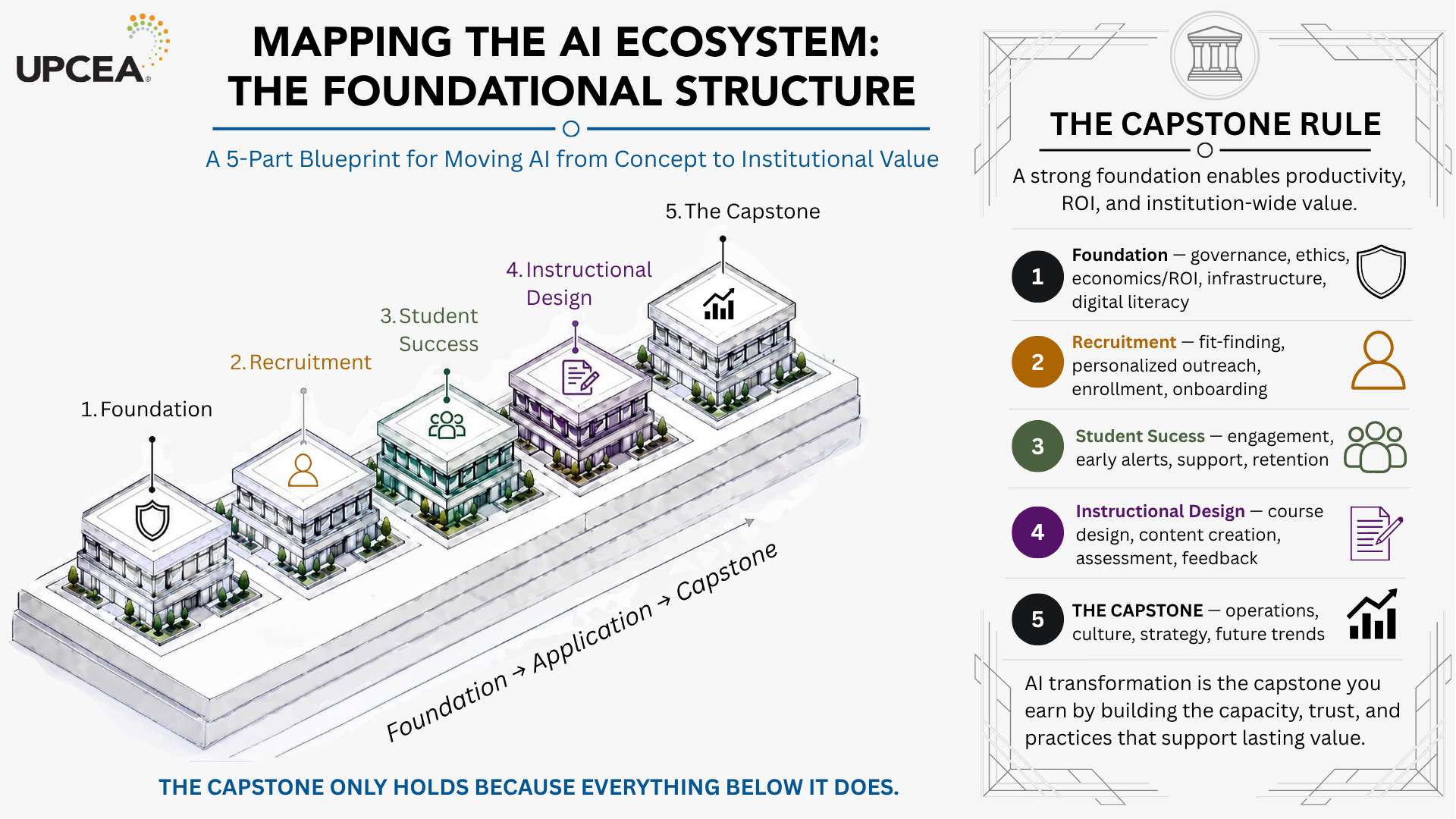
The Capstone Framework provides a practical structure for advancing AI from isolated experimentation to meaningful institutional value. It begins with a strong foundation of governance, ethics, data readiness, infrastructure, return on investment, and digital literacy; extends into applied areas such as recruitment, student success, and instructional design; and culminates in institution-wide transformation across operations, culture, and strategy.
We recognize that an institution’s AI journey is rarely linear. Institutions may begin in different places, revisit earlier decisions, or advance several areas at once. Still, lasting transformation depends on building the foundation well and implementing AI thoughtfully in the areas where it can most effectively support learners and institutional priorities. As the Capstone Framework emphasizes, transformation becomes sustainable when the layers beneath it are strong enough to support it.
UPCEA AI Maturity Index
The UPCEA AI Maturity Index helps leaders assess their online and professional continuing education unit’s current maturity in adopting and using AI responsibly, strategically, and effectively.
Grounded in the Capstone Framework for AI transformation, which holds that meaningful AI adoption depends on far more than experimentation with tools, it rests on a sequence:
- A strong foundation of governance, ethics, data readiness, digital literacy, and infrastructure must be in place
- before AI delivers durable value in recruitment, student success, instruction, and institutional transformation.
This index is designed for those leaders and decision makers guiding the experimentation and adoption of AI within their unit.
Like the UPCEA Credential Maturity Index, this is a reflective planning tool, not a ranking. It is designed to help leaders and teams gauge current practice, recognize strengths, surface gaps, and prioritize future investments in policy, people, systems, and strategy. Its purpose is learning, dialogue, and continuous improvement — not comparison or judgment.
A PDF copy of the UPCEA AI Maturity Index is available here.
AI Primers & Insights
Short, actionable overviews to get your team aligned—plus starter resources from UPCEA.
Each topic includes a few UPCEA resources so your team can operationalize AI in your online and professional education departments. These AI resources for UPCEA members will grow over time as we add new guides, cases, and tools.
Foundation - Leading AI: Governance, Ethics, ROI, Infrastructure, and Digital Literacy
Governance, Ethics & Operational Readiness
Responsible AI demands policy alignment, cross-functional coordination, and cultural readiness across marketing, enrollment, IT, data privacy, and academic units.
AI Literacy and Workforce Readiness
Applying AI to our work - Recruitment, Student Success & Instructional Design
AI-Enabled Enrollment & Marketing
AI is rewriting discovery and conversion. Recent UPCEA research shows half of prospective students use AI-powered search weekly, so showing up in AI overviews (and the SEO that feeds them) determines visibility.
- Don’t Bring a Brochure to a Robot Fight: Winning Page One and the AI Overview
- Marketing and Enrollment Management AI Readiness Report 2025
- AI Search in Higher Education: How Prospects Search in 2025
- Before Deploying AI in Admissions, Ask Why
- Artificial Intelligence and the Future of Student Recruitment
Student Success, Advising & Retention
AI is moving from content creation to tutoring and agentic systems, enabling responsive support and mastery-based progress—key for learner success.
Teaching & Learning Design
Generative and embodied AI are reshaping course design, assessment, and feedback loops across online and hybrid modalities.
- AI in Instructional Design [Use Cases, Best Tools & More]
- Smarter, Scalable, Intentional: Balancing AI in Course and Program Design
- Case Study | Bay Path University: Using an AI-Native Learning Environment to Personalize Online Learning at Scale
- Case Study | Universities of Wisconsin: Building Public AI Literacy Through the AI Skills Access Passport
Transformation: Operations, Culture, Strategy & Future Trends
Institutional Strategy & Future-Proofing
AI influences revenue models, online enterprise strategy, and institutional resilience; leaders need a forward-looking view.

What's Next + Engage More
Online: Trending Now
Insights on AI and the future of higher education from UPCEA Senior Fellow, Ray Schroeder.
GDPR Deadline Looms; Are You Ready?
Online: Trending Now #131 The General Data Protection Regulation of the European Union is going into effect on May 25. If you are not aware of GDPR, now is the time to get up to speed on this European Union policy that may reshape data privacy and security around the world. The EU has greatly expanded…
- « Previous
- 1
- …
- 68
- 69
- 70
Curated Artificial Intelligence in Higher Education News Posts
 Sign up for daily updates
- New Research Reveals AI Use Has Reached a Tipping Point in Higher Education - Newswire.caD2L, a global leader in learning innovation, and Tyton Partners have collaborated to release the annual Time for Class 2026 report, The AI Tipping Point: From Monitoring Students to Engaging Them, which examines how Artificial Intelligence (AI) is reshaping teaching, learning, assessment and workforce readiness across higher education. The report, drawing on insights from more […]
- How and when does artificial intelligence use enhance student creativity? The mediating role of knowledge-based dynamic capabilities - Huainan Wang, et al; Frontiers in PsychologyAs artificial intelligence (AI) becomes more deeply integrated into higher education, understanding its effects on student creativity has become increasingly important. However, the mechanisms through which AI use is associated with student creativity, as well as the boundary conditions of this relationship, remain insufficiently understood. Drawing on the knowledge-based dynamic capabilities (KBDC) framework, this study […]
- Math Students May Learn Less Using AI - Jill Barshay, Future-EdTo isolate AI’s effects, the researchers compared two kinds of math problems that differ in how easily students can outsource them to AI: word problems and graphing problems. Word problems can be copied and pasted directly into AI chatbots for instant answers. Graphing problems are far more cumbersome. A student would need to upload a […]
- AI didn’t break higher education—It exposed the credential trap - Jason Benedict, FortuneHigher education stands at an inflection point. Increasingly, colleges and universities are evaluated less as intellectual communities and more as economic instruments. Students, facing unprecedented tuition costs, credential inflation, labor-market anxiety, and technological disruption, often approach higher education transactionally: the degree becomes the objective, while learning itself becomes secondary. The resulting tension has profound implications […]
- Coursera adds five Workday courses to enterprise learning catalog - Emma Thompson, Ed Tech Innovation HubCoursera has added five Workday courses to its enterprise catalog, expanding access to training on the cloud software provider’s finance, human resources, payroll and student applications for organizations using Coursera’s workforce learning service. Workday provides enterprise cloud applications for financial management, human resources, planning, spend management and analytics. Anthony Salcito, Coursera’s Senior Vice President and […]