
How to Explain AI SEO ROI to University Leadership (Without Overpromising)
Discover how to explain AI SEO ROI to university leadership when attribution is imperfect, with insights and strategy from Search Influence.
Across higher education, marketing teams are being asked to explain AI search visibility before institutions agree on how to measure it.
Leadership discussions are moving quickly, while reporting frameworks remain centered on keyword rankings, sessions, and last-click attribution. Those metrics still matter, but they no longer capture the full picture.
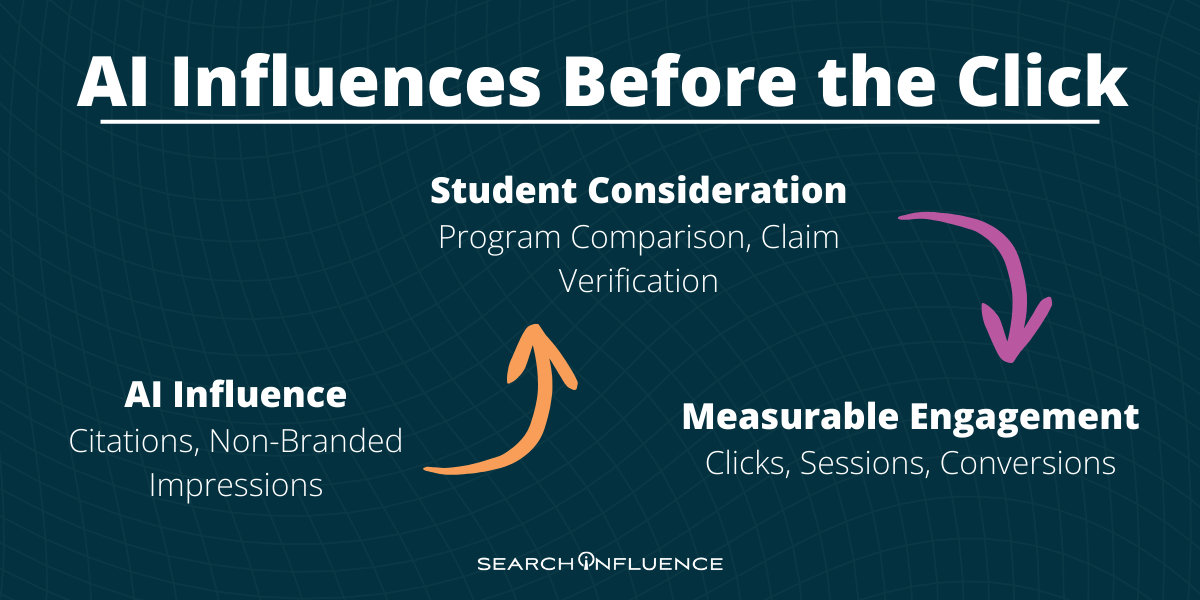
At the same time, prospective students are researching programs in AI tools. They’re asking for summaries, comparing institutions, and validating claims before visiting a website. Influence is happening inside AI-generated answers, yet reporting still assumes visibility starts with a click.
The result is a measurement gap. When leaders ask for clear AI SEO ROI, marketing teams must account for value that does not always appear as website traffic.
Search has evolved. Expectations for certainty have not.
How Prospective Students Are Using AI to Research Programs
Prospective student search behavior has changed.
2025 research from UPCEA, in partnership with Search Influence, surveyed 760 qualified adult learners ages 18 to 60 who are interested in professional and continuing education (PCE) but are not currently enrolled. The study examined how prospects use search engines and AI platforms when researching programs.
The findings confirm that AI is already embedded in student research behavior:
- 50% use AI tools at least weekly
- 79% read Google’s AI Overviews in search results
- 56% trust brands cited in AI-generated responses
This reflects a structural change in discovery behavior.
When a university is cited in an AI-generated answer, it gains credibility. When it’s absent, it may never enter the initial comparison set.
→ Download the full AI Search in Higher Education Research Study
The implication for AI SEO ROI
If trust and evaluation occur within AI environments, visibility cannot be defined solely by organic traffic.
Prospect behavior has already expanded beyond traditional search engine results pages. Meanwhile, institutional measurement frameworks remain anchored to clicks. That gap is what makes actual ROI conversations complex, and why they require a broader definition of influence and return.
Why Leadership Feels Tension Around AI SEO ROI
For leadership teams, ROI lives inside spreadsheets, enrollment models, and board reports. It is tied to headcount, tuition revenue, and institutional risk.
University leaders are focused on:
- Enrollment growth and long-term sustainability
- Cost efficiency and budget accountability
- Brand reputation and academic integrity
- Governance, compliance, and risk management
AI SEO enters that environment as a visibility strategy that does not always produce immediate, linear proof.
It may strengthen awareness, shape early consideration, and influence competitive positioning before an inquiry form is submitted. But those effects do not always map cleanly to last-click reporting.
That mismatch creates friction. Institutional decisions require confidence and a clear understanding of how strategy supports stability over time.
The work, then, is not simply proving that AI influences search. It’s showing how that influence contributes to enrollment strength, brand protection, and long-term competitiveness in ways that leadership can stand behind.
What AI SEO Is (and Is Not)
AI SEO, or “AI optimization,” can feel abstract in leadership conversations. Defining it clearly helps reduce confusion and avoid inflated expectations.
What AI SEO is
AI SEO is a visibility strategy designed for how modern search environments function.
It is:
- A probabilistic strategy. It increases the likelihood that your institution is surfaced, cited, and represented accurately in AI-generated answers.
- A long-term investment. Like traditional SEO, its value compounds as authority, structure, and credibility strengthen over time.
- A way to earn citations and trust. The goal is not only ranking in traditional search results, but being referenced inside AI-generated summaries and conversational responses.
- A response to evolving discovery behavior. It ensures program content is structured, credible, and discoverable as students research across AI tools and traditional search engines.
AI optimization strengthens how institutions are represented in emerging search environments. It operationalizes structured content, entity clarity, and authority signals so AI systems can retrieve and cite your programs accurately.
What AI SEO is not
Strategic planning also requires setting boundaries.
AI SEO is not:
- A guarantee of traditional rankings, traffic, or organic visibility. No modern search strategy can promise fixed outcomes.
- A short-term enrollment lever. It influences consideration and competitiveness, not immediate yield.
- A replacement for human oversight. Governance, editorial review, and academic approval remain central.
- An unmanaged experiment. When executed responsibly, AI SEO operates within a structured strategy, technical best practices, and institutional policies.
Defining AI SEO this way helps leadership evaluate it realistically. It’s neither a shortcut nor a speculative bet. It is a structured approach to remaining visible and competitive in the AI era.
Why “Probabilistic” Does Not Mean “Unmeasurable”
Probabilistic ≠ uncertainty. It means increasing the likelihood of an outcome rather than guaranteeing it.
Deterministic models assume fixed inputs produce predictable outputs. Traditional reporting often follows that logic. Improve rankings → gain traffic → expect proportional inquiries.
AI-driven search behaves differently. Visibility influences awareness, comparison, and trust in ways that are not always immediate or linear.
Universities already invest in probabilistic strategies, including brand campaigns, thought leadership, and long-term reputation building. These efforts shape enrollment outcomes over time, even when they cannot be tied to a single interaction.
AI optimization works similarly. It’s directional, cumulative, and improvable. Its value can be evaluated through expanded visibility, citation presence, and sustained performance trends rather than single-point guarantees.
What You Can Track and Report Today
If AI SEO ROI requires a broader definition of return, reporting must evolve with it.
You may not be able to attribute every AI interaction to a single enrollment decision. But you can measure whether your institution is visible, represented accurately, and gaining authority in AI-driven search.
Today, institutions can track:
- Non-branded AI visibility. Are your programs surfacing in AI-generated answers for competitive, non-branded queries?
- Program-level impressions and topic coverage. Which priority programs are surfacing, and for what themes or questions?
- Citation presence in AI summaries and answers. Is your institution referenced as a trusted source inside AI responses?
- Query-level authority for priority programs. Do you consistently appear for high-intent, non-branded search queries tied to enrollment goals?
- Organic search performance trends. Is expanded AI visibility aligning with stronger organic performance over time?
- Assisted and downstream conversions. Are prospects who engage with AI-influenced content later converting through other channels?
AI SEO ROI reporting works best when it connects visibility signals to enrollment performance over time, showing direction, momentum, and competitive position rather than promising immediate spikes.
→ Dive Deeper: How to Set Up AI Traffic Tracking in GA4
Addressing Leadership Concerns About AI Head-On
Even with stronger reporting, leadership conversations rarely stop at performance.
University leaders are responsible for more than growth. They’re accountable for governance, compliance, and institutional risk. So the questions naturally extend beyond visibility metrics.
Common concerns include:
- How does this fit within governance and approval processes?
- Who maintains human oversight and editorial control?
- How do we protect academic integrity and brand alignment?
- Are we operating in accordance with responsible AI policies?
- How do we ensure accuracy, trustworthiness, and compliance?
A well-structured AI SEO strategy operates inside existing review frameworks. It reinforces approved messaging and improves how programs are represented in AI-driven search environments that already shape perception.
How AI SEO Supports Existing Marketing Investments
Conversations about AI SEO ROI often assume it requires an entirely new investment. In practice, it strengthens work already underway.
AI SEO supports existing strategy by:
- Extending traditional SEO foundations. Reinforcing structured content, authority signals, and program clarity across evolving search environments.
- Protecting content marketing investments. Ensuring program pages, faculty expertise, and long-form resources remain discoverable as AI-driven search expands.
- Improving paid media efficiency. Reaching prospects who are more informed and further along in consideration after engaging with AI-mediated research.
- Reinforcing authority across the enrollment funnel. Supporting discovery, comparison, and validation stages rather than operating as a separate channel.
AI optimization functions as a connective infrastructure. It aligns with enrollment growth, brand strategy, and digital performance goals rather than competing with them.
Why Leadership Should Invest Now (Even Without Perfect Attribution)
AI-driven discovery is already influencing how institutions are evaluated. Institutional readiness, however, remains mixed.
Conducted in October 2025, an UPCEA Snap Poll of 30 member institutions found:
- 60% are exploring AI search
- 30% have a formal strategy
- 10% are not planning or remain unconvinced that it matters
At the same time, learners are actively using AI tools to compare programs and validate claims before visiting a website.
As adoption outpaces strategy, competitive gaps begin to widen. Institutions building structured visibility today are strengthening citation presence and authority over time. Those waiting may find themselves competing against content ecosystems that have already gained momentum.
Investment at this stage supports long-term competitiveness and institutional stability, even before attribution models fully catch up.
Across higher education, marketing teams are being asked to explain AI search visibility before institutions agree on how to measure it.
How to Talk About AI SEO ROI Without Overpromising
AI SEO ROI conversations succeed or fail based on language.
Overstating impact creates skepticism. Understating it creates inertia. The goal is disciplined, leadership-ready framing.
Avoid language such as:
- Guaranteed outcomes
- Immediate enrollment spikes
- AI replacing traditional SEO campaigns
These claims invite pushback and misrepresent how search actually works.
Instead, use language such as:
- Measurable visibility in AI-driven search environments
- Influence across the enrollment journey
- Compounding authority over time
- Long-term competitiveness and institutional resilience
Framing AI SEO this way aligns with how universities already evaluate strategic investments. It emphasizes visibility, stewardship, and sustainability rather than short-term gains.
The Role of a Strategic Partner in Proving AI SEO Value Internally
If AI SEO ROI feels difficult to defend in budget or board discussions, the gap may be in how it’s framed and reported.
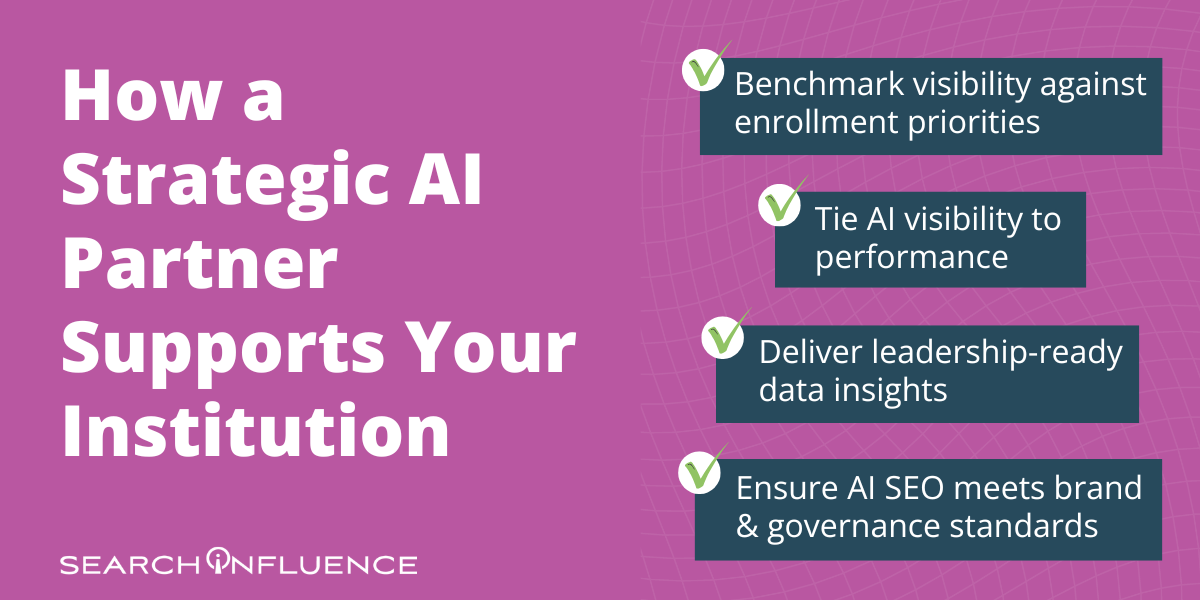
A strategic partner can support your institution by:
- Defining visibility benchmarks tied to enrollment priorities
- Building reporting frameworks that connect AI presence to performance trends
- Preparing leadership-ready data-driven insights for budget and board discussions
- Ensuring AI SEO initiatives reflect governance and brand standards
As an AI SEO agency, Search Influence works alongside institutional teams to embed AI visibility into broader enrollment strategy with consistency and accountability.
Frequently Asked Questions About AI SEO ROI in Higher Education
Can AI SEO directly increase enrollment?
AI SEO supports enrollment growth over time by strengthening visibility, credibility, and competitive digital presence early in the research process. It influences awareness and consideration before inquiry forms are submitted, helping institutions enter the comparison set sooner. Its impact builds cumulatively, contributing to sustained enrollment performance rather than immediate headcount spikes.
How long does it take to see results from AI search optimization?
The timeline for positive ROI from AI search optimization varies based on institutional authority, content strength, and competition. Early visibility signals, such as increased citation presence or broader topic coverage, can appear quickly. Broader performance impact develops gradually as authority compounds and AI-driven discovery continues to expand.
Is AI SEO replacing traditional SEO?
No. AI SEO efforts build on traditional SEO foundations. Technical health, content quality, internal linking, and authority signals remain essential for visibility in both search engines and AI-generated answers. AI optimization extends those fundamentals to ensure content is interpretable and citable in conversational search environments.
How do we protect academic and brand integrity?
Institutions can protect academic and brand integrity by embedding AI optimization within existing governance, editorial review, and content standards. All program messaging should follow institutional approval processes, faculty oversight, and compliance guidelines before optimization occurs. AI SEO then strengthens how approved content is structured and surfaced, ensuring information remains accurate, aligned, and consistent across AI-driven search environments.
What if leadership wants guaranteed outcomes?
Search performance, whether traditional or AI-driven, cannot be guaranteed. AI visibility influences awareness and evaluation in measurable but non-linear ways. Leadership conversations are strongest when grounded in benchmark tracking, citation trends, and performance correlations over time rather than promises of immediate certainty.
From Strategy to Action: Webinar and Strategy Labs for Higher Ed Marketers
Understanding AI SEO ROI is one challenge. Implementing it within tight budgets, competing priorities, and limited internal resources is another. When teams work in silos, institutions risk inconsistent messaging and missed visibility in AI answers.
To support higher ed marketers navigating this shift, UPCEA and Search Influence are hosting:
Make Your Existing Marketing Work Harder for AI Search Visibility – March 24, 12 PM ET | 11 AM CT
- Emily West, Senior Market Research Analyst, UPCEA
- Will Scott, CEO and Co-Founder, Search Influence
- Paula French, Director, Search Influence
This live webinar will focus on using your existing marketing efforts to increase AI relevance, strengthen trust, and protect program visibility.
For hands-on application, Search Influence is also hosting Strategy Labs (March 31 and April 1, 12 PM ET | 11 AM CT), led by Will Scott and Paula French. These collaborative, small group workshops provide actionable recommendations tailored to your institutional priorities.
Calculate AI SEO ROI With Confidence
AI search has changed how prospects discover, compare, and evaluate programs.
A strong AI SEO strategy defines what success looks like, aligns reporting with enrollment priorities, and embeds oversight into execution. It strengthens how your programs are represented in AI-generated answers while reinforcing brand and academic standards.
Search will continue to evolve. Institutions that align strategy now can build citation presence, authority, and competitive resilience over time.
Ready to make your AI SEO investment a smart one?
Book a conversation with the Search Influence team to discuss strategy, measurement, and next steps tailored to your institution.