
Competent Marketing Teams in a Turbulent Economy
As a fan of Discovery Channel’s Deadliest Catch, I’ve come to relate the world of higher education with the rough waters of the Bering Sea. Enrollments can be as elusive as the prized Opilio crab. Different crab (Opilio, Alaskan King, Bairdi) react to different baits and locations, just as there are differences between Generation Z, Millennials, Generation X and Boomers. There are veteran captains on the show just as there are veteran marketers in the UPCEA community. There are also the new deckhands, who might be our digital marketers. Ultimately, the boats are successful because of good leadership, staffing, and planning, as well as having the right gear. Successful boats also adapt to harsh conditions and use analytics, coupled with experience in planning.
Higher education is faced with turbulence in the form of economic transformation, degree saturation, high tuition, changing demographics, competition and new credentialing. Higher education marketers are faced with new marketing technologies and tools while operating in an often slow moving and bureaucratic process when it comes to making marketing investments. Despite these challenges, there are opportunities for professional, continuing and online (PCO) units and their marketers, to succeed in the marketplace.
PCO education units are at the forefront of educational opportunity. While traditional, campus-based education struggles, PCO units and their leaders are asked to find new streams of revenue and enrollments for the institution. Once found, marketers often need to use newer marketing techniques, such as marketing automation, content marketing and social media tactics, to chum the waters and attract Millennial decision-makers and the newly identified species of Generation Z. Once in the net or pot, new messaging, technologies and efficient, high-yield conversion and enrollment management processes take effect.
Marketing has become more complex and knowing what staff to have in-house or to outsource are important decisions for PCO units. In my August 2, 2019 blog posting, I talked about the importance and profile of the PCO marketing leader. On average, the marketing leader manages 6.1 staff. Decisions need to be made as to who these individuals are. Are they marketing managers or coordinators? Analysts? Digital or social media specialists? While these decisions are being made, are there short-term solutions through outsourcing or long-term outsourcing due to inconsistent need of certain competencies or not needing a specific competency on staff.
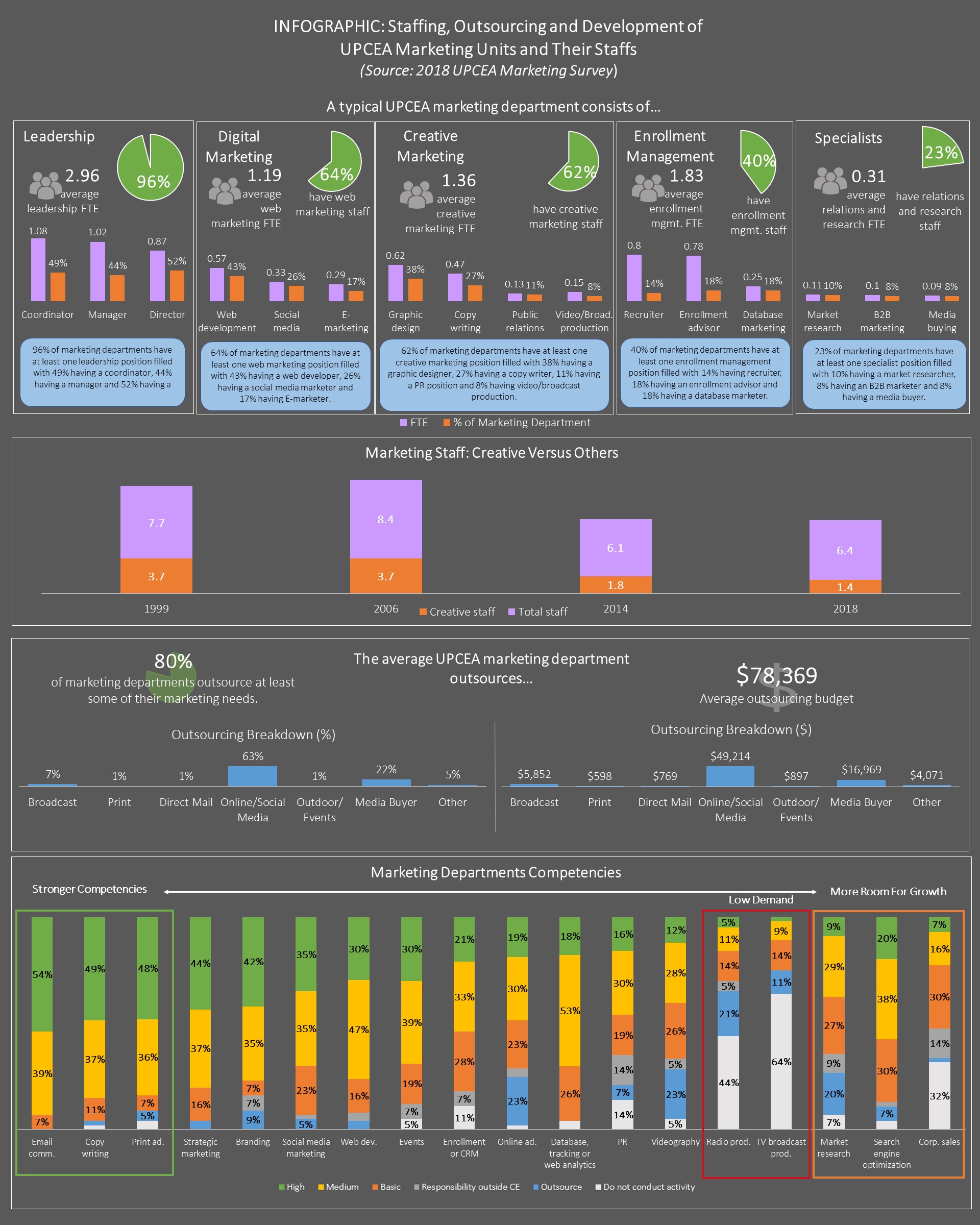
The UPCEA Marketing Survey (see infographic below) identified that most PCO units have staff leading, managing or coordinating marketing efforts (96%) and when they do, they have 2.96 full-time equivalents (FTEs). Just under two-thirds (64%) have someone in digital marketing and when they do, they have 1.19 FTEs. Interestingly, with the evolution of marketing, the number of creative staff has declined from 3.7 FTEs in both 1999 and 2006 to 1.4 in 2018.
The bottom chart on the infographic shows that despite the smaller numbers of creative staff, approximately half of PCO marketing departments say they have high competency in copywriting (49%) and print ad development (48%). Other high areas of competency include email communication, strategic marketing, branding, social media marketing and web development. The chart also shows lower or basic competency for market research, search engine optimization, videography, and CRM and analytics.
In an effort to gain competencies more quickly or efficiently, many PCO marketing departments have chosen the route of outsourcing some functions, to the tune of $78,369 on average or 10% of the unit marketing budget (or 14% of the media budget). Eighty percent of PCO marketing departments reported some level of outsourcing, mostly in online and social media or buying some other form of media or in videography or market research. Gaining external expertise or an outside perspective, especially in market research, can be important to accelerate decision-making with new program development and marketing planning. Given the potential complexities of digital marketing, such as paid search, content marketing or social media marketing, using an outside agency may yield better results through greater external expertise or efficiencies. These factors are important considerations when deciding to outsource rather than building the competency in-house.
In addition to the challenges that higher education will face, PCO marketers may struggle with new marketing technologies or tools; continued fragmentation of the market; improving enrollment management, conversion and retention; being able to leverage analytics competitively; and communicating the need for appropriate resources for marketing. Progressive institutions or those with sophisticated enrollment management systems, understand or can easily calculate the return on marketing investment. As the infographic suggests, analytic, CRM or enrollment management competencies or staffing may be lacking due to poor budget situations or lack of perceived value. Being able to show the marketing return on investment for every dollar spent, as well as conversion rates by program and media channels, can help create optimal marketing budgets. Good metrics will also help to identify what marketing tools may be better suited for strategic outsourcing.
Like Deadliest Catch, a complete or integrated approach is needed for long-term sustainability. Having strong marketing leadership, good staff, proper tools, efficient processes, success metrics and good planning should yield a positive return on investment with crab pots full of enrollments.
Learn more about UPCEA's expert consultants.
Do you need help with your PCO unit or campus? We can help. Contact UPCEA Research and Consulting for a brief consult. Email [email protected] or call us at 202-659-3130.
Trusted by the nation's top colleges and universities, UPCEA Research and Consulting provides the best value in the industry today. UPCEA's industry experts have years of experience in Online and Professional Continuing education - put them to work for you!
UPCEA Research and Consulting offers a variety of custom research and consulting options through an outcomes-focused pricing model. Find the option(s) that best suit your institution.
Learn more about UPCEA Research & Consulting
The UPCEA Difference
Unmatched Experience: For more than 100 years, UPCEA consultants have exclusively served the needs of online and professional continuing education programs. UPCEA consultants leverage their extensive industry expertise to expedite solutions, anticipate upcoming shifts, and offer distinct best practices, effectively aiding clients in achieving their goals.
Cost Effectiveness: As a nonprofit, member-serving organization, we provide unmatched value, allowing you to maximize limited research and consulting budgets.
Action in Motion: Our cadre of experienced, skilled authorities and expert practitioners propels you forward, translating research and consulting into impactful implementation, a distinctive hallmark of UPCEA. Our team of current and former institutional leaders will support you, turning research and consulting into action.
Mission Alignment: Like you, our mission is to enhance and expand educational opportunities and outcomes for adult and other non-traditional learners. We share your values and work in partnership with you to advance access and excellence in education.