
The AI Search Gap: What Students Expect vs. What Institutions Are Doing
Half of prospective students use AI tools every week. Yet, only about a third of higher education institutions have a formal strategy for AI search.
That gap isn’t just a metric. It’s a brand visibility crisis. Students are using ChatGPT and Perplexity to research programs, compare universities, and narrow their lists, often before they ever land on your website.
If your institution isn’t optimized for AI search, you’re invisible during the moments that matter most.
New research from UPCEA and Search Influence, AI Search in Higher Education: How Prospects Search in 2025, reveals the dramatic adoption of AI usage by adult learners, and a follow-up poll shows that few institutions have kept pace. Put simply, students have moved forward. Colleges and universities are lagging behind.
This post breaks down what students expect, where institutions are falling short, and what higher ed marketers can do right now to close the AI search gap.
What Students Expect From Search in 2026 and Beyond
AI use is now a normal part of search
The modern student search journey doesn’t stop at Google. Prospects are using AI platforms to summarize degree options, compare program outcomes, and weigh tuition costs in a single query.
50% of prospective students use AI tools weekly, and 79% read Google’s AI Overviews before clicking any result. This isn’t experimental behavior. It’s how college students now gather context and make early judgments about which programs seem credible.
If your program isn’t present in those AI-generated search results, you’re invisible in the zero-click stage, where attention is won or lost before a website visit ever happens.
Search behavior is diversified… and more competitive
Students aren’t abandoning traditional search altogether. They’re simply expanding it. 84% still use search engines, 61% turn to YouTube, and 50% use AI tools to search for programs. Each platform plays a distinct role: Google helps students find programs, YouTube brings those programs to life, and AI tools synthesize information and recommend next steps.
That shift makes visibility more complex. It’s not enough to rank on page one anymore. Your institution has to show up everywhere students are researching, in formats they trust, with information AI can interpret and share.
Trust is earned, and AI reflects it
Students still turn to universities for credibility, but AI is now part of how that trust forms. 56% of students say they’re more likely to trust brands cited by AI, and 77% trust university websites most when confirming information.
This creates a feedback loop: AI tools surface your content → students verify details on your website → trust compounds.
Universities with accurate, consistent, and well-structured content give AI what it needs to cite them confidently. Those with incomplete or outdated information are the ones who get bypassed by AI and by students.
Data Source: UPCEA x Search Influence: AI Search in Higher Education: How Prospects Search in 2025
What Institutions Are Doing (and What’s Holding Them Back)
While students are rapidly integrating AI tools into their research, institutions are moving a lot more slowly. In a survey of 30 UPCEA members, the UPCEA “AI Search in Higher Education Snap Poll” reveals the current state of readiness and the reasons behind the existing lag.
The state of AI search strategy
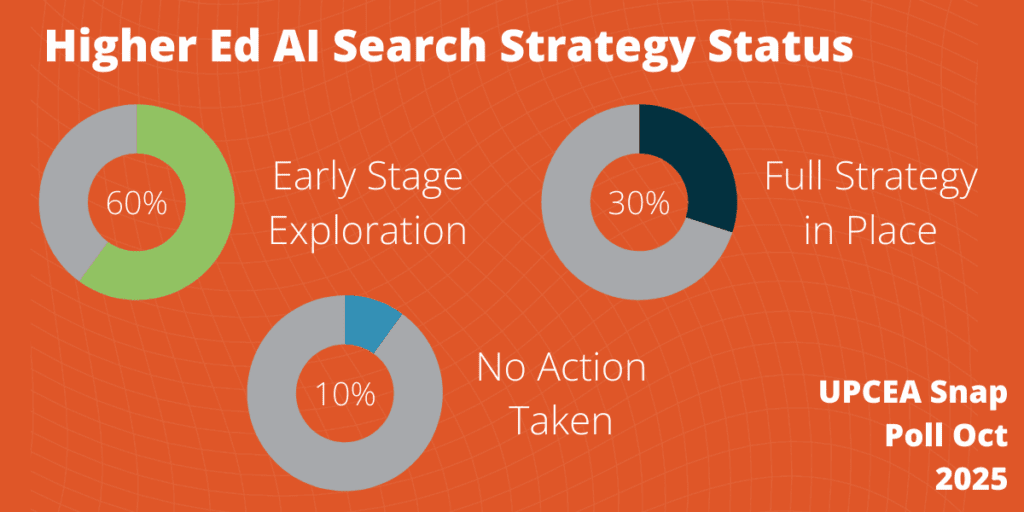
Most institutions are aware that AI search matters, but few have operationalized it. 60% are in the early stages of exploring how to adapt, 30% have a formal strategy in place, and the remaining 10% either haven’t started or don’t expect AI to impact student discovery.
Awareness is high, but activation is limited. “Exploring” signals interest, not execution, and without structure, the opportunity to lead fades quickly.
The biggest barriers to progress
Time, expertise, and clarity are slowing progress toward AI search adoption. 70% of surveyed UPCEA members cite competing priorities or limited bandwidth, 36.67% lack in-house expertise or training, and 26.67% point to unclear ROI, uncertainty about AI search mechanics, or lack of leadership buy-in.
These challenges are familiar. Most digital transformations in higher ed, and across industries in general, have historically begun with similar friction. The difference is speed. AI search is evolving faster than any channel before it, and the barrier isn’t belief. It’s clarity: who owns the AI search strategy, how to measure success, and what outcomes leadership should expect.
Visibility tracking is inconsistent
More than half of surveyed members say their site has appeared in AI-generated results, but few can measure that consistently. 56.7% say “yes” (in response to whether AI has cited their institution), 26.7% say “maybe,” and 13.3% are unsure. Only 64.29% of those tracking use formal tools.
Tracking AI visibility requires the same rigor as traditional SEO does, with tools, benchmarks, and periodic reviews. The difference is what’s being measured: citations, accuracy, and brand mentions within AI-generated content, not just rankings and clicks.
Why some teams act and others wait
When asked why they’re investing in AI search, UPCEA members cited two leading motivations: 59.26% want to ensure accurate and trustworthy information appears in AI tools, and 48.15% want to increase visibility and stay competitive.
Still, 22.22% say other priorities take precedence, and 14.81% admit they’re “waiting to see how AI evolves.” Unfortunately, the problem with waiting is that while you wait, AI models are learning, and they’re learning from the institutions already visible.
Data Source: AI Search Strategy in Higher Education – Snap Poll – October 2025
Why the Gap Matters
AI visibility compounds
The AI search gap isn’t a static problem. AI visibility builds on itself. The more often AI cites your programs, the more it learns to trust them. The less it sees your content, the more you fade from its knowledge base, which is what we call “visibility debt.”
Early adopters of AI search are building a head start in what may soon be a default search experience.
Visibility is the new enrollment funnel
Historically, traditional SEO has measured success in clicks and website sessions. AI search measures it in citations and credibility.
When a prospective learner sees your program referenced in an AI Overview, that’s awareness. When they verify it on your website, that’s consideration. The marketing funnel hasn’t disappeared, but it has moved up a layer. The enrollment journey now often begins inside generative AI, and visibility there determines whether a student ever reaches your site.
Learn why early AI visibility is becoming a long-term competitive advantage. →
How to Close the Gap
Adapting to AI search isn’t necessarily a technical overhaul as it is a strategic opportunity. With a little bit of leadership alignment and cross-functional coordination, higher ed marketing teams can build sustainable visibility across the platforms where students are already searching.
The key is to treat it like the institutional priority it is.
Step 1. Get leadership buy-in
Before any AI SEO strategy can take off, it must have executive support (obviously). Your institutional leaders need to understand that AI search isn’t just another SEO trend, but rather the next frontier for visibility and brand credibility in enrollment.
Decision-makers tend to respond to measurable outcomes, not the nitty-gritty tactics. When discussing investing in AI SEO, link the conversation to metrics they care about, such as inquiry volume, brand trust, and market competitiveness.
Use your own data to make the case. Half of students use AI tools weekly, yet 27% of institutions cite “unclear ROI” as a barrier. Reframe that question. It’s not “What’s the ROI of AI search?” — it’s “What’s the cost of being invisible where students are making decisions?”
Pro Tip: Propose a small pilot focused on three to five key programs. Track how those pages appear in AI Overviews and chat-based results. Quick, measurable wins help leadership see progress and open the door for longer-term investment.
Step 2. Formalize your AI search strategy
Once leadership is on board, turn initial interest into a structured plan of action. Define who owns AI search across marketing, IT, and communications, and establish how collaboration will work in practice.
Start with clear objectives. Are you trying to improve visibility in Google’s AI Overviews? Monitor accuracy in ChatGPT? Track how often Gemini or Perplexity references your programs? Most institutions will need to do all three, but prioritizing helps you focus limited resources where they’ll matter most.
Think of this stage as the “early SEO era” of AI visibility: foundational, fast-moving, and full of opportunity for early adopters. The institutions putting systems in place now will become the benchmarks others learn from later.
Pro Tip: Document your process. Create a short internal playbook outlining who’s responsible for updates, how often you’ll review AI citations, and what success looks like after six months. That consistency will make scaling smoother when AI visibility tracking becomes standard practice.
Step 3. Build AI-ready content
Strong visibility starts with strong site content. AI tools rely on structure, consistency, and clarity to identify credible sources, and your website is the foundation of that understanding.
Focus first on your highest-impact pages: degree programs, certificates, and areas that drive the most interest. Review them through an AI lens. Do they clearly outline key information,
like outcomes, duration, tuition, and requirements? Are those details consistent across catalog entries, landing pages, and external listings? Even small discrepancies can cause AI engines to overlook or misrepresent your programs.
Next, strengthen how information is presented:
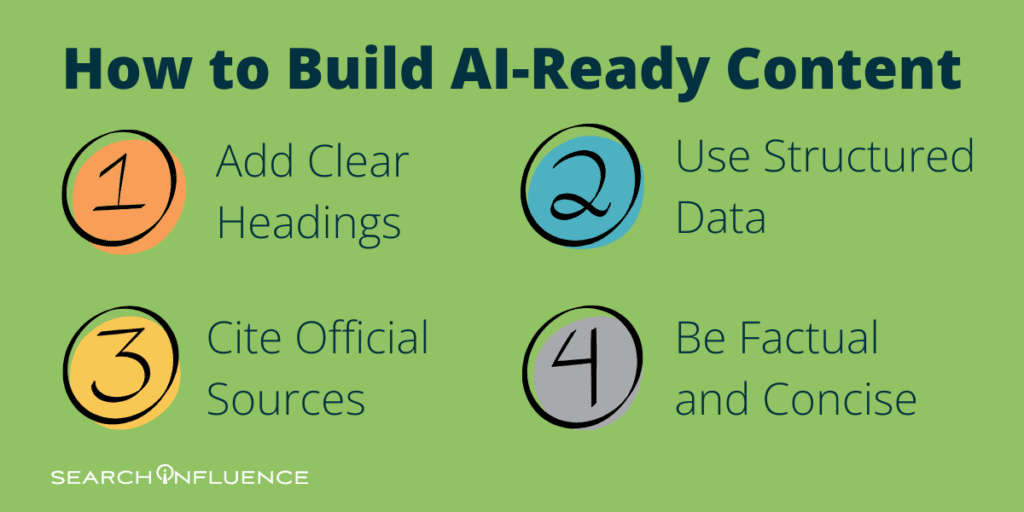
- Use clear headings that mirror how prospective students search (for example, “What You’ll Learn,” “Program Requirements,” or “Cost and Financial Aid”).
- Add structured data, such as program, organization, and FAQ schema, so AI can easily verify facts.
- Reference official sources like accreditation bodies or institutional statistics to reinforce credibility.
- Keep content factual and concise. AI values clarity over creativity when determining which sources to trust.
Every correction or clarification you make strengthens your authority in both traditional and AI-driven search.
Pro Tip: Treat program pages as data assets, not just marketing copy. Clean, well-structured information is what gets cited, and cited content is what earns trust in AI search results.
Step 4. Track and benchmark your visibility
Visibility is never static. It shifts as AI tools evolve. Tracking gives you the feedback loop you need to adapt and improve. Without it, you’re guessing where your institution stands in the conversation.
Start by identifying where your institution appears in AI-generated results across AI Overviews, ChatGPT, Gemini, and Perplexity. Then, benchmark three areas:
- Frequency: How often your programs are cited
- Accuracy: Whether AI summaries reflect your offerings correctly.
- Sentiment: The tone and context surrounding your mentions.
Use these insights to guide content updates and corrections. AI SEO tracking tools can help automate tracking, monitor citation accuracy, and benchmark performance across AI-powered search engines, offering the same kind of data discipline that keyword rankings do for traditional SEO.
Pro Tip: Treat AI visibility reviews like SEO reports. Quarterly benchmarking through AI SEO tools helps you spot trends, measure progress, and show leadership tangible proof that your AI search strategy is working.
Get the full data set and start closing your AI search gap. →
FAQs About AI Search in Higher Education
What does “AI search” mean for higher ed marketers?
“AI search” in higher education refers to how generative tools like Google’s AI Overviews, ChatGPT, Gemini, and Perplexity discover and summarize information about institutions and academic programs. Think of it as the next layer of SEO visibility, one that favors trustworthy, well-structured, and citeable content written for both humans and machines.
Is AI search replacing SEO?
No, SEO is still the foundation. AI tools depend on structured, high-quality web content to generate summaries. Strong foundational SEO gives AI engines the signals they need to find, understand, and cite your programs accurately.
How can institutions appear in AI Overviews or chat-based answers?
Focus on clarity and credibility. Keep program pages updated, use schema markup, and ensure facts are consistent across your site and external listings. AI tools favor sources that present verified, well-structured information.
What should we measure to track AI visibility?
Start with where your institution appears, how often, and what’s being said. Research some tools that can identify citations in AI-generated results, monitor accuracy, and compare your
presence against peers. Over time, these insights inform which content updates drive the biggest gains.
Get the Full AI Search Picture
AI search isn’t on the horizon. It’s happening now.
The question is whether your institution is showing up where students already are.
Download the UPCEA x Search Influence AI Search in Higher Education Research Study to see the full data set: how prospective learners use AI tools, which signals build trust, and what institutions can do to stay visible in this new era of search.
Jeanne Lobman is Director of Operations at Search Influence, a leading AI SEO and digital marketing agency serving higher education. Backed by more than 15 years of experience in digital strategy, operational management, and data analytics, she leads the systems, workflows, and campaign operations that support institutions such as Maine College of Art & Design, Tulane School of Professional Advancement, and Tufts University College. Known for her analytical rigor, Jeanne specializes in building scalable, data-driven processes and marketing programs that transform complex challenges into measurable results—optimizing efficiency, improving decision-making, and driving inquiries and applications.