
ED Issues Workforce Pell FAQs; Courts Continue Changing Professional Degree List | Policy Matters (October 2026)
Major Updates
U.S. Department of Education Provides Workforce Pell Grant FAQs
The U.S. Department of Education has released FAQs on Workforce Pell Grants for short-term programs. The guidance covers items like the baseline eligibility standards: programs be at least 8 but fewer than 15 weeks or 150 to 599 clock hours and operational for a year, as well as be certified by a governor before approval. Beyond what the law was already clear on, the FAQs answer a few more nuanced areas the legislative text did not clarify, including:
- Noncredit programs are treated as clock-hour programs, with the attendance-tracking and disbursement rules that implies.
- Each version of a program with a different length needs its own application.
- Bachelor’s degree holders may receive Workforce Pell; graduate credential holders may not.
- Through the 2028–29 award year, any job counts toward the 70% placement threshold; after that, only employment in the field the program seeks to employ students in counts.
- Participation in the SARA does not allow a program to enroll Workforce Pell students from other states. Only bilateral agreements between states’ governors, with data-sharing provisions, do.
While UPCEA previously reported on this last item, for administrators of online and continuing education units, it is worthwhile to again restate this as a major difference between traditional programs and short-term Workforce Pell-eligible programs. A governor-certified program cannot rely on SARA to serve Workforce Pell students elsewhere, so online offerings will be limited to in-state learners until states negotiate bilateral agreements. Noncredit units should confirm that their attendance systems can meet clock-hour requirements and that each program has a documented pathway to academic credit, such as an articulation agreement, before seeking state certification. UPCEA’s Workforce Pell resource hub provides a slew of information on this new federal aid program to help institutions navigate compliance and program review. Read the Department’s full FAQ.
Court Order Adds Naturopathy to the Professional Degree List as Litigation Over Loan Limits Continues
Courts are increasingly writing the list of programs ED treats as “professional.” That list decides whether students can borrow up to $50,000 a year and $200,000 in total, rather than the graduate limits of $20,500 and $100,000. On October 23, FSA updated its interim list of professional degree programs to add Doctor of Naturopathy (N.D.) and Doctor of Naturopathic Medicine (N.M.D.) programs. The change followed a ruling by Judge Michael Simon of the U.S. District Court for the District of Oregon, who granted a preliminary injunction on October 16 in a suit brought by three naturopathic medicine associations. He found the associations likely to succeed in arguing that ED applied criteria beyond the statute. The interim list exists only because a federal court in Washington, D.C., stayed parts of the Department’s definition on June 24, a fight UPCEA’s June Policy Matters covered in detail. The Department says it will continue to defend the rule. At least five other suits over excluded degrees are pending, several on schedules expected to conclude before year-end.
For administrators of online and professional graduate programs, naturopathy itself touches few units, but the mechanics FSA spelled out apply to any program whose status shifts. To lend at professional limits, institutions must report a professional student level when originating the loan. Amounts already disbursed need not be reversed if a designation changes, but later disbursements may not be made at the higher limit. FSA also suggests institutions consider capping loans for temporarily designated programs at graduate-level amounts to spare borrowers disruption. Institutions with programs whose status rests on litigation should decide now whether to use that discretion, and should tell enrolled students plainly that their borrowing limits could change. Read more.
Other News
- Rescission Package Targeting Several ED Programs Draws Congressional Pushback (NASFAA)
- DHS proposes $70K fee for initial OPT participation and $30K for extensions (Higher Ed Dive)
- Which Undergrad Credentials Offer Earnings Premiums? New Tool Breaks It Down. (Inside Higher Ed)
- Undergraduate certificates are most at risk of failing new earnings test (Higher Ed Dive)
Authored by
Policy Matters: Primers and Insights
Helping you navigate policy frameworks critical to higher education in the United States.
Access our resources providing an introduction to foundational topics in federal legislation and regulations impacting online and professional continuing education for universities and colleges. Read more.
UPCEA is a proud founding and steering committee member of the Today's Students Coalition.
UPCEA 2026-2027 Policy Committee
Corina Caraccioli, Loyola University New Orleans, Co-Chair
Abram Hedtke, Co-Chair
Holly Anderson
Curtis Brant, Bowling Green State University
Amy Collier, Middlebury College
Johnna Denning-Smith, Marian University
Sean Doyle, Purdue Global
Luke Dowden, Alamo Colleges District
Michele Gribbins, University of Illinois Springfield
Ilona Marie Hajdu, Indiana University
Laura Hendley, Stevenson University
Gloria Niles, University of Hawaii System
Kelly Otter, Georgetown University
Michelle Singh, University of North Texas
Erika Swain, University of Colorado Boulder
Ryan Torma, University of Minnesota
Get Involved with UPCEA
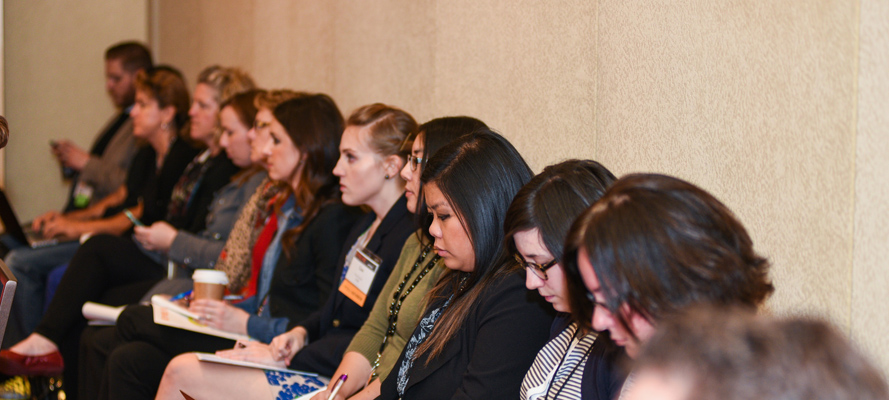
Professional development isn't just about attending sessions. Get involved with UPCEA to meet members from other institutions, share the great work your institution is doing, and hone your own skills. From submitting a session proposal for a conference or an article for a publication to serving as a volunteer on a conference planning committee, there are as many ways to engage with us!
Awards of Excellence
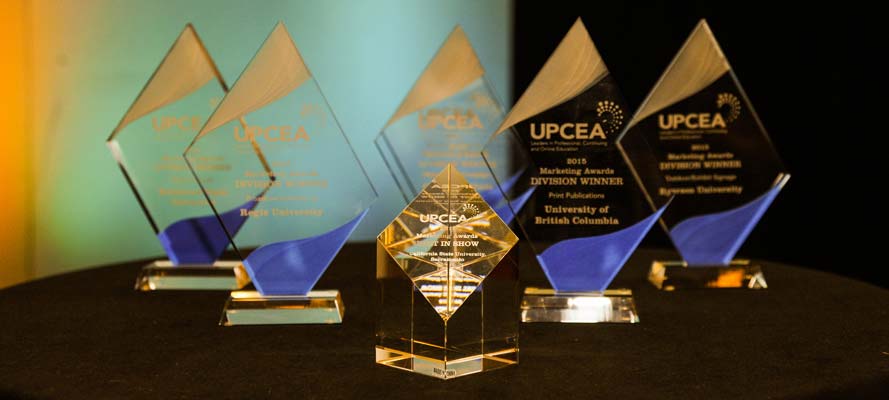
Since 1953, UPCEA has recognized its members' outstanding contributions to the Association and the field, as well as their achievements in innovative programming, marketing and promotion, community development and services, research and publications, and many other areas.