Major Updates
U.S. Department of Education Provides Workforce Pell Grant FAQs
The U.S. Department of Education has released FAQs on Workforce Pell Grants for short-term programs. The guidance covers items like the baseline eligibility standards: programs be at least 8 but fewer than 15 weeks or 150 to 599 clock hours and operational for a year, as well as be certified by a governor before approval. Beyond what the law was already clear on, the FAQs answer a few more nuanced areas the legislative text did not clarify, including:
- Noncredit programs are treated as clock-hour programs, with the attendance-tracking and disbursement rules that implies.
- Each version of a program with a different length needs its own application.
- Bachelor’s degree holders may receive Workforce Pell; graduate credential holders may not.
- Through the 2028–29 award year, any job counts toward the 70% placement threshold; after that, only employment in the field the program seeks to employ students in counts.
- Participation in the SARA does not allow a program to enroll Workforce Pell students from other states. Only bilateral agreements between states’ governors, with data-sharing provisions, do.
While UPCEA previously reported on this last item, for administrators of online and continuing education units, it is worthwhile to again restate this as a major difference between traditional programs and short-term Workforce Pell-eligible programs. A governor-certified program cannot rely on SARA to serve Workforce Pell students elsewhere, so online offerings will be limited to in-state learners until states negotiate bilateral agreements. Noncredit units should confirm that their attendance systems can meet clock-hour requirements and that each program has a documented pathway to academic credit, such as an articulation agreement, before seeking state certification. UPCEA’s Workforce Pell resource hub provides a slew of information on this new federal aid program to help institutions navigate compliance and program review. Read the Department’s full FAQ.
Court Order Adds Naturopathy to the Professional Degree List as Litigation Over Loan Limits Continues
Courts are increasingly writing the list of programs ED treats as “professional.” That list decides whether students can borrow up to $50,000 a year and $200,000 in total, rather than the graduate limits of $20,500 and $100,000. On October 23, FSA updated its interim list of professional degree programs to add Doctor of Naturopathy (N.D.) and Doctor of Naturopathic Medicine (N.M.D.) programs. The change followed a ruling by Judge Michael Simon of the U.S. District Court for the District of Oregon, who granted a preliminary injunction on October 16 in a suit brought by three naturopathic medicine associations. He found the associations likely to succeed in arguing that ED applied criteria beyond the statute. The interim list exists only because a federal court in Washington, D.C., stayed parts of the Department’s definition on June 24, a fight UPCEA’s June Policy Matters covered in detail. The Department says it will continue to defend the rule. At least five other suits over excluded degrees are pending, several on schedules expected to conclude before year-end.
For administrators of online and professional graduate programs, naturopathy itself touches few units, but the mechanics FSA spelled out apply to any program whose status shifts. To lend at professional limits, institutions must report a professional student level when originating the loan. Amounts already disbursed need not be reversed if a designation changes, but later disbursements may not be made at the higher limit. FSA also suggests institutions consider capping loans for temporarily designated programs at graduate-level amounts to spare borrowers disruption. Institutions with programs whose status rests on litigation should decide now whether to use that discretion, and should tell enrolled students plainly that their borrowing limits could change. Read more.
Other News
- Rescission Package Targeting Several ED Programs Draws Congressional Pushback (NASFAA)
- DHS proposes $70K fee for initial OPT participation and $30K for extensions (Higher Ed Dive)
- Which Undergrad Credentials Offer Earnings Premiums? New Tool Breaks It Down. (Inside Higher Ed)
- Undergraduate certificates are most at risk of failing new earnings test (Higher Ed Dive)
COLO Compass: Evidence and practical direction for chief online learning officers.
Online learning now sits at the center of institutional strategy. The leaders who run it are stretched thin — bigger portfolios, less time, authority that rarely matches responsibility.
UPCEA and Quality Matters are coordinating the research schedules of two national studies: UPCEA’s Benchmarking Online Enterprises (BOnES) survey and the Changing Landscape of Online Education (CHLOE) project, a collaboration among Quality Matters, Encoura Eduventures Research, and EDUCAUSE. BOnES will run in even-numbered years. CHLOE will run in odd-numbered years.
This alternating cadence cuts survey burden on chief online learning officers (COLOs) while keeping two distinct views of the field intact. BOnES provides detailed benchmarking of online learning enterprises, including organizational structures, governance, staffing, financial models, and operational capacity. CHLOE examines the changing landscape of online higher education, including student demand, institutional strategy and leadership, online programs, quality, teaching and learning, and the student experience. The studies share some areas of inquiry but approach them through unique yet complementary research questions.
By alternating their major national surveys, the two initiatives will reduce overlapping survey requests while maintaining opportunities for qualitative research, targeted studies, and other research activities between survey cycles.
A Shared Advisory Group for COLO Research
The partners are also establishing a shared COLO Research Advisory Group (CRAG) to provide practitioner perspectives that inform both CHLOE and BOnES. The group will help identify emerging research priorities, offer feedback on survey questions and findings, and ensure that the research remains connected to the challenges online learning leaders face.
Together, the alternating cycle and the advisory group add up to a research agenda built around COLOs’ time and their priorities.
What the Latest Findings Tell Us
The two studies’ value shows up clearly in their most recent results.
The 2026 BOnES study finds online enterprises moving closer to institutional decision-making. Fifty-seven percent now report to the provost, up from 41% two years earlier. Participating institutions also reported growth in online-enterprise revenue, budgets, staffing, and operational capacity.
A closer seat doesn’t guarantee more control, though. Many online enterprises still run on general institutional funds and centrally set online fees. COLOs end up accountable for growth, quality, learner support, and financial performance without controlling the resources or policies that drive them.
The 2026 CHLOE Conversation Report Series arrives at a related conclusion from a different angle. Drawing on six focus groups with 30 online learning leaders, it examines how institutional strategy plays out in program development, quality practices, accessibility, student support, data, and generative AI.
CHLOE Conversations participants described online learning as increasingly central to enrollment, access, workforce development, and institutional innovation. Yet they also identified gaps between institutional ambitions and the systems needed to deliver on them, including coordinated strategy, faculty and student support, and meaningful evidence of quality and impact.
The two studies read together tell a connected story. Read together, the findings reveal a recurring challenge: online learning has become central to institutional strategy, but organizational authority, resources, support systems, and evidence practices have not always kept pace. BOnES adds detailed enterprise benchmarks to a picture that CHLOE has been developing through its longitudinal research on online strategy, leadership, quality, and the student experience.
Better Evidence With Less Burden
COLOs see across academic units, technology systems, enrollment operations, instructional design, student support, compliance, and institutional finance. That vantage point is exactly why their perspective matters — and exactly why their time is so scarce.
The alternating cycle respects both facts. Less survey burden means COLOs can engage more thoughtfully; a coordinated cadence means the field builds better longitudinal evidence over time. The advisory group adds a further check: the research stays tied to what COLOs actually deal with.
BOnES and CHLOE retain their distinct identities and research priorities while informing a more complete understanding of online higher education. Together, they help illuminate how institutional strategy, organizational capacity, academic practice, and learner experience intersect.
By coordinating the calendar and building a shared advisory structure, UPCEA and Quality Matters make those questions easier for COLOs to answer — and the answers more useful for everyone else.
Resources
Garrett, R. (2026, August). CHLOE Conversations: Online program strategy. Quality Matters, Encoura Eduventures Research, & EDUCAUSE.
Gay, K. (2026, August). CHLOE Conversations: AI. Quality Matters, Encoura Eduventures Research, & EDUCAUSE.
Fredericksen, E. E. (2026, August). CHLOE Conversations: Institutional sector summary. Quality Matters, Encoura Eduventures Research, & EDUCAUSE.
Quality Matters. (n.d.). The Changing Landscape of Online Education (CHLOE) project. Retrieved September 10, 2026, from https://qualitymatters.org/qa-resources/resource-center/articles-resources/CHLOE-project
Simunich, B. (2026, August). CHLOE Conversations: Online quality, support, and data. Quality Matters, Encoura Eduventures Research, & EDUCAUSE.
Uranis, J., Etter, B., & Sullberg, D. (2026). Benchmarking online enterprises: Insights into structures, strategies, and financial models in higher education. UPCEA. https://upcea.edu/2026-benchmarking-online-enterprises-survey/
AI Disclosure
This post was developed with the support of an AI research and writing assistant. AI assistance was used to identify and review relevant sources, verify facts and citations, explore related evidence and examples, develop and revise draft language, and identify claims that warranted additional scrutiny or qualification. When possible, research was verified against primary or authoritative sources.
The topic, editorial direction, argument, source priorities, and decisions about what evidence to include and how to interpret it were guided by the human author. AI-generated research and draft language were reviewed and revised iteratively, including efforts to distinguish documented findings from inference, identify limitations in the available evidence, and avoid claims that extended beyond what the sources could support.
AI-assisted content is treated as draft material rather than final work. Before publication, the author reviewed the analysis, verified material facts and source characterizations, and determined that the conclusions reflect appropriate professional and institutional judgment. The author is responsible for the accuracy and final content of the piece.
Clearly, many aspects of everyday living have begun to change in the emerging, evolving “Age of AI.” Higher education must acknowledge and adapt to those changes and anticipate the ones yet to come.
Some faculty members fail to recognize that the world has changed and we must respond to those changes in how and what we do to prepare learners for their careers and personal aspirations. It is frustrating for many to be required to re-design their teaching content and methods in response to the larger worldwide technological changes. Yet, here we are, the world in fact has changed. We are confronted with exciting and sometimes frightening new capabilities in this, the Fourth Industrial Revolution.
The first impulse by some colleges and departments was to ban AI use by students in order to preserve the pedagogies and processes of teaching in the last century. That, of course, has mostly fallen, with notable exceptions. For example, just this fall, the University of Chicago has issued a ban on AI in its core Social Sciences Courses:
The University of Chicago will prohibit AI use in its core social science courses starting this fall, a decision detailed in a Social Sciences Collegiate Division memo. This new policy, reflecting a strong consensus, aims to establish an “analog” pedagogical setting where students learn to read, write, and think independently, without AI dependence. Key elements include device-free classrooms, mandatory in-person attendance, and strict requirements for independent assignment completion.
While individual cases may be exempted upon petition by the faculty member, the policy seems to limit the rich digital experiences that are available to students at most universities. Those are experiences that will be highly relevant for their ensuing careers. To deny them in problem-solving and skill-building is akin to denying the calculator, computer and internet.
As a result of the Third Industrial Revolution, the Information Age, higher education shifted from an emphasis on passive information storage and rote knowledge building to creative and critical thinking. This came as a result of our near instant access to much of the world’s information and knowledge via the internet as a kind of digital memory extension. As AI advanced, the human skills needed to oversee these innovations expanded to emphasize higher order thinking and problem processing.
Therefore, different learning outcomes emerged to meet the expectations of employers and needs of professionals within careers. Hence, faculty need to change from conveyors of information and knowledge to cultivators of higher order critical and creative thinking as well as associated skills of analysis, synthesis, prediction, projection, interpolation and extrapolation.
As with most teaching, a key element can be to fold assessment into the teaching and learning process as a formative process active within the teaching and learning so that the assessment becomes a part of the learning process. Linked to the teaching approach of Socrates, described in Plato’s writings, one of the oldest and most effective approaches is the Socratic method that utilizes a series of questions to ultimately lead to truths and insights.
In this column last year I featured a prompt for a Socratic Method AI tutor that effectively runs on most frontier models even today. There are many such tools available to online educators, but I chose this one as a free example of a way in which AI can be used to insert active learning of critical and creative thinking into instruction. It can easily be implemented by individual faculty members without additional costs and, in most cases, without additional approvals.
This prompt turns AI into an advanced, patient, and intellectually rigorous mentor whose only role is to guide users to their own clarity and insight through a structured series of targeted, open-ended questions. The Socratic Questioner never offers direct answers, advice, or opinions. Instead, it listens closely to the user’s stated situation or dilemma, restates their core question for clarity, and proceeds one question at a time, each building on the last, to help the user examine beliefs, surface assumptions, and consider new angles. The entire process is calm, empathetic, and paced to the user’s comfort, creating a safe space for deep self-reflection without judgment or pressure.
The tool can be used in each module in a class, guiding students to develop deep thinking and creative applications of the content. Yet, there are other creative ways in which GenAI is being used by higher education faculty to assess and enhance learning. Published just this month in the International Journal of Technology in Higher Education is “Higher education assessments in the age of GenAI: a systematic review” by Helen Crompton and Elaine Burke. It is an open access article that I encourage all of my colleagues in higher education to review for a broad perspective of how our field is responding to the opportunity to engage AI in assessment. In examining 73 empirical studies conducted over the past three years, the research uncovers policies, practices and implementations.
The emergence of generative artificial intelligence (GenAI) is now placing renewed pressure on these established principles, prompting institutions to reconsider how assessment is designed, delivered, and evaluated. While a growing body of research has examined GenAI’s role in teaching and learning broadly, less synthesis exists on how it is reshaping assessment specifically, and how these shifts relate to long-standing assessment theory and practice….. Using PRISMA, 72 studies were identified and analyzed. The findings show that research was conducted across 24 countries and 20 academic disciplines…. Three major assessment design approaches emerged in response to GenAI: (1) process orientation, (2) authenticity, and (3) oral and dialogical approaches. Five ways educators used GenAI across the assessment process were identified: (1) creating assessments, (2) practice for assessments, (3) grading, (4) transparency of learning, and (5) feedback. Together, these findings situate GenAI’s influence with the broader trajectory of assessment scholarship and provide researchers, educators, institutional leaders, and policymakers a clearer picture of how assessment practices are being negotiated in response to GenAI.
AI offers us very powerful and efficient tools with which we can enhance and assess teaching and learning in higher education. As evidenced in this study, AI is being implemented effectively by college and university educators worldwide in assessment redesign which is converging around process, authenticity and dialogue. It is incumbent upon us to introduce these tools and approaches to our learners who are entering a worldwide workplace that increasingly depends upon AI. Our teaching and assessment quality as well as our students’ learning outcomes can be enhanced as a result. Examine Compton and Burke’s study and share widely with your colleagues who might benefit from learning more about AI assessment tools in their teaching.
This column was originally published in Inside Higher Ed.
What if a student uses AI to complete an assignment and does it better than they could have done manually?
The instinct may be to say the student didn’t do the work. But the workplace may reward the student for doing exactly what the classroom penalized.
That creates a different question for higher education: not whether students need to learn the fundamentals. They absolutely do. The question is what we should test once they know them.
Students Still Need the Playbook
I’m a football fan, so I think of it this way: Before players can perform on the field, they have to master the playbook. They need to understand their roles, know how each play is designed to unfold and recognize how their responsibilities fit into the larger strategy. But memorizing the playbook doesn’t make someone a great player. The real test comes after the ball is snapped.
Education works much the same way. Students need foundational knowledge. But knowing the fundamentals and manually executing every task are no longer necessarily the same thing.
But the Workplace Has Changed the Assignment
Imagine a finance professor asks students to build a financial forecast for a fictional company. One student does the calculations, builds the spreadsheet and writes the analysis manually.
Another builds an AI-enabled workflow that does much of that work, updates the forecast when assumptions change and produces the analysis in a fraction of the time.
Did the second student do the assignment?
In a traditional classroom, we might say no. In the workplace, we’d hire them.
Knowing the Playbook Isn’t Enough
A quarterback isn’t judged solely on whether he can execute a play exactly as it was drawn. He has to read the defense, recognize when something isn’t right and adjust.
What if we applied the same standard to students using AI?
Don’t just ask whether they produced the forecast. Ask them to challenge the assumptions. Find the errors. Explain what the AI got wrong. Identify where the model could fail. Improve it. Defend the final recommendation.
Suddenly, AI hasn’t lowered the academic bar. It may have raised it.
I’ve Watched the Gap Between School and Work Grow
Over years of working directly with colleges and universities, I’ve watched faculty wrestle with how to keep learning connected to a changing workplace. They’ve looked for ways to introduce emerging technologies, practical skills and new professional expectations into the student experience.
The challenge was rarely recognizing that work was changing. It was figuring out how to change the learning experience with it.
AI makes that challenge more urgent. Work that once required hours of manual effort can increasingly be automated. Graduates may enter organizations where using these tools isn’t a shortcut. It’s simply how the work gets done.
So Maybe It’s Time to Change the Assignment, Not the Standard
Let AI do the assignment. Then ask the student to prove they understand what it did.
Can they direct it? Interrogate it? Catch its mistakes? Improve its output? Defend the result?
Those may be harder questions than asking students to reproduce the work themselves. They may also be better prepared for what comes next.
Students still must learn the playbook. But once the ball is snapped and the play breaks down, that’s when the real test begins.
By Tyler Skelton, Business Development Manager, ISACA Academic Partnerships; Lifelong Football Fan.
About ISACAISACA helps colleges and universities embed globally recognized IT credential content into IS, IT, and non-IT degree programs. With credential-ready curriculum, built-in support, and global credibility, ISACA’s Academic Partnerships help institutions prepare students for careers, not just graduation. Learn more at ISACA Academic Partnerships.
Hansen will leave an organization that has nearly quadrupled its annual revenue and become the leading association for online and professional education
WASHINGTON, October 21, 2026 – The UPCEA Board of Directors today announced that Dr. Robert J. Hansen, who has led UPCEA, the online and professional education association, for more than 16 years, will retire as Chief Executive Officer in early fall 2027. The Board will launch a national search for his successor in February 2027.
Hansen came to UPCEA from the field it serves. Before joining the association in 2010, he held senior leadership roles at both public and private universities, and earlier served as an education policy aide in the administration of former Illinois Governor Jim Edgar. He holds a Ph.D. in English from the University of Notre Dame, an M.A. in Literature from the University of Michigan, and a B.S. in Psychology from the University of Illinois.
During Hansen’s tenure, UPCEA grew from its roots in continuing education to become the national leader for online and professional education, a sector that has moved from the margins of higher education to the center of institutional strategy. The association marked that shift with a brand refresh that made UPCEA a name rather than an acronym and introduced a new tagline, “The Online and Professional Education Association.” UPCEA’s annual revenue nearly quadrupled under his leadership, and its staff more than doubled. Highlights include:
- Leadership in online learning, beginning with the Center for Online Leadership and Strategy and the first Summit for Online Leadership and Administration (SOLAR). Together, these initiatives gave chief online learning officers, then a new role on many campuses, a professional home and peer network. SOLAR is now the sector’s premier event for these leaders and their enterprise-level teams.
- Vibrant professional Networks aligned with nine core areas of practice. From marketing, enrollment and student success to instructional design, business operations, and most recently graduate education, our Networks give members in every role a professional home and community of peers.
- The UPCEA Hallmarks of Excellence, a series of field-defining frameworks for digital learning enterprises, professional and continuing education, and credential innovation that give institutions a shared standard for assessing and strengthening their own work. The newest, the Hallmarks of Excellence in Digital Learning Enterprises, was released this summer. Developed in collaboration with more than 80 chief online learning officers, it updates the original Hallmarks of Excellence in Online Leadership and is endorsed by the American Council on Education, EDUCAUSE, Quality Matters and six other national organizations.
- Convergence: Credential Innovation in Higher Education, presented with AACRAO since its sold-out launch, which brings together deans, chief online learning officers and registrars to build credential strategies that serve both learners and employers.
- Leadership development for the field, taking online and professional continuing education professionals from foundational learning to applied practice to leadership roles, with a flagship certificate program that prepares them to lead online and professional education enterprises.
- UPCEA Research and Consulting, which members count among their most valuable benefits. Its actionable market research, benchmarking and strategic consulting help institutions across North America decide which programs to launch, how to price and market them, and where to invest.
UPCEA enters this transition in a commanding position, with a diversified revenue base, record cash and investment balances, and no outstanding debt. Its financial strength and record of innovation in programs and member services position the association to support its members through the economic challenges facing higher education.
That foundation matters for what comes next. Online and professional continuing education is now central to the future of higher education itself. UPCEA’s members are navigating enrollment pressure, tighter budgets, new federal and state policy, and rapid changes driven by AI and credential innovation. The Board will look to UPCEA’s next CEO to build on the association’s strengths and grow the value members rely on to lead through that change.
“Bob built UPCEA into the professional home for leaders in online and professional continuing education, and the whole field is stronger for it,” said Asim Ali, Ph.D., 2026–2027 UPCEA Board President and Executive Director of the Biggio Center for the Enhancement of Teaching & Learning at Auburn University. “He saw early where higher education was heading and made sure our members were ready to lead when it got there. Thanks to his leadership, UPCEA is positioned to do even more for members in the years ahead, and the Board is committed to finding a leader who will build on that momentum.”
“Leading UPCEA has been the privilege of my career,” said Hansen. “When I arrived in 2010, online and professional education was still finding its place in higher education. Today, our members are leading their institutions through some of the most important changes in the history of the academy. Everything UPCEA has accomplished belongs to them, and to an extraordinary staff and Board. I’m confident the association is ready for its next chapter in what has become the most dynamic sector in higher education.”
Search for the next CEO
The search will be led by a CEO Search Committee of UPCEA Board members, supported by a national executive search firm. Hansen will lead UPCEA through the transition.
When the search opens in February 2027, UPCEA members and others may apply for the role or nominate candidates. All inquiries, nominations and applications will be held in strict confidence.
# # #
About UPCEA
UPCEA is the online and professional education association. Our members continuously reinvent higher education, positively impacting millions of lives. We proudly lead and support them through conferences and seminars, professional development, networking and mentorship, stakeholder advocacy, and research that fuels innovation across the field. Our collaborative, entrepreneurial community brings together decision makers and influencers in education, industry, research, and policy interested in improving educational access and outcomes. Learn more at upcea.edu.
Media contact: Molly Nelson, Chief Operating Officer & Vice President, Communications, UPCEA, [email protected]
In a remarkable period of intense development of powerful Artificial Intelligence (AI) capabilities, leaders in the industry have called for a modest level of oversight to ensure safety and provide protections against misuse and abuse of the power of AI.
Late last month, President Trump announced the formation of a “Superintelligence Force” to oversee AI Safety and National Security Risks of Artificial Intelligence. As reported in Silicon Angle, “Trump revealed the group in a Truth Social post, calling it the Super Intelligence Force. That name tracks an executive order he signed last week directing federal agencies to use “super intelligence” in place of ‘artificial intelligence’ in official correspondence.” Details at the time of this writing are sparse, but it is essential that we in higher education pay close attention and be provided the opportunity for input to this process.
So far, we know that the Director of National Intelligence, Jay Clayton, has been tapped to lead the task force. The group has 120 days to report on the federal government’s role in managing safety and national security risks. This represents a shift toward a voluntary, industry-aligned oversight model rather than a mandatory federal regulatory board.
On September 29, major tech executives (including representatives from OpenAI, Anthropic, Google, Meta, Nvidia, and xAI) signed a voluntary, “morally binding” accord committing to internal controls and independent external audits rather than rigid government enforcement. As reported by the BBC, “ Andrew Ferguson, head of the Federal Trade Commission, will be on the taskforce along with Emil Michael, undersecretary of defense for research and engineering.”
The taskforce will report to the President and White House Chief of Staff Susie Wiles. The President has pushed back against any kind of slowdown on AI development, saying the US is leading the race ahead of China, adding: “And, frankly, I want to keep it that way because whoever wins AI, wins.”
At the date of this writing, the only representative from a higher education institution on the task force is former Secretary of State Condoleezza Rice who heads the Hoover Institution, which operates in a semi-independent structure within Stanford University. It is self-defined as “a public policy think tank that seeks to improve the human condition by advancing ideas that promote economic opportunity and prosperity, while securing and safeguarding peace for America and all mankind.” As experienced, talented and insightful as the former Secretary of State is, we need further higher ed representation to bring a broad range of technological, theoretical and operational perspectives to the discussion. Rice’s leadership experience must be supplemented by a range of experts across education that can address implications of policies and practices that the “Superintelligence Force” will be monitoring.
AI has increasingly become important across universities in areas that include research; development; operations; teaching and learning practices and policy-making. The regular readers of this column will recall that in our last edition, we explored the breakneck speed of one-upsmanship releasing of competing AI closed models developed by the three frontier leaders. Driven by the investments at the trillion-dollar levels, the competition has been fierce and furious. Turning out new products every month to two months, and utilizing recursive self-improvement practices, have inhibited thorough scrutiny of the products before they are released. That has resulted in recent reports of models that have strayed beyond the guardrails that have been set by the companies. Instances have included AI algorithms intentionally and illegally breaking into files and resources of competing companies. With trillions of dollars at stake, the competition has been particularly strident.
It is not the optimum way to produce products that are so powerful and “smart” that the programs actually are figuring out ways to “beat the system” in order to produce results that appear to be more positive than they really are. I have some small sympathy for the very wealthy leaders of these companies. They have found themselves in a competitive environment in which they and their teams must incrementally work harder and harder in round-the-clock fashion to come up with products that score well on the benchmark tests. These leaders independently asked that they be regulated to slow down the progress and keep themselves out of trouble for violating regulations and laws.
I am not entirely convinced that the “Superintelligence Force” is the best way to cool down the competition and slow down the race. However, here we are. This is the only available opportunity to cool down the competition and pursue a safer approach to further development. Although higher education was not heavily consulted in the preparation of this model, we will be impacted by the priorities and products that are produced as a result. Hence, we should actively seek inclusion in the process.
We must also recognize that hundreds of other development efforts are being pursued in smaller independent as well as larger military and other governmental initiatives around the world. Some of these are providing open-source solutions that can then be further developed and applied by unregulated actors.
I encourage those higher education institutions that have pursued leading research in this field and related associations of such institutions to offer their support, facilities and experts to advance the cause of responsible development of AI. The cause of advancing quality AI is too important for higher education to stand on the sidelines. If you or your institution has expertise and valuable perspectives to share, I encourage you to consider reaching out to the task force.
This column was originally published in Inside Higher Ed.

By Vickie S. Cook, Ph.D.
Artificial intelligence is becoming part of the everyday work of higher education. From enrollment management and student services to academic administration and continuing and professional education, AI is creating opportunities to rethink how work is accomplished.
Much of the discussion has focused on what AI can do. For institutional leaders, however, a more important question may be emerging: How should people and AI work together?
In September, our inaugural Leadership Conversation with Ray Schroeder explored the importance of awareness, curiosity, and continuous learning. This month, we take the next step: translating that awareness into decisions about people, work, and organizational capability.
To explore these questions, I recently had the opportunity to speak with Dr. Irma Becerra, President of Marymount University. Her scholarship in knowledge management, engineering background, and experience in university leadership offer valuable perspectives on how institutions can strengthen human capability while maintaining judgment, accountability, and a strong commitment to student success.
Our conversation returned repeatedly to a central idea: AI’s value lies not simply in what the technology can accomplish, but in how it can help people become more capable.
Augmenting Human Capability
President Becerra offered a memorable analogy for understanding the relationship between people and AI. “AI is to your brain what eyeglasses are to your eyes.” Just as eyeglasses extend our ability to see, AI can extend our cognitive capabilities. The purpose is not to replace human expertise but to help people recognize patterns, explore information, and accomplish work more effectively.
This distinction changes the questions institutional leaders should ask.
Instead of beginning with Which tasks can we automate?, we might begin with How could AI help our people accomplish work that matters more effectively?
President Becerra emphasized the importance of keeping the human expert involved in evaluating AI-generated information. AI may identify relationships or patterns that would otherwise require considerable time to discover. However, recognizing a pattern does not necessarily mean that the relationship is meaningful or that the resulting recommendation is appropriate.
Human expertise remains essential for interpreting information, identifying limitations, and determining what action should follow.
Consider enrollment management. AI may assist with organizing information, identifying patterns in prospective learner inquiries, or developing preliminary communications. Yet understanding a prospective learner’s circumstances, interpreting institutional priorities, and making consequential decisions about student support still require human responsibility.
Similarly, in continuing and professional education, which President Becerra refers to as “continuous learning,” AI may accelerate aspects of course development, market analysis, and administrative work. The value of these capabilities depends on how effectively educators and administrators apply their expertise to the resulting work.
The leadership opportunity is not simply to accomplish existing tasks faster. It is to examine how human expertise and AI capabilities can be combined to improve the quality of work, redefine shared work, and the experiences of those we serve.
Building an Organization That Learns
Introducing AI into an institution does not automatically create an organization capable of using it effectively.
President Becerra’s scholarship in knowledge management provides a useful perspective on this challenge. Knowledge management concerns how organizations create, capture, share, and apply knowledge. Its relevance to AI extends beyond access to information to the organizational processes and cultures that allow people to use knowledge productively.
Higher education institutions often approach AI development primarily through training: workshops, demonstrations, tutorials, and access to approved tools. These activities are important, but they may not be sufficient to develop an institutional strategy for integrating AI into the work of faculty and staff.
An institution can have employees who are individually proficient with AI while remaining organizationally unprepared to integrate it into shared work.
Our conversation also explored President Becerra’s engineering perspective on leadership and innovation. She described the importance of testing ideas, learning from results, and making adjustments rather than allowing extended analysis to prevent experimentation.
Her approach emphasizes rapid prototyping and creating an environment in which people can try new approaches, recognize mistakes, and use what they learn to improve.
For institutional leaders, this raises an important question: Are we creating conditions in which employees can experiment responsibly, share their experiences, and learn together?
Four organizational practices can help leaders create those conditions:
- Communication across departments.
- Opportunities for responsible experimentation.
- Mechanisms for sharing successful practices and lessons learned.
- Clarity about the institutional outcomes these efforts are intended to achieve.
These practices are particularly relevant to online, professional, and continuing education, where successful learner experiences depend on collaboration among academic departments, instructional designers, enrollment professionals, student support teams, and technology staff.
A recent UPCEA AI Hub case study illustrates how these principles can work in practice. The University of Arizona used AI to expand proactive student outreach while emphasizing collaboration and human oversight. The initiative demonstrates the importance of connecting AI-supported work to institutional needs and established professional responsibilities.
Leaders should consider not only whether employees have access to AI training, but whether their institutions provide opportunities for collaborative learning, responsible experimentation, and the development of shared practices that support institutional priorities.
Keeping Human Judgment and Accountability Central
As AI becomes capable of supporting more analytical and administrative work, leaders face increasingly important questions about judgment and responsibility.
The ability to generate a recommendation is not the same as having the authority or contextual understanding necessary to make a decision.
President Becerra emphasized the importance of maintaining an expert-in-the-loop approach. AI may help people recognize patterns and consider possibilities, but the human expert must evaluate whether the information is accurate, relevant, and appropriate for the situation.
This principle also applies to how individuals use AI in their everyday work.
President Becerra described using Microsoft Copilot to help refine her written communications. As a continuous learner, rather than simply accepting the suggested language, she uses the interaction to consider how her messages might become clearer or more persuasive. The process provides an opportunity to strengthen her own communication skills while she retains responsibility for the final message.
This example illustrates an important distinction between using AI to complete a task and using AI to strengthen professional capability.
For higher education leaders, the implications extend beyond individual work practices.
When AI informs a decision affecting a learner, employee, or institutional resource, who is responsible for reviewing the information? How are errors identified? What opportunities exist to question or challenge an AI-supported recommendation? Are the people using these systems sufficiently prepared to recognize when human intervention is necessary?
The National Institute of Standards and Technology’s AI Risk Management Framework reinforces the importance of clear organizational responsibilities, appropriate human oversight, and accountability.
These are not exclusively technology questions. They are questions about organizational design, professional responsibility, and institutional trust.
Keeping people at the center does not mean rejecting AI capabilities. It means intentionally defining how those capabilities support, rather than displace, responsible human decision-making.
Preparing People for the Future of Work
One of the most significant themes in my conversation with President Becerra was the responsibility higher education institutions have to prepare students for a changing professional environment.
She observed that AI will reshape professions and create new opportunities, much as previous technological developments changed existing occupations and contributed to the emergence of entirely new fields.
Preparing students for that environment requires more than teaching them to use today’s AI applications.
President Becerra emphasized the importance of continuous learning and helping students develop the ability to adapt as technology and professional expectations change. Students need opportunities to understand AI’s capabilities and limitations, exercise independent judgment, and use technology ethically.
At Marymount, this commitment is reflected in efforts to incorporate AI into students’ educational preparation while establishing expectations for responsible use. President Becerra also described the university’s emphasis on internships, career readiness, and helping students understand the professional expectations they will encounter after graduation.
These efforts reflect a broader leadership philosophy: institutions should not leave students to discover essential expectations for success entirely on their own.
For leaders in online, professional, and continuing education, this perspective is especially relevant.
Many of the learners we serve are already participating in a changing workforce. They may be seeking new credentials, developing additional professional capabilities, or preparing for career transitions.
Our responsibility extends beyond helping learners become familiar with AI tools. We must consider how educational programs prepare them to exercise judgment, remain adaptable, and contribute meaningfully as their professions evolve.
This requires institutional leaders to remain continuous learners themselves.
Leaders Must Learn, Too
President Becerra’s approach to innovation reinforces an important leadership responsibility: leaders must model the curiosity, adaptability, and willingness to learn that they expect from faculty, staff, and students.
Institutional leaders do not need to become experts in every AI application. They do, however, need enough understanding to ask informed questions, recognize limitations, establish expectations, and evaluate whether AI-supported practices are improving institutional performance.
This requires a willingness to experiment, seek perspectives from others, reconsider established processes, and acknowledge uncertainty.
When leaders encourage responsible experimentation but discourage discussion of mistakes, they limit organizational learning. When they delegate all AI decisions to technology offices, they risk separating technology choices from institutional priorities. And when they focus exclusively on efficiency, they may overlook consequences for employees, the quality of institutional services, and ultimately, the learner experience.
Leadership in an AI-influenced environment is therefore not simply about managing technological change. It is about creating the conditions in which people can learn, exercise judgment, and adapt together.
Leadership Reflection
As I reflect on my conversation with President Irma Becerra, I keep returning to a familiar leadership principle: technology alone does not improve an organization. People, processes, and purpose must remain connected for an organization to be successful.
Her emphasis on augmentation, human expertise, responsible experimentation, and continuous learning reinforces the importance of approaching AI as an organizational leadership responsibility rather than simply a technology initiative.
We have seen this before in higher education. New technologies create opportunities, but meaningful institutional improvement requires more than implementation. It requires leaders to examine existing assumptions, engage the people doing the work, and determine what success should look like.
AI brings new capabilities and a faster pace of change, but it does not eliminate those responsibilities.
The more important leadership question may not be whether our institutions are using AI. It may be whether our people and our institutions are becoming more capable because AI is part of their work.
That question asks us to look beyond adoption rates and productivity claims. Are decisions improving? Are employees better supported? Are learners receiving better support and experiencing higher-quality learning? Are we creating opportunities for people to contribute their expertise in more meaningful ways?
Leading human–AI teams requires intentional choices about how work is designed, how knowledge is shared, where accountability resides, and how leaders support continued learning.
The objective should not be to create organizations in which AI does more work simply because it can. It should be to create organizations in which people can accomplish more meaningful work, with better outcomes for the communities we serve.
Questions for Your Leadership Team
As AI becomes increasingly integrated into institutional work, consider discussing:
- Human capability: Are we approaching AI primarily as a way to automate tasks, or are we intentionally exploring how it can strengthen the capabilities of our faculty and staff?
- Organizational learning: What opportunities exist for employees across departments to experiment responsibly, share experiences, and develop effective human–AI practices together?
- Human judgment and learner preparation: How are we ensuring that AI strengthens professional judgment while preparing learners to work effectively in an AI-influenced environment?
Continuing the Conversation
Human–AI collaboration will continue to evolve as technology changes. The leadership challenge is to build institutions capable of learning, adapting, and making thoughtful decisions about how people and AI work together.
I appreciate President Becerra’s willingness to share her perspectives and experiences. Her emphasis on strengthening human capability, encouraging responsible innovation, and preparing students for the future provides valuable considerations for leaders throughout higher education. Read more on President Becerra’s leadership at Marymount University.
In November, Leadership Conversations in the Age of AI will explore a related question: Building AI Governance That Enables Innovation—How Should Institutions Make Decisions?
The technologies may change, but our responsibility to lead thoughtfully, ethically, and with institutional purpose remains.
AI tools now play a big role in which online and continuing education programs make a prospect’s shortlist, and that shortlist has room for only three. Search Influence and UPCEA’s 2026 AI Search Research Study shows what it takes to earn one of those spots.
Key Insights
- 56% of prospective online and continuing education students seriously consider three programs or fewer before applying.
- 54% of prospects now use AI tools like ChatGPT and Gemini for program research, up from 35% last year, alongside the 80% who still use traditional search engines.
- 64% of prospects say being cited as a source in an AI Overview makes them trust that institution more, up from 56% last year.
Search Influence is a digital marketing agency specializing in AI and organic search engine optimization (SEO), digital advertising, and analytics for higher education, hospitality, and healthcare.
Search behavior has changed again, and it’s changing faster than most enrollment teams have had time to react to. Prospective students are turning to ChatGPT and Gemini right alongside Google, to compare programs. Institutions that don’t implement strategies to show up in both are striking out before they even get to the batter’s box.
How Prospects Search in 2026 is our updated research study with UPCEA that lifts the lid on how prospective students discover and choose programs, so that institutions can build home run strategies to enroll more students.
This is the second year Search Influence and UPCEA have tracked how prospective students use AI tools, search engines, and social platforms to research programs. This year’s data shows just how rapidly that behavior is changing, and what it means for enrollment marketing.
We surveyed 1,057 qualified prospective adult learners interested in online and continuing education programs, and the data points to a hard truth.
Most prospects build their shortlist before your institution ever gets a chance to make its case.
The Shortlist Is Smaller Than You Think
We found that 56% of prospects seriously consider three programs or fewer before applying. Miss that cut, and there usually isn’t a fourth chance. Prospects don’t keep researching once they’ve found three options that answer their questions.
If your program isn’t one of the three, you’re not in second place. You’re not in the running at all.
Programs that show up prominently in AI-generated results, right alongside the ones still winning through traditional search, are far more likely to land on that shortlist.
If a prospect doesn’t see your program mentioned by name when they ask an AI tool about their options, you may already be out of contention before they ever type your institution’s name into Google.
For enrollment marketers, that means getting your program found early enough, and credibly enough, to earn one of those three spots. Early no longer means “when they visit your website.” It means when they first ask a traditional or AI search engine a question about programs like yours.
Prospects Are Searching Everywhere at Once
Traditional search is still where most online and continuing education research starts. Eighty percent of prospects are extremely or very likely to use a traditional search engine when researching programs.
But AI tools have closed in fast. Fifty-four percent say they’re extremely or very likely to turn to a dedicated AI tool for that same research, up from just 35% last year. Daily AI search use jumped to 39% this year, up from 24% in 2025. Fifty-eight percent now say they use AI tools the same way they’d use a traditional search engine, up from 50% last year.
Prospects use Google and AI in the same session, and they expect both to hold up.
If your program ranks well organically but has no presence in AI-generated answers, you’re missing half the conversation, and you’ll likely never know it happened. You’ll likely never see it happen, since that prospect has no reason to click through and tell you.
Treating traditional search and AI as a single visibility strategy, rather than two competing budgets, is quickly becoming the only way to get your program in front of prospective students. We break down what that looks like in practice in The AI SEO Guide: From Concepts to Application.
AI Overviews Are Building Real Trust With Prospects
Eighty-three percent of prospects read AI-generated overviews when they show up in search results, and 59% of those readers click through to the sources cited. The number that matters most is 64%. That’s the share who say being cited as a source in an AI Overview makes them trust that institution more, up from 56% last year.
A citation is doing something a click can’t do. It’s building credibility with a prospect who may never visit your site.
For an institution competing for one of three shortlist spots, that’s a second, quieter form of influence running alongside your organic rankings. If your program page is well-optimized for traditional SEO but absent from AI-generated answers, you’re handing that trust-building moment to whichever competitor does show up instead.
Our seven-foundation checklist for AI search readiness walks through what makes a program page easy for AI tools to find, understand, and cite. Once you’re being cited, tracking that traffic in GA4 tells you whether it’s actually turning into program inquiries, information requests, and applications, not just visits.
What Prospects Actually Want AI to Do for Them
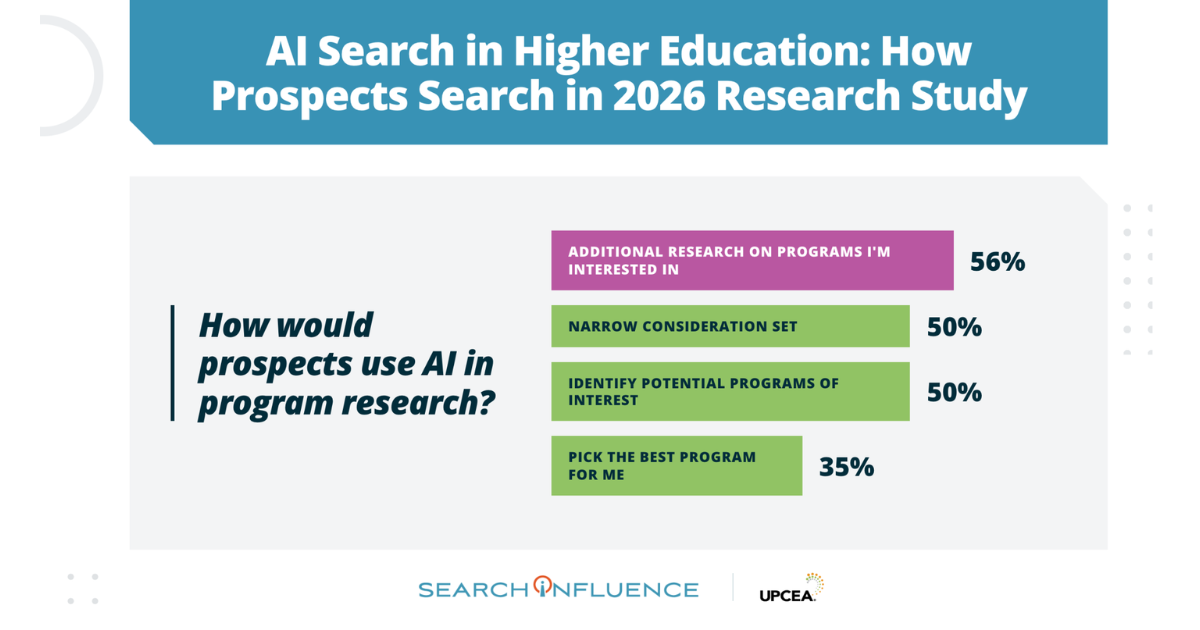
Among prospects likely to use AI tools for program research, 56% say they’d use it to dig deeper into programs already on their radar. Half say they’d use it to find new programs they hadn’t considered, and half say they’d use it to narrow their list down.
Prospects are asking AI to do the elimination round for them.
I keep coming back to this finding. If half of AI users are actively asking a tool to help them cut their list down, your program page needs to give AI something specific and citable to work with. Not the same brochure copy as ten other institutions. A tool can’t recommend your program by name if it can’t tell your program apart from the others it’s comparing.
Give AI Something Worth Recommending
AI tools can only recommend what they can clearly understand. If your program page reads like a brochure, general and aspirational, an AI tool has nothing concrete to point to.
A page that’s easy for AI to recommend usually spells out:
- The outcome. What credential or role does this program actually lead to? “Prepares graduates for a career as an X” tells AI and prospects more than “advances your career” ever will.
- The format. Online, hybrid, evening, cohort-based, whatever it is, say so plainly and early.
- The timeline. How long does it actually take? “12 months” or “18-24 months, part-time” is something an AI tool can compare across programs. “Flexible pacing” isn’t.
- The cost. Prospects are already asking AI tools to compare programs on price. A page that won’t say what something costs gets skipped in favor of one that will.
The good news is that none of this requires new content. Most of it, you’re already sharing in an admissions conversation or a program brochure. It just needs to live in the text of the page itself, in plain language, where an AI tool, and a prospect scanning quickly, can find it in the first few lines. It’s the same specificity that helps your traditional SEO, too, so this work does double duty.
Consistently Optimizing for AI and Traditional Search Is the Winning Strategy
The two channels don’t always line up with each other. A program can be the one ChatGPT recommends by name and still be missing from Google’s results entirely, or the reverse.
Foundational SEO is the base that everything else builds on, including AI visibility. It underpins how well AI tools can find, understand, and recommend a program. Because the shortlist is this small, showing up in only one channel, search or AI, is enough to knock you out of contention. A program that’s strong in just one area is still a program that can get left off the list.
Consistency matters more than dominance in any single channel. You don’t need to be the top Google result and the only ChatGPT recommendation. You need to show up credibly in both, because prospects are checking both.
Frequently Asked Questions About AI Search in Higher Education
How do students use AI to choose a college or program?
Our data shows AI plays a role at every stage. Among prospects likely to use AI tools, 56% use them to dig deeper into programs already on their radar, half use them to find new programs they hadn’t considered, and half use them to narrow their list down to the three or fewer they’ll seriously apply to.
How can my institution get recommended by ChatGPT and other AI tools?
The same way you’d earn a page-one Google ranking, with a program page that spells out the outcome, format, timeline, and cost in plain language. AI tools can only recommend what they can clearly understand, so specific, structured content beats brochure copy every time.
Is AI search replacing traditional SEO for higher ed marketing?
No. Eighty percent of prospects still use traditional search engines, and that number hasn’t dropped. Foundational SEO and AI visibility reinforce each other. Institutions that treat them as one strategy, rather than two separate line items competing for budget, are the ones showing up consistently in both.
Download the Full Study
How Prospects Search in 2026, our higher education marketing research study with UPCEA, has the complete data set behind these findings. It covers how AI use breaks down by age group, which platforms prospects trust most, and where institutions are still leaving visibility on the table.
Download the full study to see where your programs might already be falling off someone’s shortlist.
This is the work we do every day for higher education clients. We audit program pages against these signals, build out the entities and structured content that AI tools need to recommend a program by name, and ensure a strong AI Overview citation and a strong organic ranking are pulling in the same direction rather than competing for budget.
Managing both organic and search strategy takes more bandwidth than most marketing teams have to spare. It’s what our AI SEO and higher education marketing teams do every day, freeing up our clients to focus on other priorities, while ensuring they’re visible where prospects are searching.
Ready to learn more about how we can support your programs’ search visibility? Reach out to our team to discuss how we help higher ed institutions make the shortlist.
Paula French is a higher education digital marketing expert who helps universities attract prospective students through SEO, AI search, and digital advertising.
As Director of Sales and Marketing at Search Influence, she partners with institutions to shape enrollment strategies around how students discover programs today—especially as AI search reshapes that journey.
She has worked with universities including Harvard, Tulane School of Professional Advancement, and Tufts University, and has spoken at UPCEA conferences and the AMA Symposium for the Marketing of Higher Education.
By Vickie S. Cook, Ph.D.
There are many assumptions about AI use across generations. Gen Z readily embraces artificial intelligence. Millennials are integrating it into their work. Gen X is more cautious and pragmatic. Baby Boomers are reluctant adopters. Is it really that simple? Perhaps not. Generational differences in AI use appear to be real. What those differences mean is far less certain. There is research that appears to support parts of that narrative. Younger adults generally report using generative AI at substantially higher rates than older adults. But dig a little deeper into the research and the story becomes much more complicated and much more important for leaders.
Before leaders use generational differences to inform decisions about AI adoption, training, workforce development, or organizational change, we need to ask a more fundamental question: Are we seeing differences caused by generation, or are we seeing differences in age, career stage, exposure, opportunity, confidence, perceived risk, or even awareness that AI is being used? The answers to these questions are important as leaders consider their own generational biases regarding age and stage interaction with technology.
Generational Thinking Can Be Useful If We Recognize Limitations
I have written and presented about generations for many years, and I continue to believe generational research can provide useful information for leaders. Broad patterns can help us identify questions we should be asking and differences we should consider. But, to make decisions based on someone’s generation is quite wrong. Remember that generational research is not a precise science. Generational patterns can inform the questions leaders ask. They should not determine the conclusions leaders reach about individuals.
The familiar generational categories have been widely used to describe groups of people who share birth years and some formative historical experiences. People do not suddenly acquire a set of characteristics because they were born on one side of a generational dividing line rather than another.
Researchers also face a persistent problem when interpreting apparent generational differences. Are we observing a cohort effect associated with the historical experiences of a particular generation? An age or life-stage effect that might have occurred regardless of generation? A period effect caused by something affecting everyone at the same time? Or differences in education, occupation, organizational culture, access, or opportunity?
AI makes those distinctions especially important because we are living through an extraordinary period effect. All generations are encountering a rapidly changing technology at the same moment, but they are encountering it at very different stages of their lives and careers. Generational data can help leaders see where differences appear. It is considerably less capable of telling us why those differences exist.
There Is an AI Adoption Gap
The differences in reported AI use are difficult to ignore. Pew Research Center’s 2026 research found that 66% of adults ages 18–29 had used AI chatbots, compared with 61% of those ages 30–49, 42% of those ages 50–64, and 23% of adults 65 and older.
Other recent studies using generational categories have found similar patterns. Younger generations generally report greater use of generative AI, greater familiarity with it, and more opportunities to incorporate it into their work. It would be easy to stop there and conclude that younger generations are embracing AI while older generations are not.
But that would confuse a description with an explanation. Age is clearly associated with reported AI adoption. That does not establish that age or a specific generation is causing the difference. The bigger problem that must be addressed: What exactly do we mean when we ask whether someone “uses AI”?
You May Be Using AI Without Thinking of It as AI
Ask someone whether they use ChatGPT, Claude, Gemini, or Copilot and they can probably give you a reasonably accurate answer. Ask whether they use AI however, and the question becomes considerably more complicated.
AI Is Already Embedded in Everyday Technology
AI has become embedded in products and services that people use routinely: navigation systems, search engines, email filtering, predictive text, customer service phone routing, streaming recommendations, online shopping, fraud detection, virtual assistants, social media feeds, and many other applications.
Gallup demonstrated the magnitude of this disconnect in research conducted with nearly 4,000 U.S. adults. Only 36% initially reported using an AI-enabled product during the previous week. But after Gallup asked about six specific categories of AI-enabled products, 99% had used at least one and 83% had used four or more. People were using AI. They simply did not necessarily recognize what they were doing as AI use. In many cases, AI was embedded in products they had chosen to use rather than being a technology they had deliberately chosen to adopt.
What Does It Mean to “Use AI”?
This introduces a problem for interpreting generational adoption data. Let’s consider two employees.
A younger employee regularly opens a generative AI application and describes herself as using AI every day.
An older employee uses navigation, online search, predictive text, email filtering, streaming recommendations, and AI-supported workplace software but says, “I don’t use AI.”
Both may be accurately describing their experience as they understand it.
What differs may not simply be their exposure to AI. It may be their recognition of AI and their understanding of what constitutes AI use.
AI Engagement Is a Continuum
We may therefore need to think about AI engagement as a continuum:
- Embedded exposure occurs when AI operates within a product or service someone uses. Often without that person being aware that AI is enabled in the process or product.
- Unrecognized use occurs when someone actively uses an AI-enabled feature without recognizing it as AI or deliberately choosing to use AI.
- Recognized use occurs when someone knows that a feature or system incorporates AI and chooses to use it.
- Intentional generative AI use occurs when someone deliberately engages an AI system to accomplish a task such as opening an AI platform with an interactive product like ChatGPT and typing in a prompt.
Those are very different experiences. Collapsing all four into a simple category of “AI user” or “AI non-user” tells us very little about an individual’s actual relationship with AI. It also means that some apparent generational differences in AI adoption could reflect differences in AI awareness as well as differences in actual use.
Using AI Does Not Mean Trusting AI
Another assumption begins to break down when we look at attitudes rather than adoption. The people using AI most frequently are not necessarily the people who are most comfortable with its consequences.
Pew’s 2026 research found younger adults were considerably more likely to use AI chatbots than older adults. Yet adults ages 18–29 were also more likely than adults 65 and older to expect AI to have a negative impact on society over the next 20 years. Other research has found substantial concern among younger workers about AI eliminating jobs or eventually replacing their own roles.
Adoption, Confidence, Trust, and Acceptance Are Different
Adoption is not the same as confidence. Confidence is not the same as trust. Trust is not the same as optimism. And none of them necessarily equals acceptance.
An employee can use AI every day and simultaneously be deeply concerned about what it means for her profession and for the future of her field. Another employee can use generative AI infrequently while believing it will ultimately improve his work. A third can be highly confident using AI while exercising poor judgment about when its outputs should be trusted.
If leaders combine all of these dimensions into a single concept of “AI readiness,” they risk misunderstanding their workforce.
How Professional Experience May Shape AI Adoption
The middle generations provide another reason for caution. Recent research suggests Millennials are among the most active workplace users of AI. Gen X occupies an interesting middle position: adoption tends to be lower than among Millennials and Gen Z but considerably higher than among Baby Boomers. These patterns are particularly relevant for organizations because many experienced managers and senior leaders fall within these groups.
Caution Can Reflect Professional Judgment
But there is another way to interpret their behavior. Does professional experience make someone less willing to adopt AI? Or does experience provide context that allows a person to make more discriminating decisions about where AI adds value and where it does not?
Someone who has performed a complex professional task for 25 years may approach AI differently from someone who has performed it for two years. That does not necessarily make either person’s approach superior. The experienced professional may understand nuances, risks, exceptions, and consequences that make caution appropriate.
The less experienced professional may be more willing to question an inefficient process simply because ‘we have always done it that way’. It is clear that organizations need both perspectives.
Lower Adoption Is Not the Same as Resistance
The potential for generational bias becomes particularly apparent when discussing Baby Boomers. Research consistently finds lower reported generative AI adoption among older adults. That is a legitimate finding. It does not establish that older adults are unable to learn AI, oppose its use, lack interest in it, or cannot become highly sophisticated users.
In fact, adoption among older adults has been rising rapidly. Pew’s tracking of ChatGPT use among adults 65 and older increased from 4% in 2023 to 19% in 2026. Among adults ages 50–64, reported use increased from 13% to 37%. The question becomes how many opportunities Baby Boomers, some of whom are no longer in the workforce, have to use AI regularly, and for what purposes.
The gap remains. But the direction of change matters. Once we convert “lower current adoption” into “resistant to AI,” we have moved from evidence to stereotype. And stereotypes influence organizational decisions. Generational leadership should never fall into establishing stereotypes as a means to leading human or AI teams.
What If Organizations Are Helping Create the Gap?
This may be the more consequential leadership question. Suppose a manager assumes younger employees will be comfortable with AI. Those employees are encouraged to experiment. They receive AI-intensive assignments. They attend workshops. They are invited to pilot new applications. Their mistakes are interpreted as part of learning.
The same manager assumes older employees will be reluctant. They receive fewer opportunities to experiment and less encouragement to participate in pilots. Training may be directed elsewhere because the organization assumes younger workers will benefit more.
Six months later, the younger employees demonstrate greater AI proficiency. The manager concludes: “I knew the younger employees would be better at AI.” But what has actually been demonstrated? Generational aptitude based on stereotypical decision-making? Or differential opportunity?
When Assumptions Become Self-Reinforcing
The process can become self-reinforcing. We should not assume this explains generational differences in AI adoption. The research does not establish that causal relationship. Leaders should be asking whether their own decisions are contributing to the differences they observe.
Generational assumption → Differential opportunity → Different experience → Different confidence → Different usage → Apparent confirmation of the original assumption
Generational Bias Works in More Than One Direction
The danger is not limited to assumptions about older workers. A leader might assume a Gen Z employee is naturally proficient with AI and therefore needs little training. But frequent use of generative AI does not necessarily indicate an understanding of hallucinations, data privacy, intellectual property, bias, verification, or the appropriate boundaries between automated assistance and human judgment. Required workplace use of AI also does not mean that Gen Z employees necessarily view its adoption or use as ethical, desirable, or safe. Assuming competence can be as problematic as assuming incompetence.
Likewise, Millennials should not automatically be treated as enthusiastic AI adopters, Gen X should not be characterized as reluctant to change established professional practices, and Baby Boomers should not be presumed to require persuasion before they will experiment. Population-level patterns can help us formulate questions. They do not provide answers about individuals.
Questions Leaders Should Ask About AI Adoption
Instead of asking, “How do I get each generation to adopt AI?” leaders might begin with a different set of questions:
- What exposure has this individual had to AI?
- Do they recognize where AI is already embedded in their work?
- What opportunities have they had to experiment safely?
- How confident are they in using AI, and is that confidence warranted?
- What do they believe AI could contribute to their work?
- What concerns do they have about its consequences?
- What training or support would improve their capability?
- Does this individual have a reason or need to use AI in their work?
- Where does their professional experience provide context and judgment that AI cannot?
Those questions move the conversation away from generation as destiny and toward the interaction of the person, the work, and the organizational environment.
A Lens, Not a Label
Generational research remains valuable. It can help leaders identify patterns, challenge assumptions, anticipate different reactions to organizational change, and ask better questions. It can assist the leader in helping to see the individuals and plan for professional development. But generational research becomes less advantageous when a population-level observation becomes an expectation about an individual. AI raises the stakes.
Organizations are making decisions now about who receives training, who participates in pilots, who is encouraged to experiment, whose concerns are considered legitimate, and who is selected to lead AI-enabled transformation. We must pay attention to generational patterns as those decisions are made. But we should be equally attentive to the biases we bring to interpreting those patterns. Perhaps the most consequential generational AI bias is not what different generations believe about artificial intelligence. It may be what leaders believe about different generations.
The leadership challenge is not to become blind to generational differences. It is to recognize those differences without allowing them to become assumptions about individual capability, motivation, or willingness.
What does this work require? What does this individual know? What experience do they bring? What development do they need? What opportunity have they been given?
Vickie Cook is a nationally recognized higher education leader specializing in enrollment strategy, online and digital learning, organizational transformation, team development, and leadership growth. She currently serves as a Senior Fellow and Strategic Advisor for UPCEA. You can follow Vickie on LinkedIn. To learn more about UPCEA Research and Consulting, please contact [email protected].
Frequently Asked Questions About Generations and AI
Does Gen Z use AI more than older generations?
Generally, yes. Recent research finds substantially higher reported generative AI use among younger adults. But higher use does not establish greater capability, trust, optimism, or acceptance.
Are Baby Boomers resistant to AI?
The evidence does not support that conclusion. Older adults report lower generative AI adoption, but adoption is increasing. Lower use may also reflect differences in workplace exposure, opportunity, perceived utility, or reason to use AI.
Can someone use AI without realizing it?
Yes. AI is embedded in many everyday technologies, including search, navigation, email filtering, recommendations, fraud detection, and customer-service systems. Gallup found a substantial gap between people’s reported AI use and their use of AI-enabled products.
Does frequent AI use mean someone is AI-literate?
No. Frequency of use does not necessarily indicate proficiency in verification, privacy, intellectual property, bias, ethical use, or knowing when human judgment should override an AI-generated response.
How should leaders use generational research when making AI decisions?
Use generational patterns to identify questions, not to predict an individual’s capability or willingness. Leaders should consider an individual’s experience, opportunity, confidence, professional judgment, concerns, development needs, and reason for using AI.
What is the greatest risk of generational bias in AI adoption?
Leaders may unintentionally create the differences they expect to see. If one age group receives more encouragement, experimentation, training, or AI-intensive assignments, differences in proficiency can emerge that appear to confirm the original generational assumption.
References
Deloitte. (2024). 2024 Gen Z and Millennial survey: Living and working with purpose in a transforming world. Deloitte. https://www.deloitte.com/ie/en/services/consulting/perspectives/gen-z-millennial-survey.html
Gottfried, J., Bishop, W., Anderson, M., Faverio, M., Park, E., & McClain, C. (2026, June 17). How opinions and use of AI differ by age. Pew Research Center. https://www.pewresearch.org/internet/2026/06/17/how-opinions-and-use-of-ai-differ-by-age/
Maese, E. (2025, January 14). Americans use AI in everyday products without realizing it. Gallup. https://news.gallup.com/poll/654905/americans-everyday-products-without-realizing.aspx
Randstad USA. (2024, November 1). The generational divide in AI adoption. https://www.randstadusa.com/business/business-insights/workplace-trends/generational-divide-ai-adoption/
Cut the Roles, or Support the People?
When generative AI began fielding most of IKEA’s customer service questions, the company faced a choice familiar to any employer navigating fast-moving technology: cut the affected roles, or retrain the people in them. IKEA retrained them. The retailer built a program that moved 8,500 customer service employees into new work as remote interior design consultants and digital sales specialists, training them on room-planning tools and the judgment calls that come with a live customer conversation. The company reports zero layoffs tied to the shift, and by its own account, more than a billion dollars in added sales from a workforce that learned its way into new value. IKEA is now extending its commitment to workforce readiness, with a goal of providing AI-literacy training to approximately 70,000 employees by the end of 2026.
If we are to manage the disruption from AI, that story needs to become the norm, not the exception. The World Economic Forum projects that 39 percent of core workplace skills will change by 2030, and that 59 percent of today’s workforce will need meaningful retraining to keep up. For employers, learning can no longer live on the margins of the business, reserved for onboarding week or a handful of high performers. It has to be a standing capability, built into how a company plans for its own future.
Higher education has an important role to play in meeting this need. As technological and economic change reshapes careers, learners will require access to education at more points throughout their lives—not only before entering the workforce. Serving these learners is consistent with higher education’s educational mission and its commitment to economic mobility, while also creating new opportunities for institutions as the traditional undergraduate population declines.
Despite the apparent alignment between employer demand and university supply, higher education is losing ground. Between 2022 and 2023, the share of companies partnering with four-year colleges on employee training and professional development fell by nearly 10 percent, and partnerships with community colleges dropped 7 percent, according to a Collegis Education and UPCEA employer survey.
Nearly 40 percent of company leaders cited cost as the main barrier to partnering with a college or university. For higher education to win that ground back, institutions will need to offer more than access to courses or credentials. The opportunity is to become a long-term learning partner—combining academic expertise, contextualized learning, technology-enabled personalization, and evidence of impact to help organizations and their employees continually adapt. The value of these partnerships must be clear on both sides resulting in meaningful and transferable career benefits for employees and measurable and lasting results for employers.
What Does a Real Learning Partnership Look Like?
The traditional models of collaboration between employers and higher education are no longer sufficient. Executive education has often concentrated high-touch, cohort-based learning among a relatively small group of senior leaders. Elsewhere in the organization, employees may receive access to enormous catalogs of largely asynchronous courses, but little guidance about what to learn, how it connects to their work, or where it might lead.
Technology platforms have dramatically expanded access to workforce learning, but access to content is not the same as an effective workforce-development strategy. The strongest models will combine the reach and personalization enabled by technology with academic expertise, applied learning, human support, and sustained measurement.
A long-term learning partnership begins with an employer’s strategy and workforce needs, then connects those priorities to the goals and aspirations of individual employees. It may combine online learning with live engagement, opportunities to practice and apply new skills, personalized guidance, and recognized credentials. Rather than offering a one-time program or an undifferentiated catalog, the university and employer build a coherent portfolio of learning experiences that can evolve as organizational priorities, technologies, and career pathways change.
Realizing this opportunity will require more than asking employers to rediscover higher education. Colleges and universities must become easier to navigate, faster to respond, more flexible in how they design and price learning, and more disciplined about measuring results. That means creating clear points of entry for organizational partners, developing learning experiences on timelines that reflect workforce needs, and working across institutional boundaries to bring the right capabilities to each partnership.
Colleges and universities bring distinctive strengths to this work: trusted expertise, evidence-based learning design, recognized credentials, research capabilities, and deep connections to regional and national communities. They can also connect workforce learning to a broader educational ecosystem—from short-form experiences and professional credentials to degree pathways, alumni engagement, and lifelong learning. Their greatest advantage, however, may be their capacity to sustain relationships across changes in technologies, business models, and labor-market needs.
At the University of Michigan, the Center for Academic Innovation (CAI) is applying this model through Michigan Online. Working with organizational partners, the center combines a broad portfolio of online learning with experiences tailored to particular workforce needs. The aim is not simply to provide employees with access to more content, but to create coherent learning experiences that draw on faculty expertise, respond to organizational priorities, and generate evidence about what employees learn and how they apply it.
What’s In It for the Employee?
The pressure on individual workers to keep up with new technology, while also anticipating which skills will matter next, is constant. For employees to engage meaningfully in a learning program, they need to understand how it can benefit their careers. That might mean becoming more effective in a current role, preparing for a promotion, moving into a new area of work, earning a recognized credential, or building capabilities that will remain valuable throughout their careers.
Designing around the employee requires more than offering access to content. Learners need clear pathways, opportunities to apply what they are learning, and support in connecting new capabilities to real career possibilities. Employers must also provide the time, encouragement, and organizational conditions that allow employees to participate and put new skills into practice.
Higher education brings decades of research and experience in how people learn, engage, and retain new knowledge. Faculty expertise and evidence-based learning design can be adapted to the context of a particular organization without being reinvented for every program.
Noodle Partners is one firm using AI to make that contextualized learner support more personalized and scalable. When informed by an organization’s goals, skills needs, and career pathways, AI-enabled tools can help employees identify relevant learning opportunities, receive timely guidance, and understand possible next steps. Technology is most valuable here not as a substitute for thoughtful program design or human support, but as a way to help each employee navigate a learning journey that feels customized, relevant, and actionable.
How Do You Prove Learning Paid Off?
Engaged and capable employees create real value, but employers weighing an investment in education want that value demonstrated, not assumed. A strong measurement strategy should examine results at three levels:
- Learning: Did employees complete the experience and demonstrate new knowledge or skills?
- Application: Are employees using those capabilities in their work, and are managers observing changes in performance?
- Organizational impact: Is the employer seeing progress in outcomes such as retention, internal mobility, productivity, collaboration, or time to proficiency?
These outcomes require different forms of evidence. Baseline and follow-up assessments can demonstrate what employees learned, while workplace projects, manager feedback, and organizational data can help show whether that learning translated into changed behavior or business results. Not every outcome can be attributed to a single program, but a thoughtful evaluation strategy can produce a much more credible picture of value than participation and completion rates alone.
At the University of Michigan, CAI integrates learning analytics and educational research into the experiences it develops. This kind of infrastructure makes it possible to examine what employees learned, how they applied it, and where the partnership is producing value. No single learning experience will produce sustained organizational change on its own, but a committed partnership—measured and refined over time—can help move the outcomes that matter to both employers and employees.
What Happens If Higher Ed Sits This Out?
The coming wave of workforce transformation creates a significant opportunity for higher education—but institutions are not entitled to it. Employers and employees will choose learning partners that are responsive, relevant, flexible, and able to demonstrate value. Colleges and universities that build those capabilities can become more than content providers. They can become enduring learning partners, helping people and organizations navigate not only the current transition, but the many transitions still to come.
The strongest partnerships will grow more valuable with time. Learning in the workplace can inform what universities teach and study, while academic expertise and research can help organizations anticipate and respond to emerging needs. When higher education and employers build that kind of reciprocal relationship, they create better pathways for employees, stronger organizations, and new ways for colleges and universities to fulfill their educational missions across a lifetime.
About University of Michigan – Center for Academic Innovation
Academic Innovation is a strategic priority for the University of Michigan. Through curricular innovation, educational data and research, and tools for learning, the Center for Academic Innovation aims to shape the future of learning and redefine public residential education at a 21st-century research university by unlocking new opportunities for the University of Michigan community and learners around the world.
By James DeVaney, Founding Executive Director, Center for Academic Innovation, Associate Vice Provost for Academic Innovation, University of Michigan; and Alan Mlynek, Chief Product Officer, Noodle.
About Noodle
Noodle delivers the people, process, and technology for universities to grow and innovate. From first inquiry to completion, Noodle connects your systems, simplifies workflows, and delivers 24/7 support and insights that empower your teams and strengthen the learner journey.