

By Amy Claire Heitzman, Ph.D.,
Deputy CEO and Chief Learning Officer, UPCEA
Reflections from a Fireside Chat with President Jon Alger on March 18, 2026
There are moments in this fellowship year that feel distinctly formative—where the conversation you’re facilitating is also, quietly, shaping you.
Last week’s fireside chat with American University President Jon Alger was one of those moments for me.
As part of my ACE Fellowship, I’ve had the privilege of learning alongside and from Jon as my placement mentor. I came into this conversation hoping to surface insights about leadership, governance, and strategy at a time when higher education feels particularly complex. What I didn’t expect was how much I would find myself reflecting—not just as a moderator, but as a leader-in-progress.
Leadership Is Built in the Moments You Don’t Plan For
I opened our conversation by asking Jon about his path to the presidency, which is something we’ve bonded over, as neither of us took a particularly “traditional” route.
“My career was not a straight line.”
That simple statement landed more deeply than I expected.
In the ACE Fellows community, we often talk about leadership trajectories: what prepares us, what qualifies us, what comes next. But this was a reminder that leadership is often shaped in the in-between moments: the decisions to pivot, to raise your hand, to say yes before you feel fully ready.
I found myself reflecting on my own path and realizing that the moments that felt least linear were often the ones that stretched me the most.
Governance Is Where Leadership Gets Tested
I’ve long been fascinated by governance, perhaps because it’s where leadership becomes most visible, and most vulnerable.
As Jon described the realities of working across boards, faculty, students, and external stakeholders, I was struck by how much of this work comes down to relationships. Not just formal structures, but trust, communication, and the ability to navigate tension with intention.
“You have to have a thick skin and be prepared for those conversations.”
Sitting in that moment, I thought about how often we prepare leaders for strategy, but not always for the emotional and relational complexity that comes with it.
What I took away most clearly is that governance, at its best, is not about control, it’s about alignment, built over time.
Strategy That Actually Means Something
One of the things I was most curious about going into the conversation was how institutions are making strategy feel real, not just aspirational.
As Jon walked through AU’s approach, I found myself leaning in, not just as a fellow, but through the lens of my work at UPCEA, where we think a great deal about workforce alignment and the articulation of value.
What stood out was the intentionality behind making student readiness visible, through skills, experiences, and outcomes that translate beyond the campus.
It reinforced something I think many of us are grappling with: we can no longer assume that the value of higher education is understood. We have to design for it, communicate it, and deliver on it in ways that resonate across audiences.
Naming the Moment We’re In
At one point, I asked Jon how he is thinking about the broader landscape: the policy shifts, the scrutiny, the sense of pressure that many of us are feeling across the sector.
His response was candid:
“I never thought that I would see a time when higher ed would be under such frontal assault.”
It’s a statement that stayed with me, not because it was surprising, but because it was so plainly stated.
And yet, what followed was not discouragement, but direction. A focus on partnership, on collective action, and on expanding who is part of the conversation about higher education’s value.
In my own work, I often talk about building a “coalition of the willing,” bringing together those who see shared purpose and can help move work forward. Hearing that echoed in this context felt both affirming and urgent.
Civic Life and the Work of Bridging Difference
One of the areas I was most eager to explore was civic life at AU, work that feels especially important right now.
As Jon described the emphasis on civil discourse, problem solving, and innovation, I found myself thinking about how these are not just student skills, they are leadership skills.
Skills that we, too, are being asked to practice in real time.
The idea that we must move beyond simply understanding difference to actually working through it together is one I’ll carry with me well beyond this conversation.
Staying Close to What Matters
As we closed, I asked Jon for a final takeaway for the fellows. His response was simple:
“Spending actual time with students… that is a constant reminder of why you do what you do.”
It was one of those moments where everything else quieted.
In a role—and a sector—that can so easily become consumed by complexity, it was a needed reminder of purpose. And, candidly, one I’m still sitting with.
Final Reflection
If I’m honest, I walked away from this conversation with more questions than answers, but in the best possible way.
What does it mean to lead with clarity when the path isn’t clear?
How do we build trust across differences in increasingly complex environments?
How do we stay anchored in mission while adapting to what’s ahead?
What I do know is this: leadership in higher education right now is not about having it all figured out. It’s about how we show up in conversation, in decision-making, and in relationship to the communities we serve.
I’m deeply grateful to Jon for his openness, for his mentorship, and for modeling a kind of leadership that is both steady and evolving.
And I’m equally grateful for the space this fellowship creates, not just to learn from others, but to reflect on who we are becoming as leaders in the process.
Amy Heitzman, Ph.D., is Chief Learning Officer and Deputy CEO of UPCEA and an ACE Fellow, leading work at the intersection of research, policy, and innovation in professional, continuing, and online education.
Content was refined with assistance from ChatGPT.
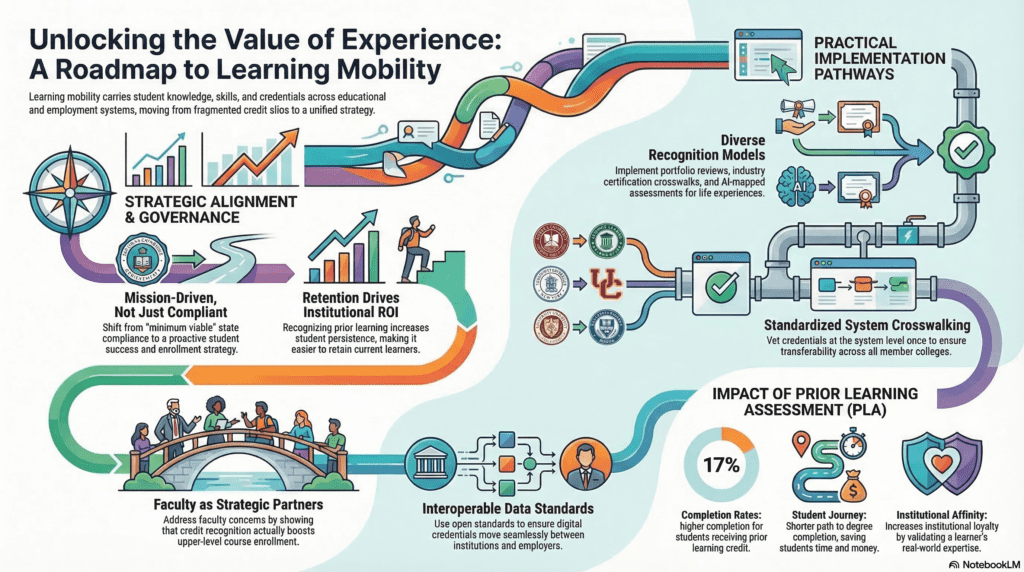
There has been much discussion about the more than 41 million US learners with “Some College No Credential” (SCNC) over the past several years. Despite a strategic focus by higher education institutions to re-enroll these learners, and with some success, the population has continued to grow. UPCEA hosted a strategic conversation with the Council for Credential Innovation and higher education leaders in March 2026 to explore one of the potential solutions to this issue, learning mobility.
As defined by AACRAO and endorsed by UPCEA, learning mobility is a learner-centered framework where systems and policies are designed around the needs of modern learners, facilitating the seamless recognition, transfer, and portability of credits, competencies, and credentials across institutions, workplaces, and life experiences. It is a fundamental shift: moving from the degree as a static, terminal destination to viewing learning as a portable, liquid asset that belongs to the human being, not the institution.
For decades, the American higher education narrative has followed a rigid, linear script: enroll at eighteen, spend four years in a lecture hall, and emerge with a parchment passport to the middle class. But the reality on the ground has moved on, leaving a staggering 41.9 million adults in the United States with “some college, no degree.” These individuals are not empty vessels waiting to be filled; they are the backbone of the modern workforce, managing complex logistical chains, leading teams through crises, and navigating the profound ethical demands of caregiving. Yet, when they try to return to the academy, they find their accumulated expertise treated as invisible, a ghost in the machine.
This represents more than just a bureaucratic hurdle; it is a systemic “tax” on the lives of adult learners. By treating education as a closed loop where credit is granted only for “seat time” under faculty supervision, institutions force students to repeat content they have already mastered. This friction-filled journey extends the time-to-degree exactly when the cost of tuition is at an all-time high, effectively penalizing those who have spent time gaining real-world wisdom.
The “Seat Stealer” Myth vs. the Persistence Reality
The biggest barrier to this mobility isn’t technology; it’s a zero-sum mindset in higher education. There is a persistent “seat stealer” myth; the fear that if a university grants Credit for Prior Learning (CPL) for a student’s ten years of military logistics experience, a chair in a traditional introductory course will sit empty, and a department’s budget will dwindle.
However, data from CAEL (the Council for Adult and Experiential Learning) and WICHE (the Western Interstate Commission for Higher Education), as well as from many of the senior leaders in the strategic conversation, suggests the opposite. CPL doesn’t cannibalize enrollment; it fuels it. When an adult student sees their lived experience validated on a transcript, they gain “skin in the game” almost immediately. According to CAEL and WICHE research, adult students who receive Credit for Prior Learning (CPL) are 17% more likely to graduate, with some studies indicating even higher completion rates (49% for CPL students vs. 27% for non-CPL students). By removing redundant hurdles, institutions allow students to reach the advanced, specialized coursework where they are most likely to stay engaged and eventually graduate.
From Parenting to “Ethical Judgment”: The Radical Trust in Life Experience
Moving beyond the data requires a form of “radical trust”; trusting that the learning occurring in the home or the community is as rigorous as the learning in the lab. Consider the “Parenting Portfolio” pilot, a program developed by one of the leaders in the UPCEA Council for Credential Innovation. Using the Kolb assessment model—a framework for experiential learning—and AI-driven role-play scenarios, the program maps the high-stakes decision-making of parenting to professional skill sets.
The brilliance of this pilot lies in its translation. The institution was intentional about creating a “shared language” with the workforce. They didn’t issue a “Parenting Badge,” which a recruiter might overlook; instead, they titled the micro-credential “Ethical Judgment.” By mapping parenting challenges to three unique professional skills, they created a credential that speaks the employer’s dialect while honoring the learner exactly where they are.
The Faculty Survival Strategy: Innovation in a Frozen Economy
Institutional change often stalls because faculty incentives are trapped in outdated structures. Another UPCEA Council for Credential Innovation leader shared that their workforce development unit has reframed itself as a lifeline rather than a competitor to degree programs.
In an era of budget freezes, position freezes, and system-level max-salary policies that make raises impossible, the university’s workforce unit uses a “cost-sharing” model. Faculty are paid to develop and deliver non-credit, workforce-aligned programs, essentially allowing them to supplement their income by doing what they do best—building workforce aligned curriculum—without seeking external “side hustles” or consulting gigs. This aligns the personal financial survival of the faculty with the university’s innovation goals, turning potential resistors into the loudest advocates for change.
The Active Military Member: Digital Learning as Existential Strategy
To succeed today, an institution must embrace “swirling”; a student-centered model where the rules regarding delivery modes are demolished. Students take a mix of online, on-campus, and branch-campus courses in a single term based on the shifting demands of their lives.
This is best illustrated by active military enrolled in courses. At any given time, the active military member may need to flex their modality. By providing a fully online path for that term, the institution ensures these students don’t fall behind or fail out. This isn’t a perk; it is a critical strategy for institutional survival. As one leader noted, “We’d be a much smaller institution if we were only in-person.” In a world of rising costs, flexibility is no longer a convenience, it is a requirement for graduation.
The Cost of Strategy Whiplash: A Cautionary Tale
The most dangerous threat to learning mobility is “strategy whiplash,” the cycle where a leadership transition leads to the dismantling of essential units. Leaders in the credential innovation space offered a stark warning of the waste involved in this turnover.
One institutional leader shared that during an interim presidency, a decision was made to shut down a successful online enrollment management unit to save costs. The “savings” proved catastrophic: while graduate enrollment stayed stable, the gains in undergraduate enrollment were lost entirely. A subsequent president eventually had to spend significant resources to rebuild the exact same unit from scratch.
This irony highlights the human and financial waste inherent in short-term thinking. Learning mobility requires a long-term commitment that transcends the tenure of a single interim leader.
Conclusion: Practice Over Polish
Learning mobility is not a final destination, nor is it a piece of software you can buy off a shelf. It is an institutional practice, a constant exercise in building trust and shared language between the academy and the workforce. National initiatives like UPCEA’s “Synchronizing Pathways,” supported by a Strada Education Foundation grant, are currently working to improve data quality for non-degree credentials, ensuring that these pathways are transparent and valuable for the millions who need them.
As higher education faces an inflection point, leaders must decide which side of history they want to be on. The question is no longer whether we can recognize life experience, but whether we will. Are your current policies built for the preservation of institutional silos, or for the mobility of the human beings you serve? The future of work, and the 41 million, is waiting for the answer.
Special thanks to UPCEA CCI co-chairs Doris Savron (University of Phoenix), Sheila LeBlanc (University of Calgary), and Melissa Jimenez (Colorado Community College System) for their contributions to this report.
Julie Uranis, Ph.D., is UPCEA’s Senior Vice President for Online and Strategic Initiatives.Amy Heitzman, Ph.D., is UPCEA’s Deputy CEO and Chief Learning Officer.Melissa Peraino is UPCEA’s Director of Content Development and Volunteer Leader Management.Stacy Chiaramonte is UPCEA’s Senior Vice President of Strategy and Operations for Research and Consulting.
Content for this resource was refined with the assistance of ChatGPT, an AI language model. All text has been thoroughly reviewed, edited, and approved by UPCEA staff with subject matter expertise. References and links have been verified for accuracy and reliability.

By Vickie S. Cook, Ph.D.
I recently contributed a chapter in the recently released book, AI Applications in Online Higher Education Administration: Strategies for Maximizing Returns and Improving Outcomes edited by Kathleen Ives, Marie Cini, and Ray Schroeder. This blog highlights key take-aways from my chapter. Higher education recruitment is undergoing one of the most significant transformations in decades. Traditional strategies—direct mail campaigns, college fairs, generalized advertising, and broad outreach—once served institutions well. However, these methods are increasingly insufficient in a digital-first environment shaped by new student expectations, demographic shifts, and intense enrollment competition. The 2026 Modern Learner Report re-evaluates how prospective students search, evaluate, and ultimately choose an institution.
Artificial intelligence (AI) is rapidly emerging as a strategic tool for modernizing enrollment management. By leveraging data analytics, predictive modeling, and machine learning, institutions can move beyond broad recruitment tactics that are no longer meeting the needs of today’s students toward personalized, efficient, and scalable engagement strategies.
For enrollment leaders, the question is no longer whether AI will influence recruitment. The real question is how institutions can thoughtfully integrate AI into their enrollment management strategies to provide their prospective students with choices that align to the students’ personal values.
Why Traditional Recruitment Models Are Under Pressure
For decades, recruitment models treated prospective students largely as a homogeneous audience. Institutions relied on broad messaging and generalized outreach strategies designed to reach large pools of potential applicants. While these methods once generated strong results and allowed institution to accurately predict enrollment. Let’s explore why these approaches no longer meet the needs of students or institutions:
- Traditional outreach often lacks personalization. Students increasingly expect communication tailored to their academic interests, career goals, and personal aspirations. Generic messaging can feel disconnected and may fail to capture student attention.
- Traditional recruitment efforts are resource-intensive. Activities such as mass mailings or extensive travel to recruitment events require substantial financial and human capital investment, often with limited ability to measure real-time impact.
- Many institutions underutilize the data they already collect. Admissions systems, marketing platforms, and student information systems contain valuable insights, yet traditional recruitment models rarely leverage predictive analytics to identify high-potential prospects or triangulate the data for prospective students in meaningful ways.
Meeting these current challenges have opened the door for AI-driven recruitment strategies.
AI as a Strategic Enrollment Tools
Artificial intelligence tools offer institutions the ability to transform recruitment practices by combining automation with sophisticated data analysis. AI-powered systems can analyze large datasets to identify patterns in student behavior, predict enrollment more accurately, and automate communication processes that previously required significant manual effort.
When used effectively, AI tools can support enrollment teams by:
- Identifying prospective students most likely to apply or enroll
- Personalizing communication across multiple platforms
- Improving response time to student inquiries
- Streamlining admissions operations
- Enhancing the efficiency of recruitment campaigns
Importantly, AI should not replace the human relationships that remain central to recruitment. Instead, it enables enrollment professionals to spend less time on repetitive tasks and more time engaging directly with students and families.
Personalization at Scale
One of the most significant advantages of using a variety of AI tools in recruitment is its ability to deliver personalized communication at scale.
Today’s students—particularly those from Generation Z and Generation Alpha—expect interactions that are fast, relevant, and tailored to their interests without being overly complex in implementation. Institutions that fail to meet these expectations risk appearing outdated or unresponsive.
Examples of AI-enabled personalization include:
- Chatbots that are accurate and provide 24/7 responses to student questions
- Automated email campaigns tailored to specific academic interests
- Targeted digital advertising aligned with student preferences and values
- Customized recruitment messaging based on engagement patterns
- Institutional communication that respects individual privacy
The Power of Predictive Modeling
Predictive modeling represents another major application of AI in enrollment management. By using machine learning algorithms, institutions can analyze historical data to identify patterns that predict which students are most likely to apply, enroll, persist, and graduate and thus assign more human interaction with those prospective students. This improves recruitment efficiency while allowing institutions to allocate resources more strategically toward yield.
However, effective predictive modeling requires a strong data infrastructure. Institutions must ensure that data from various systems—such as CRM platforms, admissions systems, and marketing tools—are integrated into a unified data environment.
Moving Forward with Responsible AI
Responsible AI adoption requires clear policies governing data privacy, transparency, fairness, and algorithmic accountability. Students must trust that institutions are using their data responsibly and ethically. Training and professional development will also be essential. Enrollment professionals must develop the skills needed to interpret AI insights accurately and integrate these insights into effective recruitment strategy.
The Future of AI in Enrollment Management
Artificial intelligence will continue to reshape student recruitment. As technologies evolve, institutions will see increasing integration between recruitment, admissions processing, financial aid, and student success systems.
Institutions that begin building AI-ready infrastructures today will be better positioned to meet the expectations of future students and remain competitive in a rapidly changing enrollment landscape.
For enrollment leaders, the task ahead is clear: move beyond experimentation and begin developing strategic frameworks for responsible, effective AI adoption.
References:
Cook, V. S. (2026) Artificial Intelligence Employed in Student Recruitment in Ives, K.S., Cini, M, Schroeder, R. (Eds). AI Applications in Online Higher Education Administration: Strategies for Maximizing Returns and Improving Outcomes. New York: Routledge.
Education Dynamics (2026) Modern Learning Report. https://insights.educationdynamics.com/rs/183-YME-928/images/EDDY-Modern-Learner-Report-2026.pdf
Vickie Cook is a Strategic Advisor for UPCEA Research and Consulting. To learn more about UPCEA Research and Consulting, please contact [email protected].
I asked Gemini 3 Thinking, ChatGPT 5.4 Thinking, and Sonnet 4.6 Extended to tell me what jobs in higher education are most vulnerable to replacement by Artificial Intelligence (AI) in the next five years. I also asked for recommendations for current and prospective employees in the field.
First, let me share with you links to the prompts and responses, then we will do a brief summary of the responses and logic. All of these were conducted on March 7, 2026.
I encourage those doing significant explorations using AI for research and related purposes to try out the same prompt on each of the three leading AI providers as above. This helps to give a better rounded response tapping the strengths of each as well as making any hallucinations, biases or other unwanted artifacts more obvious. Those who are particularly interested in this topic should visit each of the URLs listed above to get a comprehensive view of what we should expect in higher education employment in the next four to five years.
OpenAI’s latest version responded first with the worthwhile observation “that the most vulnerable positions are not the most prestigious ones; they are the most routine, rules-based, text-heavy, and workflow-driven ones. In higher education over the next five years, agentic AI is more likely to reconfigure jobs and shrink headcount in selected functions than to eliminate whole professions at once. That is consistent with broader labor-market evidence and with recent higher education surveys: the World Economic Forum projects substantial job disruption by 2030, while EDUCAUSE finds that institutions already see AI’s biggest opportunities in automating repetitive processes, offloading administrative burdens, and analyzing large datasets.” These points are well taken. We are most likely to see a reconfiguration of positions with AI augmenting significant portions of full time positions. This will result in fewer, but highly productive employees, with many heavily using AI.
Anthology’s Sonnet 4.6 notes:
“This is one of the most consequential career planning questions in higher education right now.” It goes on to caution “The blunt truth: Do not pursue a career in higher education administration in a transactional or process-heavy function. The hiring that sustained those roles for decades will contract sharply in the next 5–7 years, and entry-level pipelines will thin first.” Sonnet is very honest in its replies, painting a difficult picture for those who seek to find new jobs in Higher ed. For those already in the field, Sonnet suggests becoming the most adept user of AI in your office. Seek to transfer to the unit or office where AI is a top priority. Adding that “Consider whether your institution is viable. Smaller, tuition-dependent institutions without strong endowments are in structural decline. Loyalty to a sinking ship is not a career strategy.”
Gemini 3 Thinking Mode responded to my prompt
“As we navigate this ‘Agentic Era’ of higher education, a transition you’ve been closely monitoring at UPCEA, the landscape for university careers is shifting from the management of tasks to the management of outcomes. The emergence of agentic AI (systems that don’t just generate text, but autonomously execute multi-step workflows) is fundamentally redefining institutional efficiency. By the end of this decade (2030), we will see a “silicon-based workforce” handling much of the operational churn.”
Gemini 3 goes on to say:
“The most vulnerable roles are those defined by structured, repetitive, and rules-based workflows. Agentic AI excels at ‘nurturing funnels’ where a student or process moves from Point A to Point B without needing high-level strategic intervention.” Looking at the remainder of the decade, Gemini suggests that “such positions as Admissions Document Verifiers and Recruiters; Financial Aid Processors and Compliance Officers; and in Academic Support TAs (Grading/Q&A), Librarians (Cataloging) are all vulnerable.”
Across all career stages in higher education, Gemini recommends: “To remain relevant, higher education professionals must pivot toward AI Orchestration. Success is no longer measured by how well you perform a task, but by how well you direct the agents performing them.” This reinforces the common wisdom that programming is not the essential skill that will dominate the workforce, rather it is how to orchestrate and manage the available AI tools to achieve useful and efficient outcomes. It is likely that both formal and informal continuous professional development will be required to succeed in the emerging environment in higher ed.
Sonnet 4.6 Extended summarizes:
“Your value proposition must shift from ‘doing’ to ’judging, contextualizing, and leading.’ Mid-career professionals who have not moved from execution to oversight are most at risk. If you’re still doing work that looks like entry-level work plus experience, that’s a problem. Position yourself as an AI implementation leader. Who at your institution will evaluate vendor AI tools? Manage the transition? Train staff? Handle the ethical and equity questions? That person needs your institutional context and trust. Make it you. Pursue leadership development intentionally. If you haven’t already moved into management, do it now — not because management is immune, but because leadership requires the organizational trust that AI systems cannot earn.”
ChatGPT 5.4 Thinking Mode summarizes a key to assessing sustainability among jobs: “A more precise rule of thumb: A university position becomes more vulnerable as more of its value can be described as: “‘Receive information → summarize it → apply rules → generate standard output → route it onward.’” However, “A position becomes less vulnerable as more of its value can be described as: ‘Diagnose ambiguity → exercise judgment → build trust → persuade humans → handle exceptions → take responsibility for outcomes.’” That cuts across all positions in higher ed and many other fields.
Specifically regarding faculty, ChatGPT 5.4 says:
“Faculty whose work is heavily lecture-delivery, generic content generation, low-authenticity assessment, and standardized feedback are exposed. Faculty whose work centers on coaching, seminar leadership, studio critique, clinical supervision, research judgment, community-engaged learning, and complex assessment become more valuable. EDUCAUSE found that faculty were especially active in using AI for creating learning activities and assessments, which indicates that instructional work itself is already being redesigned. The vulnerable part of faculty work is not expertise; it is the repeatable packaging of expertise.”
Gemini 3 Thinking Mode closes with the sharing of a bit of transformative wisdom: “The ‘Co-Bot’ Workforce Formula: In this new economy, professional value ‘V’ is no longer a function of effort ‘E’, but a function of human judgment ‘J’ applied to agentic output ‘O’ Thus:V = J * O.
If J (judgement) is zero, the Value is zero, no matter how great the Output.”
This column was originally published in Inside Higher Ed.
Major Updates
Public Comment Period Opens on Workforce Pell Implementation Rules (Due April 8)
The U.S. Department of Education has officially opened the public comment period on proposed regulations to implement Workforce Pell Grants, with comments due April 8, 2026. These grants offer a new federal financial aid pathway that will allow students to use Pell Grants for high-quality, short-term workforce training programs. The proposed rule outlines details within eligibility for these workforce programs, accountability measures such as completion and job-placement benchmarks, and state approval processes designed to ensure programs align with statutory requirements. Higher education leaders, workforce partners, and stakeholders now have an opportunity to provide feedback before the regulations are finalized. For institutions that offer short-term workforce, professional, continuing, and online programs, the proposal is worth close attention because it would shape how eligible workforce programs are approved, overseen, and measured for value under the new federal aid framework.
The Department offered some directed questions focused on seven specific parts of the regulation for input, including: whether ineligible partners should be limited to providing 25 percent of a workforce program under written arrangements; how to prevent institutions from sidestepping the new Pell restriction when nonfederal grants or scholarships cover a student’s full cost of attendance; whether the Department should use an interim value-added earnings measure before official earnings calculations begin in 2030–31; whether additional groups of students should be excluded from the completer cohort used for earnings calculations; how many years of cohorts should be combined for smaller programs. The two final areas have particular relevance to the online education community: how interstate distance education could best work within bilateral agreements between governors; and how earnings should be handled when large shares of students are located out of state.
Responses from the UPCEA community are encouraged. Keep your comments focused on items within the regulatory framework which are able to be tweaked. Avoid those that are constrained by the language within public law, which the Department is not able to affect change on. View the proposed rule and submit comments ahead of the April 8 deadline.
The Trump Administration and DEI: When One Door Closes with the DCL and its Certification Requirement, Another Door Opens with the GSA’s New Certification Requirement (Thompson Coburn LLP)
“Higher Ed’s battle with the Trump Administration over DEI can feel a bit like whack-a-mole, with the DCL defeat closely followed by the emerging GSA proposed revisions and then the Fourth Circuit’s ruling upholding the DEI Executive Orders. What makes the GSA’s new proposed certification requirement particularly potent for the Government’s anti-illegal DEI campaign is that it controls the federal purse. This may result in a chilling effect—some institutions may stop programs, even if they have been upheld by courts or authorized by Congress—for fear of losing them. For now, the GSA proposed revisions are only that—proposed. They are not final until the notice and comment period ends, and even then only after the final policy is adopted—which may be different from the proposal. Thus, there is not an immediate date on which GSA has stated financial assistance recipients may expect to see the GSA certification in SAM. […]
Although much has happened with the Trump Administration’s war on illegal DEI in the last few months, the bottom line has not changed: the Administration’s anti-illegal DEI efforts will continue, perhaps until the Supreme Court weighs in on the Administration’s broad interpretation of the Students for Fair Admissions, Inc. v. President & Fellows of Harvard College decision. At the end of the day, even if the DEI Executive Orders are declared unlawful and the GSA proposed rule is struck down after becoming final, what matters most is whether the Government’s view of the Students for Fair Admissions, Inc. v. President & Fellows of Harvard College decision is the correct one, and how soon the Supreme Court might make that determination.” Read more.
Other News
- Education Department Will Send More of Its Programs to Other Agencies (EdWeek)
- Education Dept. Layoffs Leave Scars Behind the Scenes (Inside Higher Ed)
- Press Release: U.S. Department of Education Receives Recommendations to Reform the Institute of Education Sciences (U.S. Department of Education)
- UPCEA Joins with ACE and Other Organizations on RISE Public Comment
By Amy Claire Heitzman, Ph.D.,
Deputy CEO and Chief Learning Officer, UPCEA
In March 2026, UPCEA convened senior leaders from across higher education for a timely conversation about how institutions are navigating one of the most challenging periods the sector has faced in decades.
Hosted in partnership with the UPCEA Council for Chief Online Learning Officers and the UPCEA Council for Credential Innovation, the 2026 Senior Leader Virtual Annual Briefing focused on a pressing question: How are leaders in online and professional continuing education responding to growing financial and strategic pressures across higher education?
The discussion was grounded in UPCEA’s advocacy guide, The Future Is Now: Essential Conversations for Building Tomorrow’s University Today, which calls on institutions to confront major structural shifts reshaping higher education—from enrollment volatility and declining public funding to increasing expectations for flexible learning pathways and demonstrable return on investment.
The panel brought together four prominent leaders in online and professional continuing education:
- Rovy Branon, University of Washington
- Nancy Coleman, Harvard University
- Lisa Templeton, Oregon State University
- Robert G. Bruce, Rice University
The conversation was moderated by Bob Hansen, CEO of UPCEA, with contextual remarks from Amy Heitzman, UPCEA’s Deputy CEO and Chief Learning Officer.
Together, the panelists explored how online and professional continuing education units are evolving from peripheral operations into central engines of institutional resilience and innovation.
Financial Pressures Are Reshaping Institutional Priorities
Across the sector, universities are confronting a convergence of financial pressures: enrollment uncertainty, demographic shifts, declining public funding, and increasing expectations for affordability and workforce alignment.
For many institutions, these pressures are elevating the importance of professional and online education units as drivers of revenue diversification and strategic growth.
At the University of Washington, Rovy Branon described how a new presidential administration has placed significant emphasis on expanding the university’s overall capacity.
The institution is pursuing an ambitious goal: growing institutional capacity by 20 percent over five years, with online and workforce programs playing a central role in achieving that expansion.
While revenue generation is a key factor, Branon emphasized that mission remains the primary driver of these efforts. Strategic partnerships, such as a recently announced collaboration with Microsoft, reflect the university’s commitment to aligning educational offerings with workforce needs while expanding access to new learners.
Other panelists echoed this shift toward greater institutional reliance on professional and online education units.
Nancy Coleman noted that Harvard’s Division of Continuing Education is now receiving stronger institutional support and resource investment, reflecting growing recognition of its contributions to both mission and revenue generation.
Similarly, Oregon State University has undertaken a structural transformation. Two years ago, the institution reorganized its online and professional education efforts into the Division of Educational Ventures, positioning the unit as a central player in institutional growth strategies.
The division now has a bold goal: reaching 30,000 online learners by 2030, driven by both the university’s access mission and physical campus capacity constraints.
These examples illustrate a broader shift across higher education: institutions increasingly see professional and online education as strategic assets rather than auxiliary operations.
Expanding the Revenue Model Beyond Tuition
Another key theme of the discussion was the evolving financial model for professional and continuing education units.
At Rice University, Robert Bruce described a diversified funding approach that mirrors the structure of other academic schools within the institution.
In addition to tuition revenue, approximately 20 percent of the school’s budget now comes from philanthropy, reflecting a growing emphasis on fundraising and donor engagement.
However, Bruce emphasized that philanthropy alone cannot sustain mission-driven initiatives. As a result, institutions must continue developing additional revenue streams, including:
- Professional master’s programs
- University-to-business partnerships
- Alternative and stackable credentials
Panelists also highlighted the importance of building relationships before seeking financial support. Branon described this process as “friendraising” before fundraising, noting that many institutions receive a significant portion of philanthropic contributions from supporters who are not alumni.
The takeaway: financial resilience in higher education increasingly requires a diversified portfolio of revenue strategies, rather than reliance on a single funding source.
Change Management Is Now a Core Leadership Skill
Beyond financial considerations, the conversation also focused on the human side of institutional transformation.
Panelists noted that while many universities have adopted formal strategic plans, the real challenge lies in operationalizing those plans and aligning stakeholders across campus.
Nancy Coleman emphasized that change management remains one of the most difficult aspects of leadership. Even when institutions invest in formal change management frameworks, staff often struggle with prioritization and implementation.
Preparing teams for ongoing change, she argued, requires sustained investment in professional development and leadership training.
Other panelists highlighted strategies for embedding change management into institutional culture.
At Rice University, for example, leaders are working with institutional data teams to create automated dashboards that track progress on strategic plan metrics, helping ensure transparency and accountability across the organization.
At Oregon State, leadership has focused on establishing clear ownership and accountability for strategic initiatives, supported by regular check-ins and performance metrics.
These approaches reflect a growing recognition that successful transformation requires not just visionary leadership, but also structured processes and institutional alignment.
A New Leadership Model Is Emerging
The panel also explored how leadership expectations in higher education are evolving.
Several panelists observed that an increasing number of university presidents now come from the online and professional continuing education field—a sign of the growing influence of these units within the broader higher education ecosystem.
The leaders who succeed in this environment, panelists argued, tend to share several core competencies:
Financial fluency.
Leaders must understand complex institutional business models and make informed decisions about resource allocation.
Collaborative leadership.
Effective leaders prioritize cross-campus partnerships and view the entire university (not individual units) as their “first team.”
Strategic communication.
Leaders must articulate compelling visions that connect institutional mission, financial sustainability, and learner success.
This shift represents a move away from older leadership models that relied on hierarchical authority. Instead, today’s leaders must navigate complex networks of stakeholders while fostering collaboration and innovation.
Artificial Intelligence Is Accelerating Institutional Change
No conversation about the future of higher education would be complete without addressing artificial intelligence.
Panelists shared a wide range of institutional approaches to integrating AI into teaching, administration, and strategic planning.
At Oregon State University, Lisa Templeton reported a rapid increase in AI adoption across online courses. In just one academic term, the proportion of courses incorporating AI tools doubled from 10 percent to 20 percent.
The University of Washington is exploring AI through several initiatives, including a project that uploads course maps into an AI-powered system to make program pathways more searchable and accessible.
Meanwhile, Harvard has taken a governance-focused approach, convening committees and developing institutional guidelines to support responsible AI use while protecting academic freedom.
These efforts highlight the dual nature of AI in higher education: it presents both significant opportunities for innovation and new challenges for leadership and policy development.
Becoming Indispensable to the Institution
Perhaps the most powerful insight from the discussion was the importance of positioning online and professional education units as indispensable partners within their universities.
Panelists described several ways their units are doing this:
- Acting as internal experts on employer partnerships and workforce development
- Supporting data-driven program design and curriculum review
- Serving as internal OPMs for non-credit and professional education programs
- Contributing to student success and retention initiatives
By demonstrating value through both financial contributions and mission alignment, these units are increasingly shaping institutional strategy rather than simply responding to it.
As one panelist noted, sometimes the most effective way to demonstrate value is to ask a simple question: What would happen if this unit disappeared tomorrow?
For many institutions today, the answer is clear: online and professional continuing education units are no longer optional—they are essential to the university’s future.
Looking Ahead
The conversation made one point unmistakably clear: higher education institutions cannot afford to delay adaptation.
As financial pressures intensify and learner expectations evolve, universities must rethink how they deliver education, partner with industry, and sustain their missions.
Online and professional continuing education units are uniquely positioned to lead this transformation.
By combining entrepreneurial thinking with mission-driven innovation, these leaders are helping universities navigate uncertainty—and shape the future of higher education.
The conversation will continue at the upcoming UPCEA gathering in New Orleans, where leaders will further explore how institutions can move from strategic discussion to sustained action.
Amy Heitzman, Ph.D., is Chief Learning Officer and Deputy CEO of UPCEA, leading work at the intersection of research, policy, and innovation in online and professional continuing education.
Content for this resource was refined with assistance from ChatGPT and fully reviewed by UPCEA staff for accuracy.
Microcredentials remain firmly embedded in the higher education landscape, but institutional momentum appears to be leveling off.
In the recently released 2026 Institutional Perspectives on Microcredentials Report, jointly produced by UPCEA, The EvoLLLution, and Modern Campus, institutional leaders describe a sector that is committed to workforce alignment but constrained by structural and strategic barriers. Based on survey data, the findings show that while involvement in credential development has increased, institutional embrace has not meaningfully expanded.
For leaders across UPCEA’s membership, this signals a critical moment of reflection. Microcredentials are no longer emerging innovations and the question now is whether institutions are positioned to sustain and scale them effectively.
Workforce Alignment Has Sharpened
The purpose of microcredentials has become clearer. Eighty-five percent of respondents report designing microcredentials for workforce development, and 84 percent for professional advancement. Institutions are increasingly viewing these credentials as tools that connect education to employment outcomes.
Additionally, 66 percent of respondents indicate that helping students gain experience or prepare for employment is a primary motivation when considering new microcredential offerings. Institutions now recognize that learners, employers, and policymakers expect more explicit connections between credentials and career mobility.
The intent is evident. Microcredentials are being developed with workforce outcomes in mind. Yet intent alone does not guarantee institutional impact.
Adoption Has Plateaued
Despite increased involvement among practitioners, just over half of respondents report that their institution has embraced credential innovation, a figure that remains largely unchanged from prior research.
This suggests a disconnect between individual engagement and institutional commitment. For example, faculty and administrators are actively participating in credential development, but broader systems, leadership structures, and institutional priorities may not have evolved at the same pace.
For online and professional education units, this gap is significant. Enthusiasm from practitioners can’t make up for a lack of strategic alignment, fragmented governance or infrastructure. Without coordinated institutional support, microcredential efforts are likely to stay siloed instead of scaling in a meaningful way.
Fiscal Confidence Is Softening
Another notable finding is the decline in perceived financial impact. Fewer leaders report that microcredentials are critical to revenue and enrollment goals or that they have delivered substantial fiscal benefit to their institution.
This does not necessarily indicate failure. It may simply reflect more grounded expectations as institutions shift from experimenting to evaluating what actually works. Microcredentials require real investment in program design, marketing, employer partnerships, and administrative systems. The payoff can take time and often hinges on how well the effort aligns with institutional strategy and market demand.
The report makes clear that institutions that embed microcredentials within their strategic plans report stronger alignment and greater effectiveness competing with non-traditional providers. Strategic coherence appears to correlate with stronger outcomes. Where microcredentials are treated as core components of institutional transformation rather than peripheral offerings, confidence is higher.
Barriers Are Structural and Cultural
The most significant challenges reported by respondents are a mix of structural and cultural: lack of resources, traditional mindsets, and legacy systems. As microcredentials mature, the barriers shift from awareness to execution. Institutions must navigate questions of ownership, governance, faculty engagement, quality assurance, and cross-unit collaboration. Resource allocation becomes more complex when microcredentials intersect with credit-bearing programs, continuing education divisions, and centralized administrative systems.
The findings indicate that innovation alone is insufficient and institutional readiness matters. Leaders need supportive policies, aligned incentives, and systems that allow new credentials to move from pilot phase to sustained portfolio.
A Strategic Choice for Institutions
Institutions now face a strategic choice. Microcredentials can remain discrete innovations managed at the unit level, or they can become coordinated elements of institutional transformation. The difference may determine their long-term impact on competitiveness, enrollment, and learner success.
For UPCEA members leading online and professional continuing education initiatives, the path forward may hinge on integration rather than expansion. The data suggests that microcredentials deliver the greatest perceived value when they are embedded within institutional strategy, supported by leadership, and aligned with employer demand.
To explore the full findings and detailed analysis, download the 2026 Institutional Perspectives on Microcredentials Report here.
Release offers practical strategies for ethical, student-centered AI integration
WASHINGTON, DC — March 11, 2026 — Artificial intelligence is rapidly reshaping higher education, particularly in online and professional continuing education. A new book published by Routledge in association with UPCEA, the online and professional education association, examines how institutions can thoughtfully integrate AI into administrative and academic practices to improve outcomes for students and institutions alike.
AI Applications in Online Higher Education Administration: Strategies for Maximizing Returns and Improving Outcomes, edited by Kathleen S. Ives, Marie A. Cini, and Ray Schroeder, brings together leading practitioners, researchers, and administrators to explore how AI is influencing student recruitment, enrollment, advising, course design, assessment, and institutional strategy.
The 16-chapter volume provides practical insights into the opportunities and challenges associated with AI adoption in higher education. Contributors examine topics including AI-powered student support, instructional design, predictive analytics for retention, ethical considerations, and the operational implications of AI implementation.
“This book captures a critical moment,” writes Rovy F. Branon III, Vice Provost for Continuum College at the University of Washington, in the foreword. “It moves beyond breathless headlines and instead offers grounded, nuanced insights from institutional leaders, designers, and practitioners doing the hard work of integrating AI into the realities of academic life.”
Rather than presenting AI as a technological quick fix, the editors and contributors focus on how institutions can apply AI thoughtfully to enhance human-centered education. Across the book’s five sections, authors explore how AI can support recruitment and onboarding, personalize learning experiences, improve student success, and help institutions design more responsive systems.
“The contributors to this volume bring together deep experience from across higher education and educational technology,” said Robert J. Hansen, UPCEA CEO. “Their work offers leaders a practical framework for understanding how AI can improve student outcomes, strengthen institutional effectiveness, and support responsible innovation across online and continuing education.”
Edited by three leaders in digital learning and higher education innovation, the book reflects decades of experience at the intersection of technology, administration, and institutional strategy.
Kathleen S. Ives, D.M., serves as Chief Business Development Officer and Senior Vice President at UPCEA and previously served as CEO of the Online Learning Consortium. Marie A. Cini, Ph.D., is Provost at University of the People and a recognized leader in adult and online learning innovation. Ray Schroeder, M.S., is Professor Emeritus at the University of Illinois Springfield and Senior Fellow at UPCEA, widely known for his writing and thought leadership on emerging technologies in higher education.
The book is designed for higher education leaders, including provosts, presidents, chief online officers, instructional designers, and faculty working in educational technology. It is also well suited as a textbook for graduate programs in higher education administration, instructional design, and related fields.
Availability
AI Applications in Online Higher Education Administration: Strategies for Maximizing Returns and Improving Outcomes (2026), published by Routledge, is available in hardcover, paperback, and e-book formats.
Learn more and purchase the book here: https://upcea.edu/book-ai-applications-in-online-higher-education-administration/
UPCEA members receive a 20% discount through June 30, 2026 using code 26AFLY1.
###
About UPCEA
UPCEA is the online and professional education association. Our members continuously reinvent higher education, positively impacting millions of lives. We proudly lead and support them through cutting edge research, professional development, networking and mentorship, conferences and seminars, and stakeholder advocacy. Our collaborative, entrepreneurial community brings together decision makers and influencers in education, industry, research, and policy interested in improving educational access and outcomes. Learn more at upcea.edu.
CONTACT:
Molly Nelson, UPCEA Vice President of Communications, [email protected]
Discover how to explain AI SEO ROI to university leadership when attribution is imperfect, with insights and strategy from Search Influence.
Across higher education, marketing teams are being asked to explain AI search visibility before institutions agree on how to measure it.
Leadership discussions are moving quickly, while reporting frameworks remain centered on keyword rankings, sessions, and last-click attribution. Those metrics still matter, but they no longer capture the full picture.
At the same time, prospective students are researching programs in AI tools. They’re asking for summaries, comparing institutions, and validating claims before visiting a website. Influence is happening inside AI-generated answers, yet reporting still assumes visibility starts with a click.
The result is a measurement gap. When leaders ask for clear AI SEO ROI, marketing teams must account for value that does not always appear as website traffic.
Search has evolved. Expectations for certainty have not.
How Prospective Students Are Using AI to Research Programs
Prospective student search behavior has changed.
2025 research from UPCEA, in partnership with Search Influence, surveyed 760 qualified adult learners ages 18 to 60 who are interested in professional and continuing education (PCE) but are not currently enrolled. The study examined how prospects use search engines and AI platforms when researching programs.
The findings confirm that AI is already embedded in student research behavior:
- 50% use AI tools at least weekly
- 79% read Google’s AI Overviews in search results
- 56% trust brands cited in AI-generated responses
This reflects a structural change in discovery behavior.
When a university is cited in an AI-generated answer, it gains credibility. When it’s absent, it may never enter the initial comparison set.
→ Download the full AI Search in Higher Education Research Study
The implication for AI SEO ROI
If trust and evaluation occur within AI environments, visibility cannot be defined solely by organic traffic.
Prospect behavior has already expanded beyond traditional search engine results pages. Meanwhile, institutional measurement frameworks remain anchored to clicks. That gap is what makes actual ROI conversations complex, and why they require a broader definition of influence and return.
Why Leadership Feels Tension Around AI SEO ROI
For leadership teams, ROI lives inside spreadsheets, enrollment models, and board reports. It is tied to headcount, tuition revenue, and institutional risk.
University leaders are focused on:
- Enrollment growth and long-term sustainability
- Cost efficiency and budget accountability
- Brand reputation and academic integrity
- Governance, compliance, and risk management
AI SEO enters that environment as a visibility strategy that does not always produce immediate, linear proof.
It may strengthen awareness, shape early consideration, and influence competitive positioning before an inquiry form is submitted. But those effects do not always map cleanly to last-click reporting.
That mismatch creates friction. Institutional decisions require confidence and a clear understanding of how strategy supports stability over time.
The work, then, is not simply proving that AI influences search. It’s showing how that influence contributes to enrollment strength, brand protection, and long-term competitiveness in ways that leadership can stand behind.
What AI SEO Is (and Is Not)
AI SEO, or “AI optimization,” can feel abstract in leadership conversations. Defining it clearly helps reduce confusion and avoid inflated expectations.
What AI SEO is
AI SEO is a visibility strategy designed for how modern search environments function.
It is:
- A probabilistic strategy. It increases the likelihood that your institution is surfaced, cited, and represented accurately in AI-generated answers.
- A long-term investment. Like traditional SEO, its value compounds as authority, structure, and credibility strengthen over time.
- A way to earn citations and trust. The goal is not only ranking in traditional search results, but being referenced inside AI-generated summaries and conversational responses.
- A response to evolving discovery behavior. It ensures program content is structured, credible, and discoverable as students research across AI tools and traditional search engines.
AI optimization strengthens how institutions are represented in emerging search environments. It operationalizes structured content, entity clarity, and authority signals so AI systems can retrieve and cite your programs accurately.
What AI SEO is not
Strategic planning also requires setting boundaries.
AI SEO is not:
- A guarantee of traditional rankings, traffic, or organic visibility. No modern search strategy can promise fixed outcomes.
- A short-term enrollment lever. It influences consideration and competitiveness, not immediate yield.
- A replacement for human oversight. Governance, editorial review, and academic approval remain central.
- An unmanaged experiment. When executed responsibly, AI SEO operates within a structured strategy, technical best practices, and institutional policies.
Defining AI SEO this way helps leadership evaluate it realistically. It’s neither a shortcut nor a speculative bet. It is a structured approach to remaining visible and competitive in the AI era.
Why “Probabilistic” Does Not Mean “Unmeasurable”
Probabilistic ≠ uncertainty. It means increasing the likelihood of an outcome rather than guaranteeing it.
Deterministic models assume fixed inputs produce predictable outputs. Traditional reporting often follows that logic. Improve rankings → gain traffic → expect proportional inquiries.
AI-driven search behaves differently. Visibility influences awareness, comparison, and trust in ways that are not always immediate or linear.
Universities already invest in probabilistic strategies, including brand campaigns, thought leadership, and long-term reputation building. These efforts shape enrollment outcomes over time, even when they cannot be tied to a single interaction.
AI optimization works similarly. It’s directional, cumulative, and improvable. Its value can be evaluated through expanded visibility, citation presence, and sustained performance trends rather than single-point guarantees.
What You Can Track and Report Today
If AI SEO ROI requires a broader definition of return, reporting must evolve with it.
You may not be able to attribute every AI interaction to a single enrollment decision. But you can measure whether your institution is visible, represented accurately, and gaining authority in AI-driven search.
Today, institutions can track:
- Non-branded AI visibility. Are your programs surfacing in AI-generated answers for competitive, non-branded queries?
- Program-level impressions and topic coverage. Which priority programs are surfacing, and for what themes or questions?
- Citation presence in AI summaries and answers. Is your institution referenced as a trusted source inside AI responses?
- Query-level authority for priority programs. Do you consistently appear for high-intent, non-branded search queries tied to enrollment goals?
- Organic search performance trends. Is expanded AI visibility aligning with stronger organic performance over time?
- Assisted and downstream conversions. Are prospects who engage with AI-influenced content later converting through other channels?
AI SEO ROI reporting works best when it connects visibility signals to enrollment performance over time, showing direction, momentum, and competitive position rather than promising immediate spikes.
→ Dive Deeper: How to Set Up AI Traffic Tracking in GA4
Addressing Leadership Concerns About AI Head-On
Even with stronger reporting, leadership conversations rarely stop at performance.
University leaders are responsible for more than growth. They’re accountable for governance, compliance, and institutional risk. So the questions naturally extend beyond visibility metrics.
Common concerns include:
- How does this fit within governance and approval processes?
- Who maintains human oversight and editorial control?
- How do we protect academic integrity and brand alignment?
- Are we operating in accordance with responsible AI policies?
- How do we ensure accuracy, trustworthiness, and compliance?
A well-structured AI SEO strategy operates inside existing review frameworks. It reinforces approved messaging and improves how programs are represented in AI-driven search environments that already shape perception.
How AI SEO Supports Existing Marketing Investments
Conversations about AI SEO ROI often assume it requires an entirely new investment. In practice, it strengthens work already underway.
AI SEO supports existing strategy by:
- Extending traditional SEO foundations. Reinforcing structured content, authority signals, and program clarity across evolving search environments.
- Protecting content marketing investments. Ensuring program pages, faculty expertise, and long-form resources remain discoverable as AI-driven search expands.
- Improving paid media efficiency. Reaching prospects who are more informed and further along in consideration after engaging with AI-mediated research.
- Reinforcing authority across the enrollment funnel. Supporting discovery, comparison, and validation stages rather than operating as a separate channel.
AI optimization functions as a connective infrastructure. It aligns with enrollment growth, brand strategy, and digital performance goals rather than competing with them.
Why Leadership Should Invest Now (Even Without Perfect Attribution)
AI-driven discovery is already influencing how institutions are evaluated. Institutional readiness, however, remains mixed.
Conducted in October 2025, an UPCEA Snap Poll of 30 member institutions found:
- 60% are exploring AI search
- 30% have a formal strategy
- 10% are not planning or remain unconvinced that it matters
At the same time, learners are actively using AI tools to compare programs and validate claims before visiting a website.
As adoption outpaces strategy, competitive gaps begin to widen. Institutions building structured visibility today are strengthening citation presence and authority over time. Those waiting may find themselves competing against content ecosystems that have already gained momentum.
Investment at this stage supports long-term competitiveness and institutional stability, even before attribution models fully catch up.
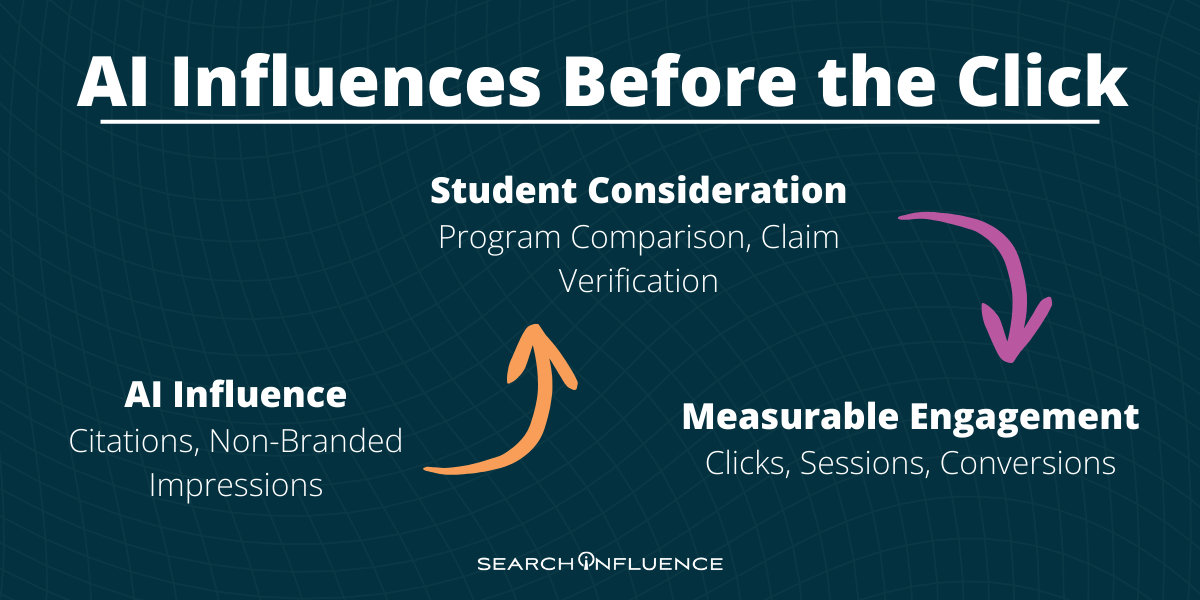
Across higher education, marketing teams are being asked to explain AI search visibility before institutions agree on how to measure it.
How to Talk About AI SEO ROI Without Overpromising
AI SEO ROI conversations succeed or fail based on language.
Overstating impact creates skepticism. Understating it creates inertia. The goal is disciplined, leadership-ready framing.
Avoid language such as:
- Guaranteed outcomes
- Immediate enrollment spikes
- AI replacing traditional SEO campaigns
These claims invite pushback and misrepresent how search actually works.
Instead, use language such as:
- Measurable visibility in AI-driven search environments
- Influence across the enrollment journey
- Compounding authority over time
- Long-term competitiveness and institutional resilience
Framing AI SEO this way aligns with how universities already evaluate strategic investments. It emphasizes visibility, stewardship, and sustainability rather than short-term gains.
The Role of a Strategic Partner in Proving AI SEO Value Internally
If AI SEO ROI feels difficult to defend in budget or board discussions, the gap may be in how it’s framed and reported.
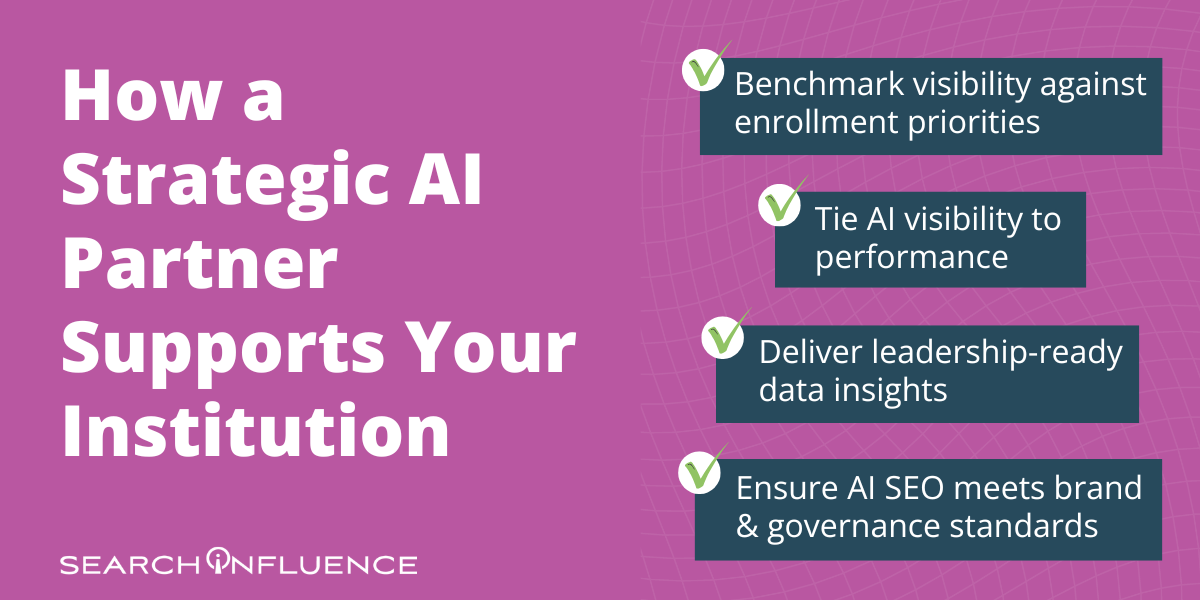
A strategic partner can support your institution by:
- Defining visibility benchmarks tied to enrollment priorities
- Building reporting frameworks that connect AI presence to performance trends
- Preparing leadership-ready data-driven insights for budget and board discussions
- Ensuring AI SEO initiatives reflect governance and brand standards
As an AI SEO agency, Search Influence works alongside institutional teams to embed AI visibility into broader enrollment strategy with consistency and accountability.
Frequently Asked Questions About AI SEO ROI in Higher Education
Can AI SEO directly increase enrollment?
AI SEO supports enrollment growth over time by strengthening visibility, credibility, and competitive digital presence early in the research process. It influences awareness and consideration before inquiry forms are submitted, helping institutions enter the comparison set sooner. Its impact builds cumulatively, contributing to sustained enrollment performance rather than immediate headcount spikes.
How long does it take to see results from AI search optimization?
The timeline for positive ROI from AI search optimization varies based on institutional authority, content strength, and competition. Early visibility signals, such as increased citation presence or broader topic coverage, can appear quickly. Broader performance impact develops gradually as authority compounds and AI-driven discovery continues to expand.
Is AI SEO replacing traditional SEO?
No. AI SEO efforts build on traditional SEO foundations. Technical health, content quality, internal linking, and authority signals remain essential for visibility in both search engines and AI-generated answers. AI optimization extends those fundamentals to ensure content is interpretable and citable in conversational search environments.
How do we protect academic and brand integrity?
Institutions can protect academic and brand integrity by embedding AI optimization within existing governance, editorial review, and content standards. All program messaging should follow institutional approval processes, faculty oversight, and compliance guidelines before optimization occurs. AI SEO then strengthens how approved content is structured and surfaced, ensuring information remains accurate, aligned, and consistent across AI-driven search environments.
What if leadership wants guaranteed outcomes?
Search performance, whether traditional or AI-driven, cannot be guaranteed. AI visibility influences awareness and evaluation in measurable but non-linear ways. Leadership conversations are strongest when grounded in benchmark tracking, citation trends, and performance correlations over time rather than promises of immediate certainty.
From Strategy to Action: Webinar and Strategy Labs for Higher Ed Marketers
Understanding AI SEO ROI is one challenge. Implementing it within tight budgets, competing priorities, and limited internal resources is another. When teams work in silos, institutions risk inconsistent messaging and missed visibility in AI answers.
To support higher ed marketers navigating this shift, UPCEA and Search Influence are hosting:
Make Your Existing Marketing Work Harder for AI Search Visibility – March 24, 12 PM ET | 11 AM CT
- Emily West, Senior Market Research Analyst, UPCEA
- Will Scott, CEO and Co-Founder, Search Influence
- Paula French, Director, Search Influence
This live webinar will focus on using your existing marketing efforts to increase AI relevance, strengthen trust, and protect program visibility.
For hands-on application, Search Influence is also hosting Strategy Labs (March 31 and April 1, 12 PM ET | 11 AM CT), led by Will Scott and Paula French. These collaborative, small group workshops provide actionable recommendations tailored to your institutional priorities.
Calculate AI SEO ROI With Confidence
AI search has changed how prospects discover, compare, and evaluate programs.
A strong AI SEO strategy defines what success looks like, aligns reporting with enrollment priorities, and embeds oversight into execution. It strengthens how your programs are represented in AI-generated answers while reinforcing brand and academic standards.
Search will continue to evolve. Institutions that align strategy now can build citation presence, authority, and competitive resilience over time.
Ready to make your AI SEO investment a smart one?
Book a conversation with the Search Influence team to discuss strategy, measurement, and next steps tailored to your institution.
Alison Zeringue is Director of Account Management at Search Influence, a leading digital marketing agency specializing in higher education. With 15 years of experience delivering white-glove client service, Alison develops and oversees marketing strategy for clients, including Tulane School of Professional Advancement, Maine College of Art & Design, LSU Online and Continuing Education, and The Program on Negotiation at Harvard Law School.
Today as I publish the several curated reading lists I maintain, it strikes me that we are approaching the integration of Artificial Intelligence (AI) into our universities in a piecemeal rather than a comprehensive fashion.
It seems that most universities began taking up the topic in a transactional way following the release of ChatGPT ‘s general release at the end of 2022. First, it was student use of AI, which triggered the still-lingering furor over “cheating on assignments.” Many of us came to realize early on that the “cheating” concern was less about learners’ academic integrity than it was about the pedagogy of teaching and assessment employed by the faculty. We came to understand that the advent of AI in higher education required that we accommodate the rapidly-changing realities of the present as well as the future in our methods and practices. We could not ignore the emerging technologies that are becoming the foundation of workplace tools and techniques in designing our classes. Our students recognized this before many faculty members did.
It is incumbent on all of us to fully integrate the current and emerging tools, techniques and practices that are relevant to the workplace our learners will enter as they leave the university whether it be with a baccalaureate degree or a certificate of completion in some aspect of professional and continuing education. AI is one of the essential tools. As I joined the faculty in the 1970s we did not expect learners to have personal computers for researching, composing and printing their assignments. Typewriters and ink pens were the tools of the day. The Readers Guide to Periodical Literature was a first stop in research. That, of course, was because the IBM PC which popularized the personal computer was not released until 1981; the World Wide Web was decades into the future. Now, half a century later, one would be hard pressed to find a student at a university who did not have a tablet, notebook or desktop computer with a wide array of programs to facilitate preparation of assignments. And with the proliferation of personal computing devices came access to the internet.
Once again, we faced a challenge of the development of technology in the surrounding world that impacted our methods and practices in teaching and learning. In 1993, the first web browser, NCSA Mosaic, was released by the National Center for Supercomputing Applications at the University of Illinois. It provided free and easy access for non-commercial, personal and educational access to the worldwide internet. Initially, the internet provided access to databases including images and real-time readings on a wide variety of topics such as weather, government economic and related data. Over time, the internet provided more and more interactive processes, offering transactional engagements.
While it took a couple of decades to integrate computers and the internet into the teaching and learning process, AI has been adopted at a much faster pace. Anara’s AI in higher education statistics: The complete 2025 report includes data from UK universities that 92% of UK students now use AI in some form, representing a dramatic surge from just 66% in 2024. The report also includes data that 86% of students globally use AI in their studies, including 54% who use it weekly and 25% who use it daily.
Students’ use of AI for classes is just one part of the overall integration of colleges and universities into the Age of AI. The inclusion of AI technologies into academic libraries; buildings and grounds; food services; health services; admissions and records; marketing; athletics; financial aid and accounting; purchasing; academic administration; and the whole host of units and services and comprise a university in 2026, is best accomplished if it is done in a comprehensive, coordinated fashion.
To date, we have been limited to a kind of “whack-a-mole” approach to introducing AI into higher education. As an opportunity or challenge appears, we begin creating a strategy and a shopping list of vendors to create an application that will solve that occurrence. Inevitably yet another new application will arise with the growing capability and capacity of AI. Too often that results in an uncoordinated approach in which differing levels and brands of AI are designated to fill the need.
The problem with this approach is that we end up with a multitude of vendors requiring multiple passwords and protocols that are inconsistently compatible with other applications, and afford only an uncoordinated upgrade process. To the extent that each college within the university and the many other non-academic units too often are not synchronized in policies, practices, methods and modes of upgrades and interoperability.
This is why we need a tight structure of committees with persons and positions represented on those committees that are charged with deciding AI policies, practices and vendors. This is not a technology that will be limited to instruction or laboratories or administration. We are entering a period of time in which AI will permeate all aspects of the university. Meanwhile, it will further infuse into commerce, business, personal lives and engagements worldwide.
There is no previous technology that is fully representative of the scope and level of the deep involvement we anticipate that AI will have in our lives in the coming few years. The internet perhaps comes the closest to doing so. It is deeply infused through smart phones and the smart device to device engagement called the “internet of things” that is pervasive today. However, AI subsumes the internet. Its capabilities are much larger in capabilities than the internet that existed in prior years.
Yet, even further immersion of AI will become prominent in the “recursive self-improvement” that we have begun to see in versions of AI algorithms today. That is, that AI will guide the development, improvement and enhancement of itself and its role in devices, practices and policies. We must recognize that we now will be seriously engaged in planning and preparing for the most powerful, lasting and “intelligent” technology that we have encountered as humans. Those who thrive with this technology will be those who are wisest in preparing and implementing the deep integration of this into our institutions. Is your university prepared for the world-changing, humanity-changing AI that we see emerge in 2026 and 2027? Are you prepared to take a leading role in guiding that change for the best interests of your colleagues, students and the entire university?
This column was originally published in Inside Higher Ed.