
Workforce Pell Moves from Rules to Reality: State Pipelines, New Federal Training, and $65 Million from Labor | Policy Matters (September 2026)
Major Updates
Workforce Pell Moves from Rules to Reality: State Approval Pipelines Mature, ED Launches Training, and Labor Awards $65 Million
Nearly three months after Workforce Pell Grants (Pell awards for programs of 150–599 clock hours, or 8 to fewer than 15 weeks) became available on July 1, the rollout is moving at very different speeds from state to state. UPCEA’s September blog post on state Workforce Pell readiness found over 30 jurisdictions with working approval pipelines, over a dozen still building them; the Opportunity Data implementation tracker now counts 36 operational jurisdictions. A governor must approve a program before an institution can submit it to ED, so state occupation lists effectively decide what can be built. Those lists range from 19 eligible occupations in Pennsylvania to 434 in Colorado. Federal approvals are still scarce: fewer than two dozen programs, all at community colleges in five states, had cleared ED review by late September.
Two federal developments add capacity for institutions to understand and build these programs. Earlier this month, ED’s Office of Federal Student Aid (FSA) released a free, self-paced Workforce Pell learning track. It covers program eligibility, the state and federal approval processes, keeping eligibility, and awarding aid. Companion modules cover adding workforce programs to the institutional eligibility application and flagging eligible students in the FAFSA Partner Portal. On September 23, the Department of Labor (DOL) awarded $65 million in Strengthening Community Colleges Training Grants to consortia in seven states (Colorado, Iowa, Mississippi, Missouri, Rhode Island, Tennessee, and Texas) to build short-term programs designed to qualify for Workforce Pell.
For administrators of online and professional continuing education units, especially at four-year institutions, the early pattern is telling: every approval so far and all of the new DOL money have gone to community colleges. Continuing education leaders should confirm where their state’s occupation list and application window stand. They should also have financial aid and program staff take the FSA track together, and check existing noncredit offerings against the 70 percent completion and job placement thresholds that apply through the 2028–29 award year. UPCEA’s guidance on preparing four-year institutions for Workforce Pell is a useful starting point, as are all of our Workforce Pell Resources.
Other News
- Under New Loan Limits, Students Struggle to Finance Final Year (Inside Higher Ed)
- OMB Grants Rule Delayed Until Mid-December (Inside Higher Ed)
- Higher Ed Groups Bash ED Proposal to Allow More Grant Terminations (Inside Higher Ed)
- Iran Sanctions – Note: Consider reviewing these changes for online international students, and join the conversation and find more information in this CORe discussion post. (U.S. Department of the Treasury, Office of Foreign Assets Control)
- Senate Panel Takes up Bill to Strengthen Student Aid Fraud Protections (ACE)
Authored by

Policy Matters: Primers and Insights
Helping you navigate policy frameworks critical to higher education in the United States.
Access our resources providing an introduction to foundational topics in federal legislation and regulations impacting online and professional continuing education for universities and colleges. Read more.
UPCEA is a proud founding and steering committee member of the Today's Students Coalition.
UPCEA 2026-2027 Policy Committee
Corina Caraccioli, Loyola University New Orleans, Co-Chair
Abram Hedtke, Co-Chair
Holly Anderson
Curtis Brant, Bowling Green State University
Amy Collier, Middlebury College
Johnna Denning-Smith, Marian University
Sean Doyle, Purdue Global
Luke Dowden, Alamo Colleges District
Michele Gribbins, University of Illinois Springfield
Ilona Marie Hajdu, Indiana University
Laura Hendley, Stevenson University
Gloria Niles, University of Hawaii System
Kelly Otter, Georgetown University
Michelle Singh, University of North Texas
Erika Swain, University of Colorado Boulder
Ryan Torma, University of Minnesota

Get Involved with UPCEA
Professional development isn't just about attending sessions. Get involved with UPCEA to meet members from other institutions, share the great work your institution is doing, and hone your own skills. From submitting a session proposal for a conference or an article for a publication to serving as a volunteer on a conference planning committee, there are as many ways to engage with us!
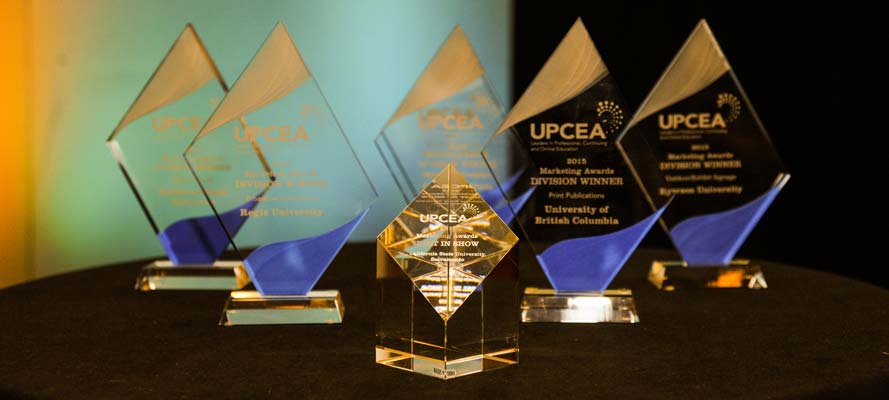
Awards of Excellence
Since 1953, UPCEA has recognized its members' outstanding contributions to the Association and the field, as well as their achievements in innovative programming, marketing and promotion, community development and services, research and publications, and many other areas.