
Workforce Pell Final Regulations Released: What Changed from the Proposed Rule | Policy Matters (May 2026)
Major Updates
Workforce Pell Final Regulations Released: What Changed from the Proposed Rule
The Department of Education has released the final rule on Workforce Pell Grants and the new Pell Grant exclusion for students whose non-Federal grant and scholarship aid meets or exceeds their cost of attendance. The Department reviewed approximately 440 comments but, in keeping with its stated intent to track the statute closely, kept the overwhelming majority of its proposed language unchanged. Substantive revisions were confined to a few provisions, some noted below which could be notable for the UPCEA community.
One of the most significant changes responds to widespread pushback on the 25 percent ceiling for instruction delivered through written arrangements with ineligible institutions or organizations. While the Department rejected calls to raise the cap broadly (to 50 percent or higher), they did allow a change that Registered Apprenticeships can have an ineligible entity provide more than 25 percent but less than 50 percent of an eligible workforce program when the program is a related instruction component of a Registered Apprenticeship. Two value-added earnings changes also stand out: a new change excludes students who were enrolled in another educational program during the relevant earnings year — addressing concerns that counting students who “stack” into further education would unfairly depress earnings figures. They also simplified and aligned with the STATS and Earnings Accountability NPRM, combining aggregation steps and dropping the minimum cohort size from 50 to 30 completers. The Department also revised the bar on counting remedial coursework applied to clock-hour as well as credit-hour programs, and concluded the statute did not allow the narrower credit-hour-only approach proposed originally.
For institutions and States, the broader takeaway is what did not change. The Department repeatedly invoked statutory constraints to decline requests to expand program-length limits, bar bachelor’s-degree holders or admit graduate-degree holders, replace bilateral agreements between states with multilateral or SARA-style frameworks, soften the 70 percent completion and job-placement thresholds for high-barrier populations, exclude WIOA or employer-provided assistance from the cost of attendance exclusion, or adopt an interim value-added earnings metric. It likewise rejected proposed new guardrails (categorical bars on “risky” institutions, private-loan/ISA prohibitions, and prescribed OIG audit frameworks), generally finding it lacked authority or that existing program-integrity rules already applied.
Stakeholders should expect any additional flexibility to come from forthcoming sub-regulatory guidance, and the discretion the rule extends to Governors, especially those provided during the first several award years. Read the final rule here.
Federal Accreditation Overhaul Clears Negotiated Rulemaking — What You Should Be Watching
On May 21, 2026, the Department of Education’s Accreditation, Innovation, and Modernization negotiated rulemaking committee reached final consensus on a slate of regulatory changes that will substantially rewrite the rules accreditors must follow. The near-unanimous vote (12 of 14 primary negotiators, with student and veteran representatives abstaining) obligates ED to publish a proposed rule that largely tracks the negotiated language. ED is targeting publication and finalization by November, with an effective date of July 1, 2027, though widespread legal challenges are expected. The package implements key pieces of the 2025 executive order on accreditation, easing the path for new accreditors to gain recognition by eliminating the current two-year waiting period and allowing upstart agencies to seek recognition after accrediting just one institution or program, while also forcing programmatic accreditors to sever formal organizational ties and stop sharing personnel, equipment, or infrastructure with affiliated trade associations, a shift that could directly affect accreditors that many professional and continuing education programs rely on.
For administrators of online and professional continuing education units, several specific provisions warrant attention. Standards of student achievement will have to be examined at the program level, with a new required focus on post-completion earnings alongside graduation, licensure, and employment outcomes; a meaningful change for short-term, non-degree, and stackable credentials where earnings data is often thin. Transfer credit is also highlighted, with institutions required to award transfer credit for comparable undergraduate coursework completed at recognized institutions unless they provide a written basis for denial, give students a 15-day window to appeal denials, and publish clear upfront disclosures about how credits are evaluated. Accreditors will also gain new oversight responsibilities around intellectual diversity and viewpoint assessments, including mechanisms to measure student and faculty perceptions (with an exemption for institutions with explicit religious missions), research misconduct procedures covering plagiarism and citation manipulation, verification of consistent enforcement of First Amendment and civil rights policies, and monitoring of institutional expenditures for cost efficiency. Institutional leaders should begin auditing program-level outcomes data, transfer articulation documentation, and faculty evaluation practices now.
Stay tuned for the upcoming proposed rule when it drops this summer or fall, as the public comment window will be the last meaningful opportunity to shape language before the July 2027 effective date. Read more.
Other News
- States sue over new student loan limits on certain nursing and healthcare degrees (NPR)
- The looming education funding gap Congress will face (Politico)
- Sen. Elizabeth Warren Calls for GAO Investigation of Education Department Dismantling (The EDU Ledger)
- Senate Introduces Companion Bill to Combat Student Aid Fraud (NASFAA)
Authored by

Policy Matters: Primers and Insights
Helping you navigate policy frameworks critical to higher education in the United States.
Access our resources providing an introduction to foundational topics in federal legislation and regulations impacting online and professional continuing education for universities and colleges. Read more.
UPCEA is a proud founding and steering committee member of the Today's Students Coalition.
UPCEA 2026-2027 Policy Committee
Corina Caraccioli, Loyola University New Orleans, Co-Chair
Abram Hedtke, Co-Chair
Holly Anderson
Curtis Brant, Bowling Green State University
Amy Collier, Middlebury College
Johnna Denning-Smith, Marian University
Sean Doyle, Purdue Global
Luke Dowden, Alamo Colleges District
Michele Gribbins, University of Illinois Springfield
Ilona Marie Hajdu, Indiana University
Laura Hendley, Stevenson University
Gloria Niles, University of Hawaii System
Kelly Otter, Georgetown University
Michelle Singh, University of North Texas
Erika Swain, University of Colorado Boulder
Ryan Torma, University of Minnesota

Get Involved with UPCEA
Professional development isn't just about attending sessions. Get involved with UPCEA to meet members from other institutions, share the great work your institution is doing, and hone your own skills. From submitting a session proposal for a conference or an article for a publication to serving as a volunteer on a conference planning committee, there are as many ways to engage with us!
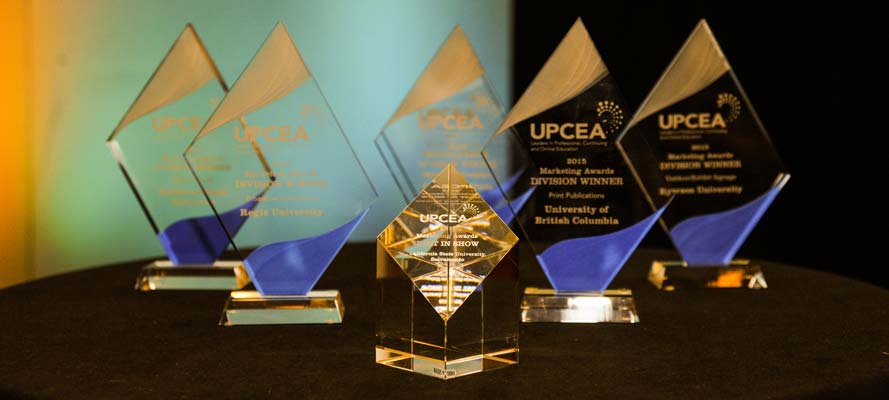
Awards of Excellence
Since 1953, UPCEA has recognized its members' outstanding contributions to the Association and the field, as well as their achievements in innovative programming, marketing and promotion, community development and services, research and publications, and many other areas.