
Public Comment Period Opens on Workforce Pell Implementation Rules (Due April 8) | Policy Matters (March 2026)
Major Updates
Public Comment Period Opens on Workforce Pell Implementation Rules (Due April 8)
The U.S. Department of Education has officially opened the public comment period on proposed regulations to implement Workforce Pell Grants, with comments due April 8, 2026. These grants offer a new federal financial aid pathway that will allow students to use Pell Grants for high-quality, short-term workforce training programs. The proposed rule outlines details within eligibility for these workforce programs, accountability measures such as completion and job-placement benchmarks, and state approval processes designed to ensure programs align with statutory requirements. Higher education leaders, workforce partners, and stakeholders now have an opportunity to provide feedback before the regulations are finalized. For institutions that offer short-term workforce, professional, continuing, and online programs, the proposal is worth close attention because it would shape how eligible workforce programs are approved, overseen, and measured for value under the new federal aid framework.
The Department offered some directed questions focused on seven specific parts of the regulation for input, including: whether ineligible partners should be limited to providing 25 percent of a workforce program under written arrangements; how to prevent institutions from sidestepping the new Pell restriction when nonfederal grants or scholarships cover a student’s full cost of attendance; whether the Department should use an interim value-added earnings measure before official earnings calculations begin in 2030–31; whether additional groups of students should be excluded from the completer cohort used for earnings calculations; how many years of cohorts should be combined for smaller programs. The two final areas have particular relevance to the online education community: how interstate distance education could best work within bilateral agreements between governors; and how earnings should be handled when large shares of students are located out of state.
Responses from the UPCEA community are encouraged. Keep your comments focused on items within the regulatory framework which are able to be tweaked. Avoid those that are constrained by the language within public law, which the Department is not able to affect change on. View the proposed rule and submit comments ahead of the April 8 deadline.
The Trump Administration and DEI: When One Door Closes with the DCL and its Certification Requirement, Another Door Opens with the GSA’s New Certification Requirement (Thompson Coburn LLP)
“Higher Ed’s battle with the Trump Administration over DEI can feel a bit like whack-a-mole, with the DCL defeat closely followed by the emerging GSA proposed revisions and then the Fourth Circuit’s ruling upholding the DEI Executive Orders. What makes the GSA’s new proposed certification requirement particularly potent for the Government’s anti-illegal DEI campaign is that it controls the federal purse. This may result in a chilling effect—some institutions may stop programs, even if they have been upheld by courts or authorized by Congress—for fear of losing them. For now, the GSA proposed revisions are only that—proposed. They are not final until the notice and comment period ends, and even then only after the final policy is adopted—which may be different from the proposal. Thus, there is not an immediate date on which GSA has stated financial assistance recipients may expect to see the GSA certification in SAM. […]
Although much has happened with the Trump Administration’s war on illegal DEI in the last few months, the bottom line has not changed: the Administration’s anti-illegal DEI efforts will continue, perhaps until the Supreme Court weighs in on the Administration’s broad interpretation of the Students for Fair Admissions, Inc. v. President & Fellows of Harvard College decision. At the end of the day, even if the DEI Executive Orders are declared unlawful and the GSA proposed rule is struck down after becoming final, what matters most is whether the Government’s view of the Students for Fair Admissions, Inc. v. President & Fellows of Harvard College decision is the correct one, and how soon the Supreme Court might make that determination.” Read more.
Other News
- Education Department Will Send More of Its Programs to Other Agencies (EdWeek)
- Education Dept. Layoffs Leave Scars Behind the Scenes (Inside Higher Ed)
- Press Release: U.S. Department of Education Receives Recommendations to Reform the Institute of Education Sciences (U.S. Department of Education)
- UPCEA Joins with ACE and Other Organizations on RISE Public Comment
Policy Matters: Primers and Insights
Helping you navigate policy frameworks critical to higher education in the United States.
Access our resources providing an introduction to foundational topics in federal legislation and regulations impacting online and professional continuing education for universities and colleges. Read more.
UPCEA is a proud founding and steering committee member of the Today's Students Coalition.
UPCEA 2025-2026 Policy Committee
Corina Caraccioli, Loyola University New Orleans, Co-Chair
Abram Hedtke, St. Cloud State University, Co-Chair
Bridget Beville, University of Phoenix
Curtis Brant, Bowling Green State University
Kristen Brown, University of Louisville
Amy Collier, Middlebury College
Ilona Marie Hajdu, Indiana University
Laura Hendley, Stevenson University
Gloria Niles, University of Hawaii System
Kelly Otter, Georgetown University
Erika Swain, University of Colorado Boulder
Craig Wilson, University of South Carolina

Get Involved with UPCEA
Professional development isn't just about attending sessions. Get involved with UPCEA to meet members from other institutions, share the great work your institution is doing, and hone your own skills. From submitting a session proposal for a conference or an article for a publication to serving as a volunteer on a conference planning committee, there are as many ways to engage with us!
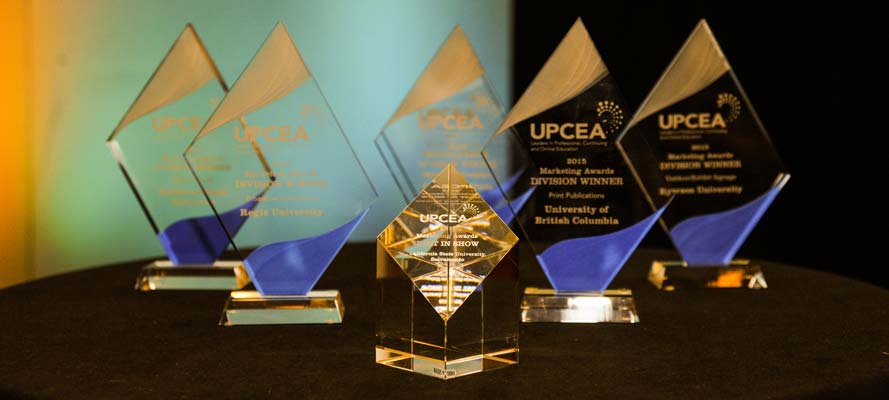
Awards of Excellence
Since 1953, UPCEA has recognized its members' outstanding contributions to the Association and the field, as well as their achievements in innovative programming, marketing and promotion, community development and services, research and publications, and many other areas.