
Leading Institutional Transformation in the Age of AI

By Vickie S. Cook, Ph.D.
Artificial intelligence is rapidly reshaping work across society, and higher education institutions are no exception. Traditionally, discussions around AI in the academy have focused on student-facing issues such as academic integrity and personalized learning. Today’s higher education leaders are called to lead institutional transformation shaped by AI. A new research study from EDUCAUSE conducted in partnership with AIR, NACUBO, and CUPA-HR demonstrates that AI is reshaping work across every facet of the institution, from administrative tasks and faculty workflows to policy development and workforce skills.
A Broad Impact on Work
The EDUCAUSE report The Impact of AI on Work in Higher Education surveys nearly 2,000 higher education professionals to understand how AI tools are changing work practices and institutional strategies. Survey results paint a picture of widespread AI use: 94% of respondents report using AI tools for work-related tasks within the past six months, yet only 54% are aware of formal institutional policies or guidelines to direct that use.
The report further indicates that while most institutions have reported articulating a work-related AI strategy (92%), explicit measurement of outcomes such as return on investment remains nascent (only 13% report evaluating ROI).
These findings reinforce something many enrollment and academic leaders already observe in practice: faculty and staff are incorporating AI into their workflows, often informally and without institutional guardrails.
Balancing Opportunity with Risk
The EDUCAUSE study highlights a dual reality:
- Opportunities: A large majority of respondents report compelling benefits from AI, including automation of repetitive processes, reducing administrative burden, and enabling deeper data analysis for decision-making.
- Risks: At the same time, many respondents identify urgent risks associated with AI use, including misinformation, loss of fundamental skills requiring independent thought, and use of data without consent.
These insights underscore that AI adoption without clear governance, workforce development, and ethical guardrails carries significant risk, even as institutions pursue innovation.
Strategic Implications for Institutional Leadership
From an institutional leadership and management perspective, the EDUCAUSE report yields several strategic implications:
- Governance Must Catch Up With Practice. AI is being used widely, yet institutional policies and guidelines are unevenly communicated and understood. Leaders must elevate work-related AI governance beyond pilot stages to systematic, institution-wide structures.
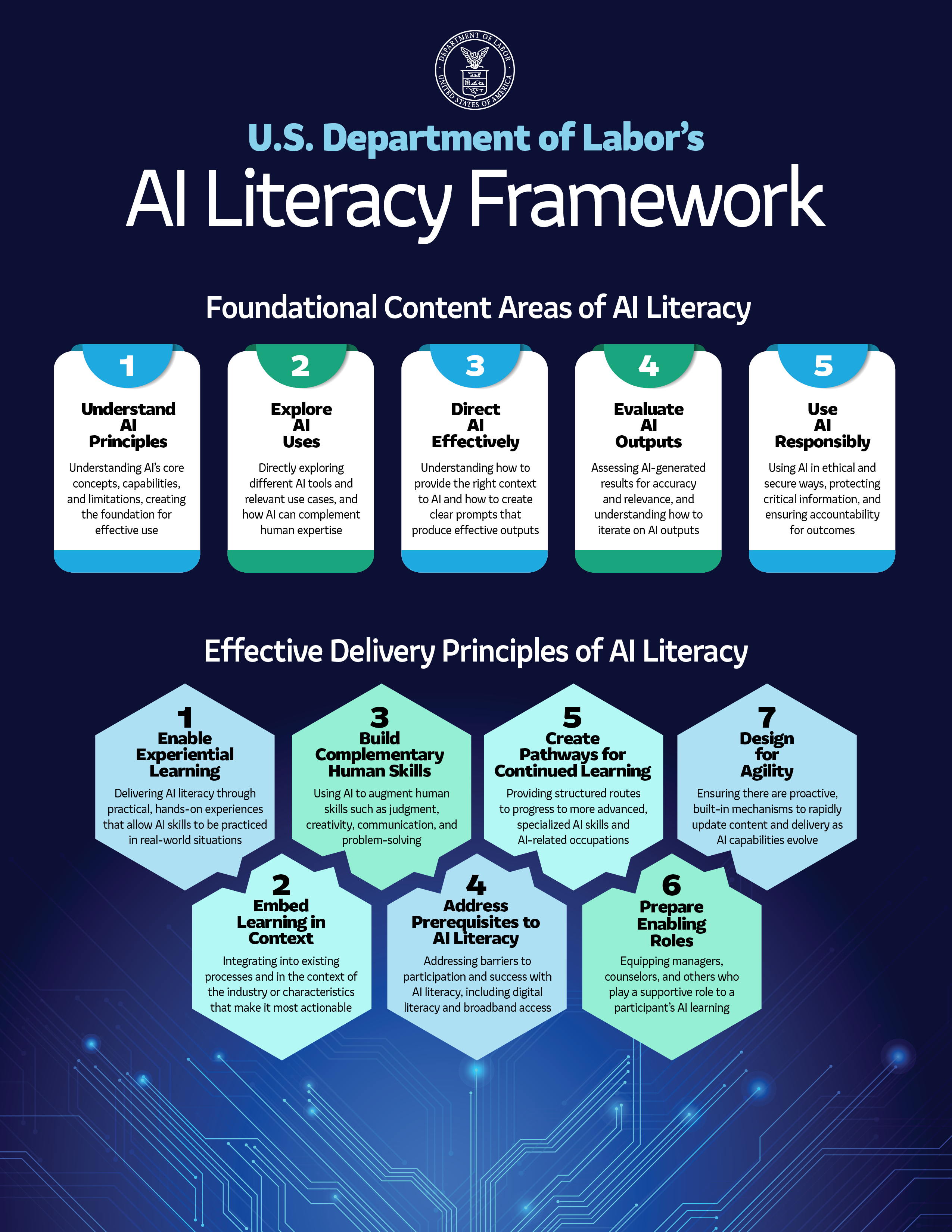
- Workforce Development Requires Strategic Investment. The most common strategy for building AI skills remains ad-hoc or self-directed learning. Structured professional development programs are needed not only to build capacity but to ensure equitable access to AI literacy across roles and units. The newly released AI Literacy Framework from the U.S. Department of Labor provides a national benchmark for workforce-aligned AI competencies. This framework will assist with considerations of AI Literacy across the higher education workforce. Higher education institutions should evaluate their professional development strategies against this emerging framework to ensure alignment with workforce expectations.
- Strategic Measurement Enables Accountability. Without clear metrics such as ROI or productivity outcomes, institutions risk conflating experimentation with strategy. Leaders should embed AI adoption metrics into broader performance frameworks to assess both costs and benefits.
- Risk Management Is Central. The breadth of perceived risks, from ethical concerns to skill erosion, positions AI governance as a central enterprise-wide risk issue. Cross-functional risk committees that include academic affairs, IT, HR, enrollment management, and compliance should engage in discussions and action items to ensure risk management is managed.
Call to Action: Institutional Next Steps
To build organizational readiness and strategic coherence, institutional leaders should consider taking the following next steps:
- Establish or Strengthen AI Governance Structures
Establish a cross-functional AI advisory council with representation from academic affairs, human resources, information technology, enrollment management, student success, institutional research, and compliance. Charge the council with updating or creating work-related AI policies and ensuring alignment with mission and values. - Develop an AI Workforce Development Plan
Integrate AI literacy and capability development into existing professional learning systems, leadership development programs, performance expectations. Include competency frameworks, credentials, and incentives that align with both role expectations and institutional priorities. - Implement a Structured AI Performance and Impact Evaluation Framework
Design measurable outcomes for AI implementation across administrative and academic domains. Include evaluations of efficiency gains, quality improvements, ethical compliance, and workforce confidence. - Promote Transparent Communication and Training
Ensure that staff and faculty understand not just how to use AI tools, but where policies apply, what risks exist, and how the institution is thinking about both innovation and responsibility.
AI is transforming work in higher education in ways that can no longer be treated as peripherals or experimental. The EDUCAUSE study makes clear that adoption is accelerating across roles and units. Without internal strategy, governance, and investment, institutional risks may outpace realized benefits. Institutional leaders have the opportunity to shape AI adoption intentionally, aligning it with organizational values, workforce development goals, and student success imperatives. The question is no longer whether AI will influence higher education work, but whether institutional leaders will shape that influence with clarity and purpose.
Sources:
EDUCAUSE – The Impact of AI on Work in Higher Education (2026)
Report: https://www.educause.edu/research/2026/the-impact-of-ai-on-work-in-higher-education
Department of Labor – AI Literacy Framework (2026). https://www.dol.gov/sites/dolgov/files/OPA/newsreleases/2026/02/ETA-20260212-hi.jpg
Vickie Cook is the Vice Chancellor for Enrollment and Retention Management and a Research Professor of Education at the University of Illinois Springfield, as well as a Strategic Advisor for UPCEA Research and Consulting. To learn more about UPCEA Research and Consulting, please contact [email protected].
Learn more about UPCEA's expert consultants.
Do you need help with your PCO unit or campus? We can help. Contact UPCEA Research and Consulting for a brief consult. Email [email protected] or call us at 202-659-3130.
Trusted by the nation's top colleges and universities, UPCEA Research and Consulting provides the best value in the industry today. UPCEA's industry experts have years of experience in Online and Professional Continuing education - put them to work for you!
UPCEA Research and Consulting offers a variety of custom research and consulting options through an outcomes-focused pricing model. Find the option(s) that best suit your institution.
Learn more about UPCEA Research & Consulting
The UPCEA Difference
Unmatched Experience: For more than 100 years, UPCEA consultants have exclusively served the needs of online and professional continuing education programs. UPCEA consultants leverage their extensive industry expertise to expedite solutions, anticipate upcoming shifts, and offer distinct best practices, effectively aiding clients in achieving their goals.
Cost Effectiveness: As a nonprofit, member-serving organization, we provide unmatched value, allowing you to maximize limited research and consulting budgets.
Action in Motion: Our cadre of experienced, skilled authorities and expert practitioners propels you forward, translating research and consulting into impactful implementation, a distinctive hallmark of UPCEA. Our team of current and former institutional leaders will support you, turning research and consulting into action.
Mission Alignment: Like you, our mission is to enhance and expand educational opportunities and outcomes for adult and other non-traditional learners. We share your values and work in partnership with you to advance access and excellence in education.