
An Early Outlook of a Millennial-led Economy in 2030
Rather than rely on what Hollywood’s vision for the what the future could be, UPCEA interviewed 21 innovation leaders in U.S. cities and 14 Millennial leaders, many of whom are CEOs, business owners and community leaders. Hollywood portrays many scenarios, ranging from a technology-driven culture in Minority Report to the pandemonium of Mad Max to the class societies of The Hunger Games. Millennial and innovation leaders suggest otherwise, at least in the short-run of 2030. Many believe that our society will change dramatically through the adoption of many technologies and the evolution of Generation Z and Millennials in the workforce, the core of which will be Millennials taking the leadership reigns as we ride into the next decade.
Innovation and Millennial leaders have told us that automation, artificial intelligence (AI), self-driving cars, improved transportation and advancements in energy and healthcare are certainties in a new economy. These advancements will offer new educational opportunities for institutions of higher education, private providers of training or the employer itself. Higher education has choices to make regarding what they want to do … maintain the bread and butter of the degree in the new economy knowing that it potentially could be a smaller piece of the educational pie or by deepening its reach and portfolio through other credentials, such as certificates or badges.
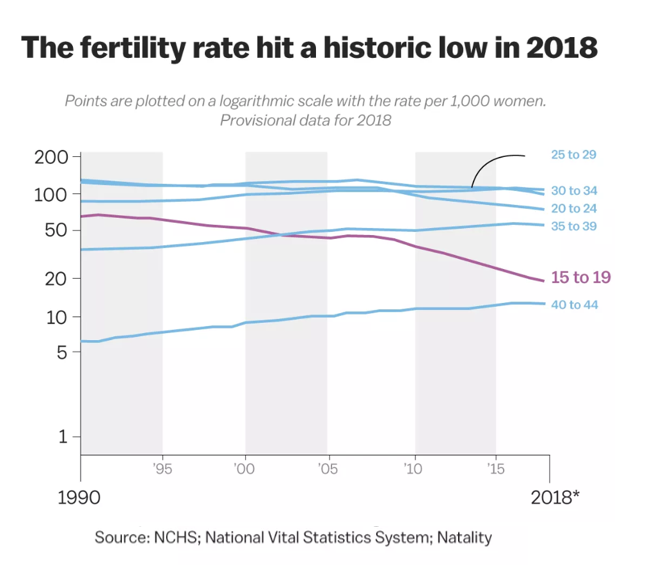 In 2030, there will be fewer college-age students, as older Millennials delayed having children, waiting into their 30s and 40s. This coupled with many college-aged young adults sitting on the sidelines contemplating college, high tuition and college loan debt; will create new economic pressures for institutions of higher education and potentially drive more colleges and universities to produce new educational products and services.
Looking at the workforce in 2030 shows that it is likely to be roughly two-thirds Millennial (70 million+) or Generation Z (40 million). In 2030, Millennials will be 35 to 49 years old. They will be entrenched managers. Generation X will be senior leaders and will be 50 to 65 years of age and will represent about 45 million workers in the U.S. About 15 million Boomers will still be actively employed, but will lose influence in the new economy decision-making.
A Millennial-led economy will most likely be balanced by the level-headedness of Generation X, but tap into the information smarts of Generation Z. Generation Z will be advocates for greater adoption of newer technologies and align in support of Millennial principles. However, the Millennial will be the heart of the new economy, burnishing both the numbers and economic power to quickly challenge the legacies of Boomer processes and infrastructures. Millennials, while the pure digital natives of Generation Z, will have the level of technical abilities needed to guide others through significant economic and societal upheaval. They also have a global perspective with a greater appreciation for diversity, making them the perfect boundary spanners in a multi-generational workforce. 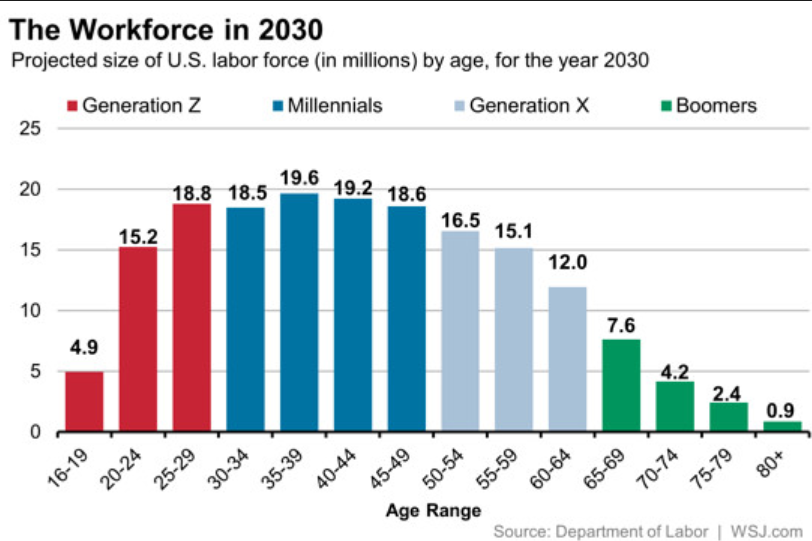
Change is inevitable. Unless the Mad Max scenario plays out, there will be many industries experiencing major change over the next decade. However, with change comes great opportunity for higher education. Higher education will need to:
- Evaluate existing degrees for relevancy in the future economy. Progressive institutions will revise and improve their degrees for greater alignment.
- Develop new degrees for the new economy. These new degrees will need to have shelf-life, but also need faster approval processes. Should the higher education institution deem that the existing process for approval stay the same with great scrutiny, they run the risk of being outflanked by more nimble colleges or universities or opportunistic private providers.
On the Role of Higher Education:
“It needs to speed up, we’re all impatient. There’s a lot of fluff that people are required to pay for and that puts people in debt. I think the high schools need to do a better job preparing students for careers to know what they want to study rather than college becoming a very expensive career exploration process. When I look at what gets in the way of speeding up the delivery of credentials through higher education, it’s usually accreditation. Accreditation has kind of kept them in that flow of, “You need to take all of these classes and this is precisely what the classes need to look like”. Colleges and universities who have the will to offer micro-credentials.” – Millennial Workforce Leader, Utah
- Develop new program credentials for industries and employers not fitting the degree-based model. There will be many educational needs that will not require the rigor and credential of a full degree. Certificates and badges could provide the upskilling and reskilling needs of employers in rapidly changing industries. In addition to programming developed to address the new products and services of a future economy, new programs could also be developed as a result of workforce changes, such as how the new workforce will function. New issues will develop from a workforce that is more diverse, global, generational and technically different and dispersed geographically.
-
- New leadership programs will need to be developed to address the unique and special qualities of emerging Generation Z employees.
- Proactive management and varied communications programs will be developed to address a more diverse workforce, such as a hypothetical scenario of a 23 year-old female graphic designer working in Burlington, Vermont on a videoconference call with a 72 year-old male engineer located in Abilene, Texas, both of whom are being managed by a 45 year-old transgender product manager working overseas.
- Programs designed to better manage a dispersed and time-flexing workforce may also arise, as Millennials and Generation Z may flex their work schedules to more personally-productive hours, while acknowledging the need to overlap their schedules with traditional 9-to-5’ers.
- New leadership programs will need to be developed to address the unique and special qualities of emerging Generation Z employees.
On the Changing Workforce:
“Because things are getting so digital, we have to communicate with people and people barely even use the phone anymore at this point. It’s texting, it’s email, so I think that communication is a big thing and being able to keep those alive because there are going to have to be face to face interactions, there’s going to be interactions via Skype or whatever kind of video medium and on the phone. So, communication needs to be big, especially if you’re not sitting next to these people anymore. You can’t just get up and go to someone’s office and ask them a question.” – Millennial Talent Retention Executive, Connecticut
- Revise existing programs to better meet the needs of employers. In earlier blogs, I identified that many employers want graduates that are better communicators and critical thinkers. Re-aligning the liberal arts degree and adding other credentials and badges to it could improve its value in the new economy.
A Millennial-led economy and society in the U.S. may even have a Millennial president that stands for similar values and principles of their generation. They may offer radical new ideas to the workplace, such as the execution of goals or the reaching of performance metrics, over the old currency of work … a forty-hour work week. The forty-hour work week may be challenged, along with the currency of higher education … the 120-credit degree. The role of higher education in this Millennial-led economy is TBD (to-be-determined), in that institutions can react, lead or share the stage with employers.
Authored by
Learn more about UPCEA's expert consultants.
Do you need help with your PCO unit or campus? We can help. Contact UPCEA Research and Consulting for a brief consult. Email [email protected] or call us at 202-659-3130.
Trusted by the nation's top colleges and universities, UPCEA Research and Consulting provides the best value in the industry today. UPCEA's industry experts have years of experience in Online and Professional Continuing education - put them to work for you!
UPCEA Research and Consulting offers a variety of custom research and consulting options through an outcomes-focused pricing model. Find the option(s) that best suit your institution.
Learn more about UPCEA Research & Consulting
The UPCEA Difference
Unmatched Experience: For more than 100 years, UPCEA consultants have exclusively served the needs of online and professional continuing education programs. UPCEA consultants leverage their extensive industry expertise to expedite solutions, anticipate upcoming shifts, and offer distinct best practices, effectively aiding clients in achieving their goals.
Cost Effectiveness: As a nonprofit, member-serving organization, we provide unmatched value, allowing you to maximize limited research and consulting budgets.
Action in Motion: Our cadre of experienced, skilled authorities and expert practitioners propels you forward, translating research and consulting into impactful implementation, a distinctive hallmark of UPCEA. Our team of current and former institutional leaders will support you, turning research and consulting into action.
Mission Alignment: Like you, our mission is to enhance and expand educational opportunities and outcomes for adult and other non-traditional learners. We share your values and work in partnership with you to advance access and excellence in education.