
By Vickie S. Cook, Ph.D.
The recently released UPCEA Hallmarks of Excellence in Digital Learning Enterprises reflect the continued evolution of digital learning from an emerging modality to a mission-critical component of institutional strategy. This series explores each Hallmark, why it matters for today’s institutions, and how institutional leaders can begin using the accompanying benchmarks to assess progress and guide continuous improvement.
Nearly a decade has passed since UPCEA first published the Hallmarks of Excellence in Online Leadership. During that time, higher education has experienced profound changes in learner expectations, technology, workforce demands, institutional finances, and the role digital learning plays in fulfilling institutional missions. The updated Hallmarks of Excellence in Digital Learning Enterprises reflect that evolution.
The most significant change is not technological. It is organizational. Digital learning is no longer viewed as a specialized initiative or a separate organizational unit. Instead, the Hallmarks position digital learning as an enterprise-wide capability that influences institutional strategy, academic planning, learner success, technology governance, enrollment management, and long-term sustainability.
Hallmark 1: Internal Advocacy and Leadership Within the Institution establishes the foundation for the remaining Hallmarks because meaningful transformation begins with institutional alignment.
From Advocacy to Institutional Integration
The 2016 Hallmarks emphasized the importance of advocating for online learning. At that time, many institutions were still working to establish credibility for online education and to demonstrate that quality learning could occur outside the traditional classroom.
While early digital learning leaders focused on demonstrating the value of online education, today’s leaders face a different responsibility. Today it is critical that integrating digital learning into the institution’s mission, planning, culture, and long-term strategy. The updated Hallmarks describe this evolution as a shift “from advocacy to integration and cultural alignment.”
This integration focuses institutions on digital learning at the enterprise level whenever discussions center around strategic enrollment, academic portfolio development, learner support, workforce partnerships, financial sustainability, technology investments, or institutional resilience. Rather than operating alongside these conversations, digital learning becomes a significant component that moves the institution forward.
Why This Matters
Learners expect flexibility, accessibility, and high-quality experiences regardless of instructional modality. At the same time, institutions face demographic shifts, increased competition, financial pressures, and rapidly changing workforce needs. The Hallmarks recognize that responding effectively requires more than expanding online offerings; it requires aligning institutional structures, policies, and leadership around a shared vision for highly effective digital learning environments.
Hallmark 1 emphasizes that internal advocacy is not simply about communicating the value of digital learning. It is about creating durable partnerships across academic affairs, student affairs, enrollment management, information technology, finance, institutional research, and other areas across the institution so that digital learning becomes an integrated institutional strategy rather than a separate initiative.
Putting Hallmark 1 into Practice
Hallmark 1 identifies several characteristics that distinguish institutions where digital learning has become part of the institutional enterprise. Among them are:
- Embedding digital learning into the institution’s mission and learner success strategy.
- Developing shared definitions and consistent data standards across the institution.
- Building cross-functional coalitions that support institutional priorities.
- Establishing clear leadership accountability for digital learning strategy and performance.
- Communicating a consistent value proposition for digital learning to both internal and external audiences.
For many institutions, these represent opportunities for reflection as much as implementation.
For example:
- Is digital learning explicitly referenced in the institution’s strategic plan?
- Do institutional leaders share a common understanding of what constitutes an online learner, an online program, or multimodal learning?
- Are discussions about enrollment, technology, learner success, and academic planning connected through a shared digital learning strategy?
These questions shift the conversation away from organizational charts and toward institutional integration.
Measuring Progress
One of the strengths of the updated Hallmarks is that they move beyond describing effective practice by identifying measurable indicators of institutional progress.
Rather than viewing the Key Performance Indicators as a compliance checklist, institutional leaders can use them as benchmarks to assess organizational maturity and identify opportunities for continuous improvement.
Hallmark 1 encourages institutions to examine evidence such as:
- Inclusion of digital learning goals within institutional strategic plans and accreditation activities.
- Existence of a strategic enrollment management plan that addresses digital learning.
- Common institutional definitions related to digital learning.
- Evidence-based improvements in learner success, completion, faculty satisfaction, and employer outcomes.
- Ongoing compliance with accreditation requirements and state and federal regulations.
Viewed together, these indicators help institutions move beyond asking whether digital learning exists to asking how effectively it has become embedded within the institution’s mission and operations.
Leadership Reflection
If your institution evaluated itself using only Hallmark 1’s Key Performance Indicators, what evidence would demonstrate that digital learning has become part of your institutional strategy rather than a separate initiative?
The answer to that question may identify your institution’s next leadership conversation.
The Hallmarks describe what excellent digital learning enterprises look like. Leadership determines whether institutions become excellent digital learning environments.
Continue the Conversation …
To explore Hallmark 1 in greater depth:
- Download the UPCEA Hallmarks of Excellence in Digital Learning Enterprises.
- Review the Key Performance Indicators for Hallmark 1: Internal Advocacy and Leadership Within the Institution.
- Register for the upcoming Hallmarks webinar series:
- August 12 at 1:00 PM Eastern: Internal Advocacy & Entrepreneurial Initiatives
- August 26 at 1:00 PM Eastern: Instructional Support & Learner Support
- September 9 at 1:00 PM Eastern: External Advocacy & Professionalism
- September 22 at 1:00 PM Eastern: Technology & Digital Innovation
Vickie Cook is a nationally recognized higher education leader specializing in enrollment strategy, online and digital learning, organizational transformation, team development, and leadership growth. She currently serves as a Senior Fellow and Strategic Advisor for UPCEA, and is a Contributing Editor for the Hallmarks of Excellence in Digital Learning Enterprises.
Framework defines the future of institutional digital strategy
WASHINGTON, D.C., ISSUED JULY 29, 2026…UPCEA, the online and professional education association, today announced the release of The Hallmarks of Excellence in Digital Learning Enterprises, a landmark framework positioning higher education at a pivotal moment of transformation.
As digital learning has become central to institutional strategy and long-term viability, The Hallmarks of Excellence in Digital Learning Enterprises address the leadership, governance, operational, financial, regulatory, and technological conditions required to sustain digital learning as a fully integrated institutional enterprise.
The Hallmarks of Excellence in Digital Learning Enterprises were developed through a structured, iterative, and highly collaborative editorial process spanning approximately six months involving more than 80 Chief Online Learning Officers and reviewed by leaders from across higher education. Endorsers include 1EdTech, AACRAO (the American Association of College Registrars and Admissions Officers), AAC&U (the American Association of Colleges and Universities), ACE (American Council on Education), EDUCAUSE, NACADA: The Global Community for Academic Advising, NACE (National Association of Colleges and Employers), NASPA: Student Affairs Administrators in Higher Education, and Quality Matters (QM).
The document calls for a decisive shift from treating online education as a siloed initiative to recognizing digital learning as essential academic infrastructure – an evolution that reflects sustained demand for flexible, accessible education, driven by working professionals, adult learners, and increasingly, residential students who expect digitally integrated experiences. It further posits that the traditional distinction between “online” and “on campus” education is becoming obsolete, replaced by a cohesive, multi-modal ecosystem that supports diverse learner journeys.
The framework makes clear that simply adapting residential models for online delivery is no longer sufficient. Effective digital learning requires rethinking program design, delivery models, and learner support systems in alignment with workforce needs and market realities. While most institutions possess strong technical infrastructure, success depends on reconfiguring policies, governance, resource models, and workflows to support digitally enable learning environments.
At its core The Hallmarks of Excellence in Digital Learning Enterprises maintains that digital learning must be embedded in academic planning, enrollment strategy, workforce engagement, and institutional governance – not simply layered atop legacy systems.
As artificial intelligence and emerging technologies continue to reshape institutional operations, the framework urges leaders to evaluate how innovation will influence staffing models, service delivery, and operational design while preserving educational quality, institutional values, and learner success.
Central to The Hallmarks of Excellence in Digital Learning Enterprises is the call form empowered and dedicated leadership to drive this transformation. The framework highlights the importance of a Chief Online Learning Officer (COLO) or equivalent role with authority over strategy, quality, compliance, and cross functional coordination. According to the document, this leadership model reflects a shift from distributed experimentation to unified execution, ensuring coherence across academic affairs, enrollment management, technology, and finance.
Internal advocacy is identified as a core leadership responsibility; the document emphasizes that digital learning leaders must position online education as an essential expression of institutional mission, rather than a supplemental or competing option. To effect this integration will require building coalitions across academic and administrative units, embedding digital learning in strategic planning and accreditation, establishing shared definitions and performance metrics, and aligning incentives and accountability structures to support collaboration and learner success.
The Hallmarks of Excellence in Digital Learning Enterprises underscores the importance of disciplined portfolio management informed by market demand, competitive positioning, and workforce needs. It stresses that institutions must move beyond opportunistic program launches toward intentional strategies that evaluate viability, scalability, and differentiation. The framework emphasizes that as learners increasingly move among educational providers, employers, and workforce platforms, institutions must ensure that credentials and evidence of learning are discoverable, portable, and trusted – thereby reflecting a broader shift toward lifelong learning ecosystems that extend beyond traditional degree pathways.
“The Hallmarks of Excellence in Digital Learning Enterprises make clear that digital learning is no longer an auxiliary function, but rather a core component of institutional infrastructure,” said Robert Hansen CEO of UPCEA. “This framework provides leaders with the clarity and confidence to build digital enterprises that are academically rigorous, financially sustainable, and fully aligned with the ultimate mission – readying learners to compete in an increasingly interconnected ecosystem.”
For more information, please visit https://upcea.edu/hallmarks-digital/.
About UPCEA
UPCEA is the online and professional education association. Our members continuously reinvent higher education, positively impacting millions of lives. We proudly lead and support them through cutting-edge research, professional development, networking and mentorship, conferences and seminars, and stakeholder advocacy. Our collaborative, entrepreneurial community brings together decision-makers and influencers in education, industry, research, and policy interested in improving educational access and outcomes. Learn more at https://UPCEA.edu and follow @UPCEA on social media.
CONTACT:
Molly Nelson, UPCEA Vice President for Communications, [email protected]
Nicole Joy Hales, PRfirst, 617-947-7983, [email protected]
Exclusive pre-conference institute highlights the growing role of data fluency in online education leadership
Washington, D.C., and Cambridge, Mass., July 28, 2026 — As higher education institutions face mounting pressure to demonstrate outcomes, improve student experience, and compete in an increasingly data-driven environment, a new kind of leadership is emerging: one grounded in analytics, benchmarking, and strategic use of data.
To support this shift, UPCEA, the online and professional education association, in collaboration with MIT Professional Education, will host Online Learning by the Numbers: An Enterprise Data Institute for Chief Online Learning Officers on July 28, 2026, as a pre-conference to the 2026 Summit for Online Leadership and Administration (SOLAR).
Hosted on MIT’s campus in Cambridge, Massachusetts, the invitation-only institute will convene a select group of Chief Online Learning Officers (COLOs) for an intensive, action-oriented experience designed to help senior leaders translate complex data into institutional strategy.
“Online education has matured into a complex, highly competitive ecosystem, said Bob Hansen, CEO of UPCEA. “Success now depends on how effectively institutions can interpret performance, benchmark against peers, and act with precision. This collaboration with MIT reflects our shared commitment to advancing that next generation of leadership.”
The Data Institute reflects a growing recognition across higher education: that online learning leaders must not only understand data, but actively leverage it to inform program design, resource allocation, and executive communication.
The program brings together expertise from across the online education ecosystem, including insights on rankings, benchmarking, student experience, and institutional performance. Participants will engage with thought leaders from organizations such as U.S. News & World Report, Quality Matters, the International Distance Education Benchmark Project (IDEBP), and UPCEA.
“As higher education becomes more data-driven, the ability to interpret and act on information is becoming a defining necessity for leaders in our field,” said Bhaskar Pant, Executive Director of MIT Professional Education. “In the spirit of MIT’s “mens et manus”—mind and hand—we are excited to partner with UPCEA to host this important conversation and to welcome senior leaders to MIT for a collaborative, future-focused experience where they can translate insight into action, strengthen their institutions, and move the industry forward.”
Designed as more than a traditional pre-conference, the institute emphasizes peer exchange, applied learning, and strategic reflection. Through a combination of expert-led sessions, small group discussions, and guided exercises, participants will develop a personalized action plan to strengthen their institution’s data strategy and leadership approach.
Sessions will explore key issues shaping the future of online education, including:
- The methodology and strategic implications of national online program rankings
- Benchmarking models and operational structures for scalable online enterprises
- Trends in online quality assurance and student experience
- Aligning internal data systems with institutional and external demands
The program will also incorporate informal networking opportunities and experiential elements, including a campus exploration activity and an evening reception featuring a fireside chat with Dr. Abel Sanchez, an MIT Research Scientist specializing in data science, and a chance to foster deeper connections among participants and the MIT community.
Attendance at the Data Institute is limited to Chief Online Learning Officers who are registered for the 2026 SOLAR conference, reinforcing its role as a focused, high-level convening of senior decision-makers shaping the future of digital learning.
The institute will take place on July 28, 2026, from 1:00–7:30 p.m., immediately preceding the SOLAR conference.
For more information about SOLAR and related programming, visit: https://conferences.upcea.edu/SOLAR26/index.html
About UPCEA
UPCEA is the online and professional education association. Our members continuously reinvent higher education, positively impacting millions of lives. We proudly lead and support them through cutting edge research, professional development, networking and mentorship, conferences and seminars, and stakeholder advocacy. Our collaborative, entrepreneurial community brings together decision makers and influencers in education, industry, research, and policy interested in improving educational access and outcomes. Learn more at upcea.edu.
About MIT Professional Education
MIT Professional Education is a leader in technology and human skills education for working professionals globally pursuing knowledge advancement, and for organizations seeking to meet modern-day challenges by expanding the knowledge and skills of their employees. Our lifelong learning courses and Professional Certificate Programs are delivered in a range of formats – in-person, on-campus, on-site, live virtual, online, and through blended and hybrid approaches to meet the needs of today’s learners and the global workforce. https://professional.mit.edu/
CONTACT:
Molly Nelson, UPCEA Vice President of Communications, [email protected]
Major Updates
Department of Education Issues Final Rule for New Accountability Standards
On June 29, the U.S. Department of Education issued its final rule establishing the Student Tuition and Transparency System (STATS) and Earnings Accountability framework, a sweeping new standard that applies to nearly all programs and sectors regardless of tax status or credential level. Under the rule, undergraduate programs must show that graduates earn more than the typical high school diploma holder, and graduate programs must show graduates earn more than the typical bachelor’s degree holder. Programs that fail this earnings-premium test in two out of three consecutive years lose eligibility for the federal Direct Loan program. And those with consistent failure of programs with at least half of their Title IV funds or at least half of their Title IV recipients associated with low-earning outcome programs could then have those programs lose eligibility to participate in all federal financial aid eligibility (including Pell Grants). The rule also harmonizes this new earnings standard, created under the OBBBA, with the Department’s existing Financial Value Transparency and Gainful Employment regulations.
Notably, the Department made several changes to the final rule in response to nearly 10,000 public comments. It will delay eligibility consequences by at least one year for programs preparing students for tipped-income occupations, so that earnings data reflects tax years when the “No Tax on Tips” policy is in effect (which begins in 2026). The final rule also adds new exemptions from automatic loss of Title IV eligibility: for institutions that don’t currently participate (and haven’t for the last five award years) in the Direct Loan program; for programs where the institution agrees to bar Direct Loan borrowing for at least five years; and for institutions that exclusively serve individuals with documented disabilities. Administrators should review how their programs measure up now, before the accountability consequences take effect. Read the Department’s full press release.
Professional Degree Determinations Impacted by Lawsuits, Department Issues Updated Guidance on Which Degrees Count
On June 24, a federal judge in the District of Columbia preliminarily blocked the Department of Education’s definition of “professional degree” under the RISE Final Rule, which had been set to take effect July 1 and would have determined which graduate program’s students can access higher federal loan limits following the implementation in OBBBA. The ruling came in response to a lawsuit filed by the American Association of Colleges of Nursing, the American Association of Nurse Practitioners, and an interprofessional coalition of organizations representing nurses, teachers, therapists, and public health practitioners, with the court finding the Department’s definition “likely contrary to law.” In response, the Department issued a June 29 Electronic Announcement via Federal Student Aid (FSA) which was updated July 10 listing the CIP codes it will treat as professional degree programs for the duration of the stay. The interim list restores several fields the rule had excluded (including MSN and DNP nursing programs, physician assistant, occupational and physical therapy, audiology, and speech-language pathology) while noting that the rest of the RISE rule, including the new graduate loan limits and repayment plans, took effect July 1 as planned.
Institutions should expect this interim guidance to govern loan processing for months to come. The court has since set a briefing schedule running through December, with both parties agreeing to resolve the case by summary judgment, meaning a final ruling could come any time after that date absent an appeal or other action by the Department. Notably, plaintiffs have signaled they may amend their complaint by July 30 to ask the court to also review the Department’s interim guidance itself, and the Department has not clarified whether its CIP code list is exhaustive, leaving open the possibility of further updates. In the meantime, financial aid offices can rely on the FSA announcement when originating loans at professional-level limits, though the Department has suggested institutions may want to consider using the new program-level loan limit authority to cap borrowing at graduate levels for temporarily reclassified programs, mitigating potential disruption to borrowers if classifications change as the litigation proceeds. Read more.
Other News
- White House to Redirect Billions in Research Funds Toward AI, Away From Colleges (Wall Street Journal)
- Education Department layoffs hindered congressionally mandated activities, inspector general reports (Government Executive)
- Trump administration caps student visa stays at 4 years under final rule (Higher Ed Dive)
- Bipartisan Senate duo wants to help students get federal aid for learning outside college (The Hill)
- Federal Court Vacates PSLF Final Rule on Employer Eligibility, Hours Before July 1 Effective Date (NASFAA)
When we reflected on the first three weeks of the UPCEA AI Study Groups in early June, one theme had already become clear: AI implementation is not simply a technology challenge. It is a leadership challenge.
By the end of the six-week pilot, that theme had deepened. Across two cohorts of UPCEA members, participants moved from broad discussion about AI experimentation, governance, and institutional readiness, into more focused conversations about use cases, roadmaps, change management, student support, faculty development, and the practical work required to move AI from possibility to responsible implementation.
The Study Groups were designed to help members build community and engagement around AI at their institutions. They also served as a listening and learning space for UPCEA as members continue to navigate fast-moving questions about AI strategy, policy, operations, teaching and learning, and workforce readiness.
The final weeks reinforced a core insight: institutions do not need to have every answer before they begin. But they do need intentional structures, realistic expectations, and communities of practice that help them learn as they go.
AI Implementation Is Moving from Curiosity to Infrastructure
The early weeks of the Study Groups focused heavily on where institutions are in their AI journeys. Some participants described early-stage experimentation, while others shared more mature approaches involving AI councils, task forces, enterprise tools, faculty development programs, AI literacy initiatives, and operational pilots.
By the final weeks, the conversation had shifted from “What are institutions doing?” to “How do we make this work responsibly and sustainably?”
Participants discussed AI as part of institutional infrastructure, not just as a set of tools. Successful implementation requires attention to data systems, privacy, procurement, cybersecurity, workflow mapping, staff capacity, faculty engagement, student communication, and governance. Several participants noted that the most difficult barriers are not always technical. They are often cultural, organizational, and procedural.
This matters especially for online and professional continuing education units, which often operate at the intersection of academic innovation, adult learner support, workforce alignment, enrollment strategy, and operational agility. For these units, AI is not an abstract future issue. It is already shaping advising, marketing, course design, student communication, curriculum planning, employer engagement, and administrative workflows.
Practical Use Cases Helped Move the Conversation Forward
The second half of the Study Groups featured practical institutional examples that helped participants think more concretely about implementation.
One student support pilot demonstrated how AI can help staff consolidate data from multiple systems, identify students who may need timely outreach, and personalize communications at scale. The pilot significantly increased proactive outreach while reducing the time needed to prepare individual student communications. Just as importantly, the example surfaced the implementation realities behind the results: data integration, workflow mapping, system testing, staff trust, transparency, vendor partnership, and return-on-investment conversations with institutional leadership.
Another institutional example focused on faculty development and teaching and learning. Participants explored how AI can be introduced through workshops, faculty cohorts, mini-grants, instructional design support, AI literacy modules, and learning management system tools. The discussion also addressed persistent concerns about academic integrity, privacy, regular and substantive interaction, student comfort levels, and the importance of ensuring that AI amplifies rather than replaces human teaching and support.
Together, these examples helped participants see that promising AI work does not begin with sweeping transformation. It often begins with a specific problem, a defined audience, a manageable pilot, and enough structure to learn from the effort.
“Crawl, Walk, Run” Remains a Useful Discipline
One of the most resonant frameworks across the Study Groups was the “crawl, walk, run” approach. Participants repeatedly returned to the importance of starting with a contained use case, building trust, demonstrating value, and scaling only after the institution understands what is working and what is not.
The distinction between what is possible, plausible, and probable also helped participants frame conversations for different audiences. Senior leaders may need to understand the broad possibilities of AI, but end users often need clarity about what is realistic, safe, and immediately useful. A project that sounds simple in theory may require significant process documentation, data review, testing, training, and communication before it can be implemented responsibly.
This was especially evident in conversations about AI agents. Participants were interested in agents for advising, financial aid communication, reporting, student outreach, and internal process support. But the Study Groups also highlighted important questions: Who is accountable for an agent’s output? How will students know when AI is being used? What policies govern the use of real images, voices, or institutional branding? What data can be used safely? What human oversight is required?
The lesson was not to avoid these tools. It was to implement them with discipline.
Governance Needs to Enable, Not Paralyze
Governance was a recurring topic throughout all six weeks. Participants described a range of institutional approaches, including AI committees, executive councils, task forces, working groups, acceptable use policies, data governance structures, procurement reviews, and faculty-led guidance.
Yet many institutions are still operating in a decentralized environment. Some participants noted unclear directives, uneven communication, leadership transitions, cybersecurity concerns, and inconsistent faculty messaging to students. Others described progress through cross-functional groups, grassroots communities of practice, and unit-level leadership even when institution-wide policy was still emerging.
A key takeaway is that governance should not become a reason for inaction. Institutions need guardrails, but they also need ways to learn. The most promising approaches appear to combine broad principles with practical pathways for pilots, review, training, and iteration.
Participants also emphasized that AI strategy should not be disconnected from digital strategy. Institutions need to understand how AI fits into broader technology, data, learner success, workforce, and academic innovation goals. In the strongest examples, AI was not treated as a side project. It was connected to mission, strategy, and institutional capacity.
AI Literacy Is Becoming a Shared Responsibility
The Study Groups made clear that AI literacy is no longer relevant only to technologists, faculty innovators, or instructional designers. It is becoming a shared responsibility across the institution.
Participants identified many roles affected by AI, including faculty, students, instructional designers, advisors, IT staff, administrative assistants, marketing and enrollment professionals, financial aid staff, curriculum leaders, and senior administrators. Each group needs different kinds of support.
For some, AI literacy begins with basic understanding: what AI can and cannot do, how to prompt effectively, how to recognize bias or inaccuracy, and how to use approved tools safely. For others, the need is moving toward AI fluency: understanding how to move across tools, apply AI in context, evaluate outputs, design workflows, and use AI as a “power tool” while maintaining human judgment.
This distinction between literacy and fluency became particularly important in conversations about workforce preparation and professional education. Students need guidance not only about academic integrity, but also about how AI is changing their fields, their future work, and the expectations of employers. Institutions need to help learners use AI ethically, critically, and effectively.
The Human Side Is Still the Hardest Part
Across both cohorts, the most consistent implementation challenge was not tool selection. It was people.
Participants discussed faculty fatigue, student anxiety, staff concerns about job displacement, uneven access to tools, lack of time, inconsistent policies, and the challenge of building buy-in across departments. They also shared the importance of framing AI as a way to enhance human work rather than erase it.
This framing matters. In the most compelling examples, AI was used to help humans do more meaningful work: advisors could spend less time compiling information and more time supporting students; faculty could experiment with new forms of engagement; staff could reduce repetitive tasks and focus on judgment, strategy, and relationship-building.
But that outcome is not automatic. It requires intentional communication, training, transparency, and trust-building. Institutions must acknowledge fear and uncertainty while also creating space for experimentation and learning.
Peer Learning Was the Greatest Value
The participant feedback reinforced the value of community. In the post-pilot survey, 80% of respondents rated the AI Study Group as valuable or very valuable. When asked what was most valuable, participants repeatedly pointed to learning from peers, hearing how other institutions are approaching AI, seeing examples of use cases, and understanding that others are wrestling with similar questions.
Respondents also reported a meaningful increase in confidence. Before the Study Group, fewer than half of respondents rated their confidence as somewhat high or very high in feeling equipped to advance AI work or build a plan. After the Study Group, 90% rated their confidence as somewhat high or very high.
The survey also showed that participants left with forward momentum. Forty-five percent reported having a specific AI workflow or use case to implement, while 55% said they had a direction and next steps that needed further refinement. In other words, every respondent left with either a concrete implementation idea or a clearer path forward.
The UPCEA AI Hub as a Continuing Resource
The AI Study Groups are part of UPCEA’s broader effort to support responsible, practical AI adoption in online and professional continuing education. The UPCEA AI Hub serves as a central resource for members seeking guidance, tools, research, use cases, and peer learning related to AI implementation.
The next release of the AI Hub later this month will add more resources and tools to support member institutions. The release will include new and reorganized content aligned around foundational elements, applied areas, and transformation, as well as institutional case studies that highlight practical examples of AI implementation. Members will also see additional resources connected to AI readiness, maturity, governance, use cases, and operational planning.
The Study Groups helped surface what members need most: examples they can learn from, frameworks they can adapt, tools they can use with colleagues, and opportunities to connect with peers who are asking similar questions.
Final Takeaways
After six weeks, several final insights stand out:
- AI implementation must be mission-aligned. The goal is not to adopt AI for its own sake, but to improve learning, support students, strengthen operations, and prepare institutions and learners for a changing world.
- Institutions should start with real problems. The strongest use cases begin with a clear challenge, defined users, and a manageable scope.
- Governance should support responsible action. Institutions need policies and guardrails, but they also need room to pilot, evaluate, and iterate.
- AI literacy must be broad and role specific. Faculty, staff, students, and leaders all need support, but not the same support.
- Human trust is essential. AI adoption depends on transparency, communication, training, and a clear message that AI should enhance human work and judgment.
- Peer learning accelerates progress. Members benefit from hearing what others are trying, what barriers they face, and what lessons they have learned.
The Study Groups confirmed that UPCEA members are not waiting passively for AI to reshape higher education. They are asking hard questions, testing new approaches, building frameworks, and looking for ways to lead responsibly.
The work ahead will require continued experimentation, shared learning, and practical tools. Through the AI Hub, CORe, future Study Groups, and member-contributed case studies, UPCEA will continue helping institutions move from AI exploration to action—grounded in the needs of adult learners, professional education, workforce alignment, and the future of online and professional continuing education.
Thank you to the guest speakers, Eric McGee, Strategic Consultant for Membership Growth and AI Engagement with UPCEA, Jessica Salata, Director, Student Success for Arizona Online, Caleb Simmons, Vice Provost for Arizona Online, Heather Breittholz, Lead Instructional Developer at UConn eCampus, and Desmond McCaffrey, Interim Director of the Center for Excellence in Teaching and Learning (CETL) at the University of Connecticut for sharing their insights and expertise. And thank you to all of the participants for their active engagement in the study group throughout the six weeks.
The AI Study Groups were facilitated by Vickie Cook, Senior Fellow and Strategic Advisor for UPCEA, with support from Stacy Chiaramonte, Senior Vice President Operations and Strategy for Research and Consulting, Mel Edwards, Director of Membership and Business Development, and Kathleen Ives, Chief Business Development Officer and Senior Vice President of Member Engagement.
Content for this resource was refined with the assistance of AI. All text has been thoroughly reviewed, edited, and approved by UPCEA staff with subject matter expertise. References and links have been verified for accuracy and reliability.
OpenAI CEO Sam Altman has floated the idea that the United States Government should become a stockholder in Artificial Intelligence (AI) companies. Yes, actually own shares of the thriving major AI companies!
Of course, it is not without precedent that the feds assume partial ownership of private companies. Benjamin D. Connard of Carnegie Investments reports that recent federal holdings have included the nearly nine billion dollar investment in Intel to boost their chip-making efforts; 15% share of NVIDIA and Advanced Micro Devices chip sales to China to help keep China dependent on US technologies; and the Pentagon’s $400 million equity stake in MP Materials, a rare-earth miner. These recent investments differ from the massive auto industry and bank bailouts in the past. Those prior bailouts were to distressed companies on the verge of collapse, whose failure threatened the entire U.S. economy and differ to the stake in the strategically important computer chip market and rare-earth resource sectors. The move suggested by Altman in the contemporary technology market could build a national AI investment vehicle or sovereign wealth fund. That is new and would take congressional action.
Altman’s concept is that shares of such companies as OpenAI, Anthropic, Google, Meta and other leaders in the field would share 5% of their valuation with the American public through the US Government. Russell Brandom, writing in TechCrunch explained the ties to the American people:
Most recently, a policy paper titled “Industrial Policy for the Intelligence Age,” released by OpenAI in April, proposed a public wealth fund that could invest directly in AI labs and companies deploying their technology. “Returns from the Fund could be distributed directly to citizens, allowing more people to participate directly in the upside of AI-driven growth, regardless of their starting wealth or access to capital,” the document reads. A more aggressive version of the policy was proposed by Sen. Bernie Sanders (I-VT) in June, calling for a one-time 50% tax on AI company stock, with the collected shares being deposited into a public wealth fund. The bill, called the American AI Sovereign Wealth Fund Act, would apply to all “systemically important” AI companies, including those dealing with data centers, infrastructure, or robotics. Under the proposal, companies like Google and SpaceX that include AI as only part of their business would be allowed to spin off non-AI portions of the company to avoid taxation.
The background on this move is key to understanding how the federal government might be able to respond to the widely predicted AI-induced job shakeout expected to come in the next five years. The concern is growing as we approach 2030 that tens of millions of Americans will be impacted by job losses or pay reductions due to businesses employing AI for efficiency reasons to replace human workers. The question is how can one find a way to extract funds from those who stand to make billions of dollars in providing AI substitutions for the workers who stand to lose their jobs?
Reportedly, Altman’s latest proposal is loosely based on the Alaska Permanent Fund Dividend. That fund, unique to Alaska, distributes a portion of the state’s oil and mineral royalties, which are invested in the Alaska Permanent Fund. The yearly payout ranges depending on the fund’s investment performance. As Wikipedia describes it, “The PFD is a basic income in the form of a resource dividend. Some researchers argue, ‘It has helped Alaska attain the highest economic equality of any state in the United States… And, seemingly unnoticed, it has provided unconditional cash assistance to needy Alaskans at a time when most states have scaled back aid and increased conditionality.’”
A similar “universal basic income” (UBI) concept as it might be applied to the AI economy hearkens back to Sam Altman and others who had in the past suggested that AI corporation profits could become a primary source of revenue sharing to supplement all residents’ income. Basic annual income (often called base salary or base pay) is a fixed amount of money that residents or citizens might receive in a 12-month period before any taxes, benefits, or deductions are applied. It excludes variable compensation such as overtime, bonuses, or commissions.
Matt Wolfe who blogs and curates AI news, expert commentary, top tools, and exclusive interviews weekly, in Future Tools describes his uneasy reaction to Altman’s proposal:
OpenAI just floated an idea that sounds great in theory but has me a little uneasy in practice. According to a Financial Times report, OpenAI has proposed giving the US government a 5% ownership stake in the company worth roughly $42.6 billion based on OpenAI’s most recent $852 billion valuation. Sam Altman’s pitch is that if AI creates massive economic upside, the public should share in it, modeled loosely on the Alaska Permanent Fund (where the state’s oil revenue gets invested and pays annual dividends to every resident). Altman also wants other major AI labs—Anthropic, Google, Meta, xAI—to each contribute a similar 5% stake to the same public wealth fund. A few context points that matter here: This isn’t happening in a vacuum. The government has been ramping up pressure on AI companies for months.
This raises economic, social and political questions that impact higher education and broadly American culture. If, as has been predicted, we see ten million or more jobs lost due to AI by the year 2030, we soon will be in dire need of a solution to backstop the salary, healthcare, and other benefits that will be assumed by the individuals and families impacted by job loss. Is this a viable way to begin to fill the gap? Does it make sense to ask the companies that develop and market the AI technologies that result in massive job losses to shoulder the loss to the masses who will be affected?
Has this been the subject of discussions on your campus? If this kind of solution were implemented, that would solve only one part of the problem, backfilling lost salaries and benefits, while neglecting other parts of the problem, such as the need to educate and train workers for full employment in the American economy. By solving the shortfall for those who are unemployed, do we run the risk of significantly diminishing the full marketplace for college graduates and certificate holders? What, then, are the implications for higher education?
Should you consider engaging or leading discussions on these questions at your institution? The implications are many. The answers to these questions may determine the future of your university and your employment.
This column was originally published in Inside Higher Ed.

By Derek Bruff
The New Assessment Challenge in Online Learning
Generative AI is complicating how we teach working adults in online and professional continuing education. I recently asked a group of educators who teach online about their biggest concerns regarding AI and assessment of student learning. They had many! These educators were worried about:
- enforcing academic integrity when AI use by students is hard to detect,
- treating students fairly when some are using AI and some are not,
- trusting students to do their “own best work,”
- students failing to develop critical thinking skills because of AI overuse,
- and helping students to use AI effectively and ethically.
Do these concerns resonate with you? Have you heard them expressed by colleagues who teach online?
Students, Shortcuts, and the Conditions We Create
There are no quick fixes for the disruptions that generative AI has caused in online education, but faculty and instructional technologists do have agency in how they respond to these disruptions. As James Lang pointed out in his 2013 book Cheating Lessons: Learning from Academic Dishonesty, most students who turn to various forms of unauthorized aid do so because of environmental factors, not a lack of morals. When there’s an emphasis on performance instead of mastery, when there are high stakes riding on an assessment outcome, when students have extrinsic motivations for and low expectations of success, that’s when they’re most likely to lean too much on AI or other shortcuts.
Designing for Mastery, Not Just Performance
The good news is that we can design against these factors!
- We can be more transparent about the purposes of our courses and assignments, so students see more value in the knowledge and skills they’ll gain.
- We can design more authentic assessments, drawn from real-world professional contexts that help students develop durable skills like communication and collaboration.
- We can lower the stakes in our courses through alternative grading practices that prioritize feedback over grades and progress over perfection.
- And even in online courses we can create more embodied experiences for students, like this clever approach to teaching calculus online.
From AI Anxiety to AI-Aware Teaching
None of these strategies alone will “solve” the problem of AI and assessment in online courses, but together they create conditions that motivate students to do the hard work of learning. We need students to engage in robust assignments in our online courses—the assignments that provide students opportunities for deep learning and provide us with meaningful ways to assess that learning. We can’t let AI take these assignments away from us! And we don’t have to, if we can be AI-aware in the design of these assignments.
Practical Strategies for More Trustworthy Assessment
 What does that look like in practice? My co-authors Annette Vee and Marc Watkins and I share concrete examples in our new book, The Norton Guide to AI-Aware Teaching, published this summer with W.W. Norton. While not written exclusively for online educators, the book offers practical strategies for instructors who teach online to respond to the challenges and opportunities that generative AI presents in their teaching. We argue that being “AI-aware” means:
- being clear on course learning goals and objectives,
- understanding something about how AI works, and
- exploring what students think about AI and how they’re using AI tools.
When we’ve done that, we’re in an excellent position to decide how to adapt our assignments and assessments to work in a world where students have ready access to AI.
The book is full of examples of AI-aware instructional practices, illustrating the “carrot” approaches I mentioned above but also the “sticks” of more secure online assessments—providing students clear boundary lines for their AI use, implementing transparency measures like process tracking and oral exams, using AI detectors thoughtfully and appropriately, and building any interventions with students on a foundation of trust.
We cover a lot of ground in the book, and no matter what approach an instructor takes to AI, from resistance or restriction to exploration or engagement, I think they’ll find examples of AI-aware guidelines and assignments they can easily adapt to their particular teaching context.
Keeping Opportunity Open for Adult Learners
Online education has opened up so many doors of opportunity for students in online and professional continuing education programs. We don’t want to close those doors because of generative AI. Keeping them open, however, will require changes to what and how we teach. We can learn from and with each other as we figure out those changes together, and I hope the new book will be a part of that collaborative work. Find out how to order the Norton Guide to AI-Aware Teaching here.
Derek Bruff is an educator, author, and higher education consultant. He is currently associate director at the Center for Teaching Excellence at the University of Virginia and host of the UPCEA-sponsored podcast, Intentional Teaching, as well as a Strategic Advisor for UPCEA Research and Consulting. To learn more about UPCEA Research and Consulting, please contact [email protected].
Remarkably, in this highly-partisan era of American history, there is a newly-formed, non-partisan association with the stated purpose of “partnering with governors, employers, and training partners to help the American workforce make a successful transition to an AI economy.”
This is the first large-scale independent entity formed to address the challenge that is top-of-mind of many of us in higher education and associated fields who are concerned with the anticipated impact of Artificial Intelligence (AI) on the workforce. It is good news!
This announcement comes in the wake of dire predictions and hiring trends. Rather modest four and five year predictions were reported earlier this year by Davron, who provide executive search and outplacement services for the engineering, architecture, construction, and manufacturing industries. They reported:
- Approximately 6% of U.S. jobs (around 10 million roles) could be automated by 2030.
- Up to 30% of U.S. jobs may have substantial portions of their tasks automated.
- As many as 60% of jobs could see meaningful workflow changes due to AI integration.
Meanwhile, layoffs have taken place as companies take advantage of AI in a variety of areas, though most notably in displacing workers in the IT, coding and customer service areas. Yet, there is a less-transparent movement in the workforce. This may be an underlying cause of wide discrepancy in impact predictions. CBS News reported in Money Watch at the end of May that weaker hiring “can draw less attention than layoffs because companies rarely announce such decisions. They simply fail to replace workers who resign, retire or otherwise leave their employment. Research from Goldman Sachs shows that in the past year, AI reduced monthly payroll growth by roughly 16,000 jobs, raising the unemployment rate by 0.1 percentage point.” The CBS report goes on to cite Daniel Keum, associate professor of management at Columbia Business School that “the approach is not so much through increased layoffs, rather, the strategy tends to be reduced hiring, especially reduced hiring of junior workers.”
Ignoring those positions that are consolidated from full time to part time, let’s use the prediction of 10 million jobs are lost from the U.S. economy in the next four years as suggested by the DAVRON report cited above. The fallout in the human loss of traditional workers’ benefits, incomes, and support services would be massive. It would not just be the workers themselves, but the U.S. The Department of Labor Statistics reports that more than 70% of the households include adult partners, and 40% of all families include children under 18 with half of these households having two or more children.
When one includes spouses and children, ten million lost jobs would most directly impact an additional 12 million more family members. To put this in perspective, that’s the sum of the total populations of the half dozen largest cities in the country: New York City, Los Angeles, Chicago, Houston, Phoenix and Philadelphia! Just imagine the impact. We would see huge increases in the need for food, housing, health care; social services needed by the workers, dependent children and spouses; re-training needed for those seeking to qualify for new jobs in the expanding AI growth economy. Who would pay for the lost benefits and needed services? How could we meet these needs? We only have about four years to solve this looming problem!
As we approach 2030, we need to take some action to address the inevitable impact of increased unemployment as well as underemployment, and the shift of jobs from some industries to others. Therefore, it is comforting that public-minded leaders have been moved to pro-actively address the workforce challenges that AI presents for our near-term future and beyond.
Former Biden administration Commerce Secretary and prior Democratic Governor of Rhode Island, Gina Raimondo and Indiana’s former Republican governor, Eric Holcomb, are leading the RAISE US initiative, which has been created for “building the workforce infrastructure America needs so workers can train, transition, and thrive in an AI economy.”. Raimondo is CEO and co-chairs the association with Holcomb. Together they lead a distinguished administration and advisory board pulling members from government, education, business and industry. Secretary Raimondo oversaw huge federal programs, notably in the tech area including $39 billion in incentives for chip manufacturing, $40 billion in broadband grants, and significant investments in climate resilience and minority business support. Prior to the Commerce Secretary post, she served as the 75th Governor of Rhode Island, where she focused on economic development, infrastructure, and education. Under her leadership, Rhode Island became the first state to offer tuition-free community college for all high school graduates. Co-chair, Eric Holcomb, served as Indiana Governor from 2017 to 2025. His eight years of leadership focused on economic growth, workforce development, and infrastructure, earning Indiana a AAA credit rating from all three major credit agencies.
The ties to education are strong throughout the leadership of the association, including the Executive Director of CollegeBound Foundation and Chair of the Maryland Higher Education Commission Cassie Motz and Kaya Henderson, Executive Vice President and Executive Director of the Center for Rising Generations at the Aspen Institute and former Chancellor of DC Public Schools from 2010–2016. College and university presidents, deans and professors are prominently represented on the 25 member Board of Advisors.
The Next Web reports that OpenAI, Anthropic, Amazon and Microsoft were among the first to provide grants to RAISE US. Other early benefactors include Bank of America, IBM, Mastercard, AMD, Eli Lilly and the Rockefeller Foundation. RAISE US has secured half a billion dollars to seed their efforts that focus on workforce training. The nonpartisan nonprofit hopes to secure a total of a billion dollars to fund their initiative to help workers through the anticipated AI disruption.
This is an impressive and promising start to addressing the shakeout in the workforce that is expected with the advent of AI. I am elated to see the deep representation of higher education in the leadership and administration of RAISE US. Yet, even if the shakeout of jobs is a mere fraction of predictions, we will need more engagement both at the individual institution and industry-wide levels in higher education if we are to have a chance at smoothing the transition in this country. The time for planning is very short. It is time for action. Is your institution prepared to handle the volume of workers needing retraining if a major employer in your region shifts from human to AI workers? Are you leading discussions on how to best serve learners preparing for the AI future of the workplace? What can you do to ensure your institution, your community, and you are prepared for 2030?
This column was originally published in Inside Higher Ed.
Colleges and universities have never had more data at their fingertips. Still, many higher education leadership teams still make major decisions on incomplete internal reporting or even gut instinct alone. Benchmarking offers a structured alternative. When done well, it gives higher ed leaders a reliable framework for understanding where their institution stands versus peer organizations are achieving, plus where performance gaps are costing them enrollment, revenue, or talent.
The following sections break down the core concepts of benchmarking in higher education — from key performance indicators (KPIs) and comparator selection to education analytics measurement cadences — and explain why having the right external context can fundamentally change the decisions leaders make.
Why Benchmarking Matters in Higher Education
So, what exactly does benchmarking mean within the larger picture of institutional effectiveness?
What Benchmarking Actually Means
Put simply, benchmarking is the practice of comparing your institution’s performance against defined standards or peer organizations to identify gaps, set goals, and drive improvement. Benchmarking in higher education generally takes several forms:
- Internal benchmarking (comparing departments within the same institution)
- Competitive benchmarking (direct peer comparison)
- Functional benchmarking (comparing specific processes against best-in-class performers regardless of institutional type)
The key components of any benchmarking effort include:
- Clearly defined KPIs
- A set of comparator institutions or industry standards
- A consistent cadence for data collection and review
Without these elements in place, benchmarking quickly becomes an unfocused data collection exercise rather than true decision support data.
Why Internal Data Alone Is Not Enough
Internal data tells you what happened. It does not, however, tell you whether what happened was good, bad, or average relative to your competitive landscape. An enrollment decline of 3% might represent a crisis at one institution and a strong performance at another, depending on what peers experienced in the same period.
When it comes to program review, relying solely on internal higher education data also creates blind spots around emerging trends. If your online program completion rate held steady at 61% over two years, that may feel like stability — but if sector-wide completion rates improved from 58% to 67% during that same window, your institution is losing ground. Without external comparison points, institutions cannot distinguish between their own performance and broader market conditions.
What to Measure First
Enrollment, Revenue, and Portfolio Performance
For institutions operating online and professional continuing education programs, enrollment metrics are usually the most immediate priority:
- Application volume
- Yield rates
- Headcount by program and modality
- New vs. returning learner ratios
Revenue metrics provide the financial picture that enrollment growth numbers alone cannot supply. These may include:
- Net tuition revenue
- Revenue per program
- Cost-to-revenue ratios
Portfolio performance benchmarks matter just as much. Comparing program mix and revenue concentration against peers can reveal whether your institution is overexposed in a shrinking market or underinvested in a growing one. These comparisons are most useful when set against institutions with similar delivery models and market positions rather than generic national averages.
Staffing, Capacity, and Operational Efficiency
Higher education staffing benchmarks are frequently underutilized despite being among the most persuasive data points available to academic leaders. These comparisons can offer concrete context to staffing conversations that are otherwise difficult to quantify:
- Staff-to-student ratios
- Advisor caseloads
- Marketing spend per enrolled student
- Technology costs per learner against peers
For instance, if your advising team carries caseloads 40% higher than peer benchmarks, that is a meaningful data point beyond merely an anecdote.
Institutions that benchmark operational processes alongside outcome metrics are better positioned to make the structural changes that improve student experience and reduce administrative overhead simultaneously.
Learner Outcomes, Retention, and Completions
Outcome-focused benchmarks are increasingly important as accreditors and prospective learners place greater emphasis on demonstrable results. All worth tracking against external standards include:
- Retention rates
- Term-to-term persistence
- Time-to-completion
- Post-program employment outcomes
Outcome benchmarks carry particular weight in strategic planning because they connect directly to mission fulfillment. A program that enrolls well but graduates poorly is not succeeding, even if its revenue line looks healthy in the short term.
How to Choose the Right Comparators
Why Institutional Type, Size, and Model Matter
The value of a benchmark depends entirely on the quality of the comparison. Comparators should be selected based on meaningful shared characteristics:
- Institutional type
- Carnegie Classification
- Market geography
- Program mix
- Delivery modality
- Target learner demographics
For institutions in the professional and continuing education space, comparators should reflect similar business models, like:
- Self-supporting units
- Non-credit portfolios
- Workforce development partnerships
- Employer-facing programming
How to Avoid Bad Comparisons That Skew Decisions
Choosing institutions that flatter your performance rather than challenge it, or selecting peer sets based on aspiration rather than operational reality, can lead teams to conclude they are performing well when they are not. To avoid this:
- Document the rationale for each comparator.
- Revisit peer groups annually as institutional profiles shift.
- Triangulate against multiple data sources.
When one comparator looks like an outlier, it usually is — and chasing it without understanding why leads to misaligned higher education strategy.
How Often to Benchmark and What Cadence Works Best
Matching review cadence to the nature and volatility of the metric is a practical way to make benchmarking sustainable.
When to Review Monthly, Term by Term, or Annually
- Enrollment pipeline metrics (e.g., inquiries, applications, deposits) benefit from monthly review during active recruiting periods.
- Term-by-term review works well for retention, completion, and revenue-per-program metrics, where trends emerge across enrollment cycles.
- Annual reviews are appropriate for staffing ratios, portfolio strategy, and market positioning benchmarks, where institutional patterns move slowly and full-year normalization adds clarity.
How to Build a Simple Benchmarking Rhythm Your Team Can Sustain
Benchmarking programs often fail not due to poor design but because of unsustainable execution. A practical rhythm typically starts small:
- Identify five to 10 core higher education KPIs that matter most to current leadership priorities.
- Assign clear ownership for each.
- Establish a consistent data source and definition.
- Schedule structured review conversations at the appropriate cadence.
Building in a brief annual audit keeps the program relevant without requiring a full rebuild. Ask yourself: Are these still the right metrics? Are our comparators still right? The goal is not a perfect system; it is a consistent one that teams will actually use.
How Benchmarking Changes Decisions
Using Data to Support Budget Asks and Staffing Requests
One of the most immediate practical applications of benchmarking is strengthening the case for resource allocation. Budget requests that cite only internal needs are less persuasive than those grounded in external context. Showing that peer institutions invest 30% more per enrolled student in advising services, or that comparable programs at competitor schools run with substantially higher marketing budgets, transforms a subjective request into an evidence-based argument.
The same logic applies to staffing. Demonstrating that your advisor-to-student ratio is a significant outlier compared to peer benchmarks gives leaders a credible basis for requesting additional headcount. In addition, it provides budget committees a framework for evaluating that request against something more objective than prior-year spending.
Using Data to Prioritize Programs, Services, and New Investments
When program performance is viewed in isolation, it is difficult to know whether flat enrollment reflects underperformance or a market-wide plateau. But benchmarked against peers in comparable markets, the picture comes into clearer focus, and the decision to invest, reposition, or sunset becomes more defensible.
New investment decisions benefit from the same approach: Identifying where your institution lags behind peer activity creates the strategic rationale for innovation that goes beyond internal advocacy.
Turning Benchmarking Into Better Leadership Decisions
Questions Leaders Should Ask Before Acting on the Data
A benchmarking gap is a prompt for inquiry, not an automatic mandate for change. Before acting on benchmarking findings, leaders should ask a short set of grounding questions:
- Are we comparing ourselves to the right institutions?
- Do we understand why a gap exists, or are we assuming we know?
- Is the gap meaningful enough to warrant action, or is it within normal variation?
- What would it cost (in time, money, and capacity) to close this gap, and is that a worthwhile investment given current priorities?
How Peer Data and Associations Like UPCEA Help Add Context
Among the most notable challenges in higher education benchmarking is access to reliable, sector-specific peer data. Publicly available data sets are often delayed, too broadly aggregated, or focused on traditional residential enrollment in ways that do not reflect the realities of online and professional education.
This is where associations like UPCEA play a critical role. UPCEA’s research, benchmarking initiatives, and member networks are specifically designed to serve institutions in this space — providing the nuanced, relevant comparisons that broad sector surveys cannot.
Start Benchmarking With the Right Community Behind You
Effective benchmarking is not a one-time project. It is an ongoing leadership practice that compounds in value as institutional knowledge deepens and comparator relationships mature. Institutions that build this capability consistently make better-informed decisions about where to invest, what to build, and when to change course.
UPCEA membership gives institutions access to a network of peers who understand the specific pressures and opportunities of online and professional continuing education. From research and benchmarking resources to professional development and community, we connect your team to the information and relationships that make better data-driven decisions possible. Explore membership types, review the benefits of becoming a UPCEA member, or take advantage of a current membership offer today.
FAQs: Benchmarking in Higher Education
1. What is benchmarking in higher education?
Benchmarking in higher education is the practice of comparing your institution’s performance, processes, or outcomes against peers or standards to better understand strengths, gaps, and opportunities.
2. What higher education performance metrics should colleges and universities benchmark first?
Most institutions should start with a small set of core measures such as enrollment, revenue, completions, staffing, and operational efficiency. These metrics are easier to track and tie directly to decision-making.
3. Why are comparators important in benchmarking?
Comparators matter because the wrong peer group can lead to misleading conclusions. Institutions should compare themselves to peers with similar size, mission, student population, and operating model.
4. How often should higher education leaders benchmark performance?
That depends on the metric. Some measures make sense monthly, others each term, and others annually. The best cadence is one your team can maintain consistently.
5. How does benchmarking support budget and staffing decisions?
Benchmarking gives leaders outside context they can use to explain needs, justify requests, and show whether current staffing or spending levels are aligned with peer institutions.
6. How does benchmarking help with program prioritization?
It helps leaders identify which programs are performing well, which ones may need support, and where new investment could have the strongest impact.

By Dave Jarrat
The 2026 State of Continuing Education report makes one thing unmistakably clear: UPCEA member institutions know where they want to go. What they need is help getting there.
The findings from this year’s study read less like a progress report and more like a stress test. Microcredential adoption has hit an all-time high (88%). Workforce Pell looms large. Adult learner enrollment continues ticking upward. Institutions are energized and ambitious. They are also increasingly strained.
Sixty-two percent of respondents say their unit lacks the staffing to execute on institutional goals. Marketing support gaps nearly doubled year-over-year, from 14% to 30%. Fewer than one in three institutions report seamless technology integration between their continuing education systems and main campus. Administrative burden and market uncertainty outrank faculty resistance as the top barriers to expansion, a striking reversal from earlier years that signals the bottlenecks have shifted from academic to operational.
This all points to significant opportunity for UPCEA corporate partners to support institutional members.
UPCEA institutions are not short on vision. They are short on infrastructure, staff, data visibility, and time. The partners who will thrive in this environment are the ones who show up as genuine problem-solvers, willing to meet institutions where they are and help them move forward.
Here are five suggestions on where to start.
1. Lead With the Data Gap, Not the Product Demo
The report reveals a quiet crisis in institutional data confidence. Only 39% of respondents agree it is easy to access real-time enrollment data. While slightly above the average of the last 5 years, this still means that most institutions are partially flying blind.
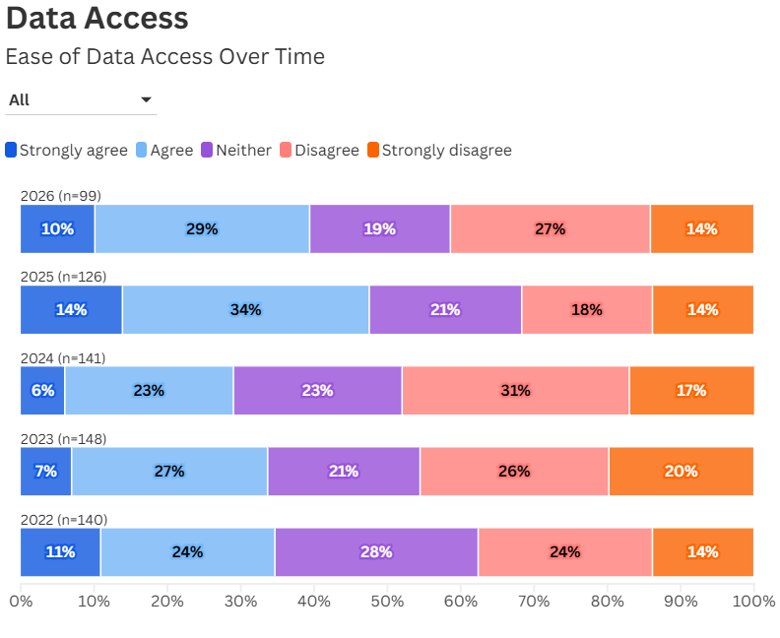 Meanwhile, demand for dashboards and reporting tools jumped from 52% in 2025 to 69% in 2026, the sharpest increase from last year of any capability tracked in the survey.
Institutions are not asking for more data. They are asking for data they can actually use. They need data that is visible in real time, accessible across units, and connected to the outcomes that matter. Workforce Pell will sharpen this need dramatically, with 65% of respondents citing the ability to connect learner data to state longitudinal systems as their top implementation concern.
What this means for you: If your solution touches data in any form, lead with what your platform makes visible, not just what it captures. Show institutional leaders specifically how your tools reduce the number of steps between a question (“Are our microcredential completers finding jobs?”) and a reliable answer.
2. Make Workforce Pell Readiness Part of Your Value Proposition
Workforce Pell is the most significant new policy development in the 2026 report, and institutions are split. Sixty-seven percent say they are at least somewhat likely to expand programs in response to it. Forty-two percent say they are not ready to meet the associated reporting requirements.
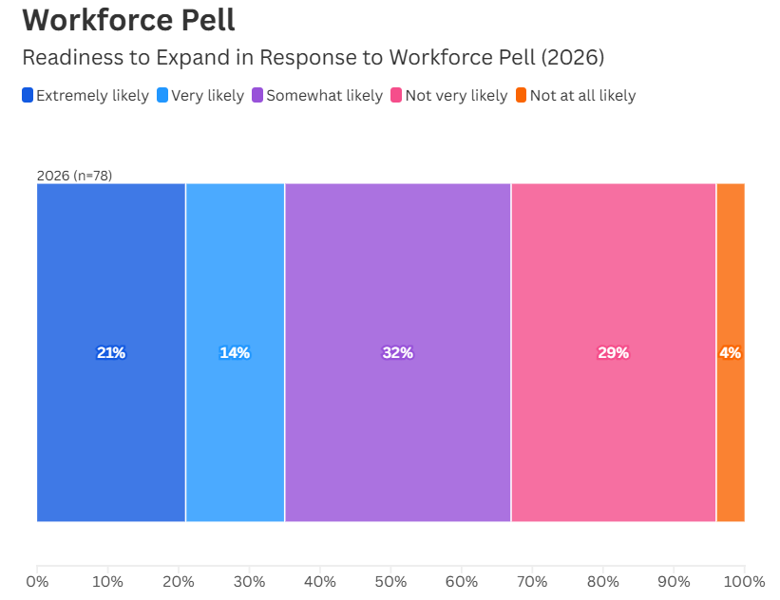
This is a rare moment where institutional need and partner opportunity are almost perfectly aligned. The compliance and data infrastructure that Workforce Pell demands (credential outcome tracking, program CIP code identification, connection to state longitudinal data systems, external credential attainment capture) is exactly the kind of unglamorous but mission-critical work that UPCEA corporate partners are well positioned to deploy.
What this means for you: Do not wait for your institutional contacts to bring up Workforce Pell. Bring it to them, with a clear point of view of how best to capture the opportunity. Audit your platform or service against the four implementation challenges identified in the report (data connectivity, eligibility determination, learner data capture, credential attainment tracking) and develop an honest map of where you add value and where you do not. Then help your contacts build the internal case for investment.
3. Help Fill the Marketing and Instructional Design Staffing Void
The 2026 report documents something that many institutional leaders will privately confirm but rarely say out loud: they don’t have the right skill sets in house. The marketing support gap widened from 14% to 30% in a single year. Instructional design vacancy reports nearly tripled, from 9% to 22%.
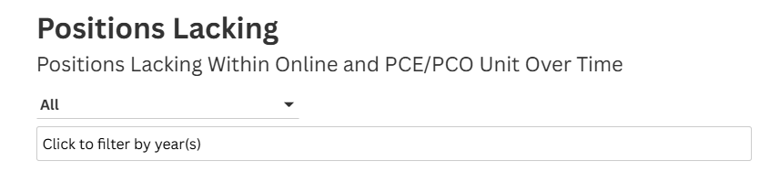
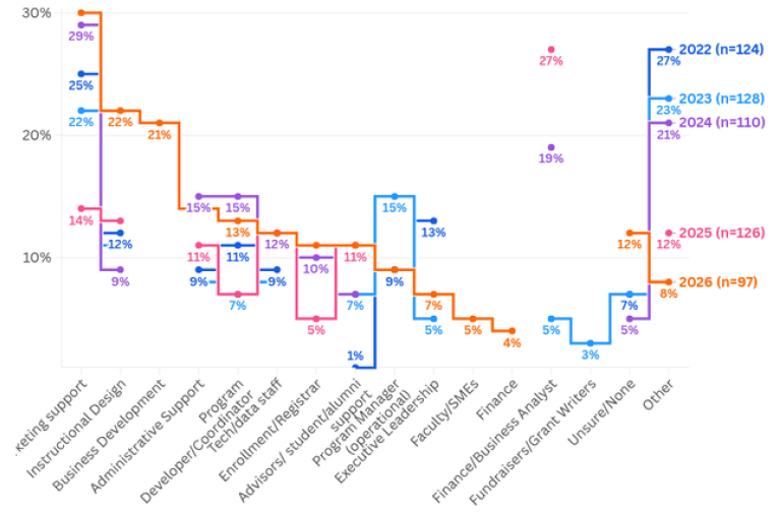
These gaps are not primarily about compensation or hiring pipelines. They reflect the reality that PCE units are being asked to do more programs, more modalities, more employer partnerships, and more short-form credentials without a proportional increase in the people who make those things work.
What this means for you: If your company offers services, this finding should be a central theme in your pitch. Use it to reframe the conversation from cost to capacity. You are not an expense; you are a substitute for headcount that institutions cannot hire fast enough. Make the case in terms that institutional leaders can take to a provost: “We free up your team to focus on strategy while we handle execution.”
4. Reduce Time-to-Market, Not Just Time-to-Launch
Fifty-six percent of 2026 respondents cite time-to-market as a significant barrier to expanding credentials. Governance bottlenecks, approval processes, and cross-unit coordination are the culprits. This is where institutions consistently lose ground to nimble private providers.
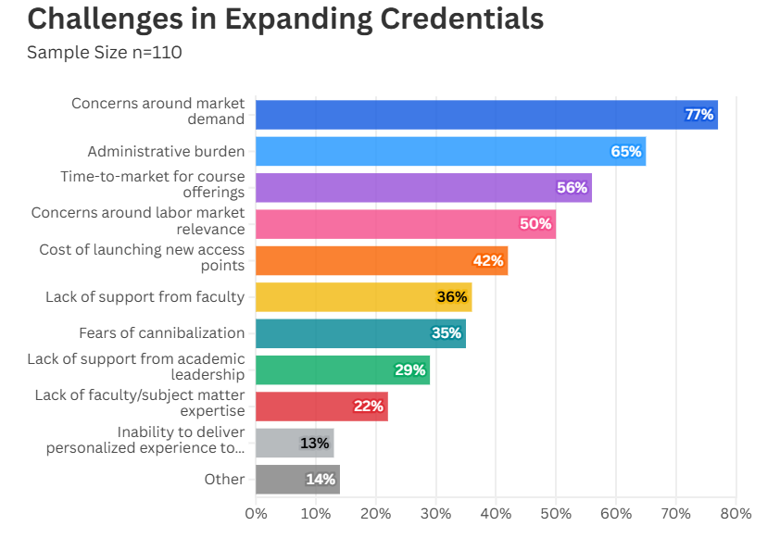
This is also an area where well-designed partner solutions can create genuine competitive advantage. For example, a registration system that cuts three weeks out of program setup is not a feature, it is a strategic answer to one of the most persistent frustrations among UPCEA member institutions.
What this means for you: Identify relevant points in the program development and launch process where time is lost and your solutions can help. Build your demonstration around those moments. If your platform enables non-credit certificate setup in hours rather than weeks, show that. If your content catalog lets institutions launch a new workforce program without starting from scratch, lead with the timeline. The key is making the time-to-market narrative explicit, not assumed.
5. Become a Collaborator in Cross-Campus Coordination, Not Just a Vendor to One Unit
One of the more subtle but significant findings in this year’s report is the decline in perceived cross-campus collaboration. Agreement that other units collaborate with online and PCE on continuing education development dropped from 71% in 2025 to 62% in 2026. Only 13% say their continuing education offerings are well integrated into the broader institutional portfolio. Siloing remains stubbornly at 41%.
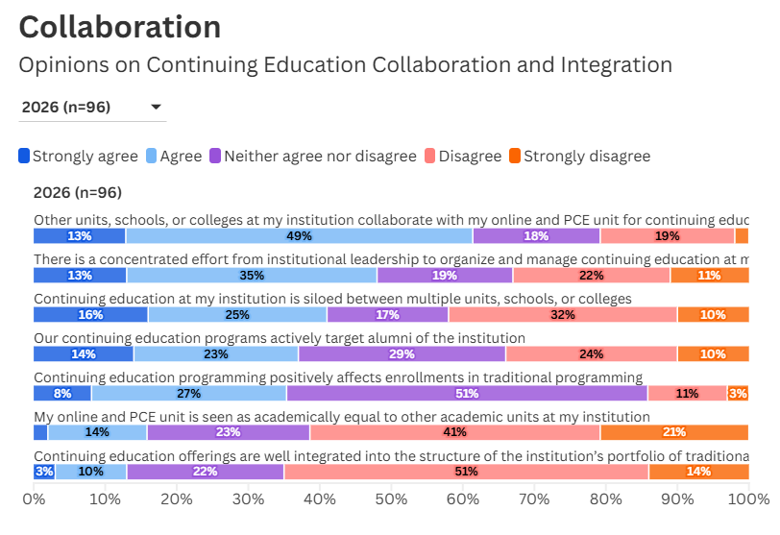
Institutions are not just struggling to build programs. They are struggling to get the right people in the same room, or at least the same workflow. This creates an unusual opportunity for corporate partners who are willing to operate beyond their traditional lane.
What this means for you: Think about who else at the institution should be in the conversation you are already having. The partners who distinguish themselves in 2026 will be the ones who help institutions see across their own silos, not by overstepping, but by asking the connective questions no one else is asking.
The Bottom Line
The 2026 State of Continuing Education report is, at its core, a document about institutional will running ahead of institutional capacity. UPCEA member institutions have made a decisive commitment to workforce-aligned, short-form, outcomes-focused learning. They have the leadership buy-in (79% report strong senior support), the learner demand (adult enrollment up 29% since 2022), and in many cases the strategic clarity.
What they lack are the systems, staff, and operational structures to execute at scale.
That is not a gap that institutions can close alone. The UPCEA corporate partner community exists precisely to help institutions do things they cannot do as effectively on their own. The question is not whether you have a role to play. The question is whether you are playing it in a way that meets this particular moment.
Dave Jarrat serves as a Senior Fellow for UPCEA and as a Strategic Advisor to a broad range of higher education institutions and organizations, including the University of Cambridge, Edquity and Scholarships360. He is a social impact executive focused on improving educational opportunities and outcomes for historically underrepresented populations.
Content for this resource was developed with the assistance of AI. All text has been thoroughly reviewed, edited, and approved by UPCEA staff with subject matter expertise. References and links have been verified for accuracy and reliability.