
 UPCEA joins colleagues, friends, and the broader higher education community in mourning the passing of Dr. Gary W. Matkin, a distinguished leader in online and professional continuing education whose nearly five decades of service shaped institutions, expanded access, and advanced innovation across the globe.
Dr. Matkin began his career with the University of California, Berkeley Extension in 1973, where he held a series of leadership roles focused on financial management, academic quality, and technology initiatives. In 2000, he joined the University of California, Irvine as Dean of the Division of Continuing Education, later also serving as Vice Provost of the Division of Career Pathways. Over the course of his tenure, he led a thriving continuing education enterprise serving tens of thousands of learners annually and helped integrate career services across the UCI campus.
Known as an innovative and forward-thinking leader, Dr. Matkin played a central role in advancing open educational resources, online learning, and alternative digital credentials. He helped develop initiatives that brought learning opportunities to millions of students and contributed significantly to national and international conversations about digital credentials and workforce-relevant education. His scholarship and writing, including foundational books on financial management in continuing education, provided practical guidance to generations of leaders in the field. His 1985 book, Effective Budgeting in Continuing Education, received an honorable mention for UPCEA’s Phillip E. Frandson Award for Literature in 1987, reflecting early recognition of his influence on the profession.
Dr. Matkin’s engagement with UPCEA spanned decades, beginning in the late 1980s. Over the course of his service, he contributed as both a volunteer leader and a thought partner to the association. He served on the association’s Board of Directors from 1998 to 2004 and held numerous volunteer leadership roles, serving on planning committees, advisory groups, and long-range planning efforts that helped shape the association’s direction.
A frequent and generous contributor to UPCEA conferences and professional development programs, Dr. Matkin shared his expertise through numerous presentations at events over the course of his career. His sessions on budgeting, financial management, online education strategy, partnerships, and institutional leadership helped equip peers to lead sustainable and forward-looking continuing education enterprises.
In recognition of his leadership and contributions to the field, Dr. Matkin received UPCEA’s Julius M. Nolte Award for Extraordinary Leadership in 2010. He served as a member of the 2015-16 Annual Conference Advisory Committee, and more recently as a Founding Faculty member of UPCEA’s online professional development program, and the course developer and instructor for Forecasting, Budgeting, and Managing Money in an Environment of Uncertainty and Risk. He also served as a Strategic Advisor for UPCEA Research and Consulting, lending his insight and experience to help other members.
Throughout his career, Dr. Matkin championed the idea that continuing education should be both mission-driven and financially sound. He believed institutions must operate with clarity, integrity, and adaptability in order to serve learners effectively. Those principles continue to guide leaders across the field.
Dr. Matkin retired from UC Irvine in 2022, concluding 49 years of service to the University of California. His legacy endures in the institutions he strengthened, the programs he built, the scholarship he contributed, and the countless colleagues and learners influenced by his work.
As we remember Dr. Gary Matkin, we honor a life defined by leadership, service, and an enduring commitment to expanding educational opportunity.

By Vickie S. Cook, Ph.D.
Artificial intelligence is rapidly reshaping work across society, and higher education institutions are no exception. Traditionally, discussions around AI in the academy have focused on student-facing issues such as academic integrity and personalized learning. Today’s higher education leaders are called to lead institutional transformation shaped by AI. A new research study from EDUCAUSE conducted in partnership with AIR, NACUBO, and CUPA-HR demonstrates that AI is reshaping work across every facet of the institution, from administrative tasks and faculty workflows to policy development and workforce skills.
A Broad Impact on Work
The EDUCAUSE report The Impact of AI on Work in Higher Education surveys nearly 2,000 higher education professionals to understand how AI tools are changing work practices and institutional strategies. Survey results paint a picture of widespread AI use: 94% of respondents report using AI tools for work-related tasks within the past six months, yet only 54% are aware of formal institutional policies or guidelines to direct that use.
The report further indicates that while most institutions have reported articulating a work-related AI strategy (92%), explicit measurement of outcomes such as return on investment remains nascent (only 13% report evaluating ROI).
These findings reinforce something many enrollment and academic leaders already observe in practice: faculty and staff are incorporating AI into their workflows, often informally and without institutional guardrails.
Balancing Opportunity with Risk
The EDUCAUSE study highlights a dual reality:
- Opportunities: A large majority of respondents report compelling benefits from AI, including automation of repetitive processes, reducing administrative burden, and enabling deeper data analysis for decision-making.
- Risks: At the same time, many respondents identify urgent risks associated with AI use, including misinformation, loss of fundamental skills requiring independent thought, and use of data without consent.
These insights underscore that AI adoption without clear governance, workforce development, and ethical guardrails carries significant risk, even as institutions pursue innovation.
Strategic Implications for Institutional Leadership
From an institutional leadership and management perspective, the EDUCAUSE report yields several strategic implications:
- Governance Must Catch Up With Practice. AI is being used widely, yet institutional policies and guidelines are unevenly communicated and understood. Leaders must elevate work-related AI governance beyond pilot stages to systematic, institution-wide structures.
- Workforce Development Requires Strategic Investment. The most common strategy for building AI skills remains ad-hoc or self-directed learning. Structured professional development programs are needed not only to build capacity but to ensure equitable access to AI literacy across roles and units. The newly released AI Literacy Framework from the U.S. Department of Labor provides a national benchmark for workforce-aligned AI competencies. This framework will assist with considerations of AI Literacy across the higher education workforce. Higher education institutions should evaluate their professional development strategies against this emerging framework to ensure alignment with workforce expectations.
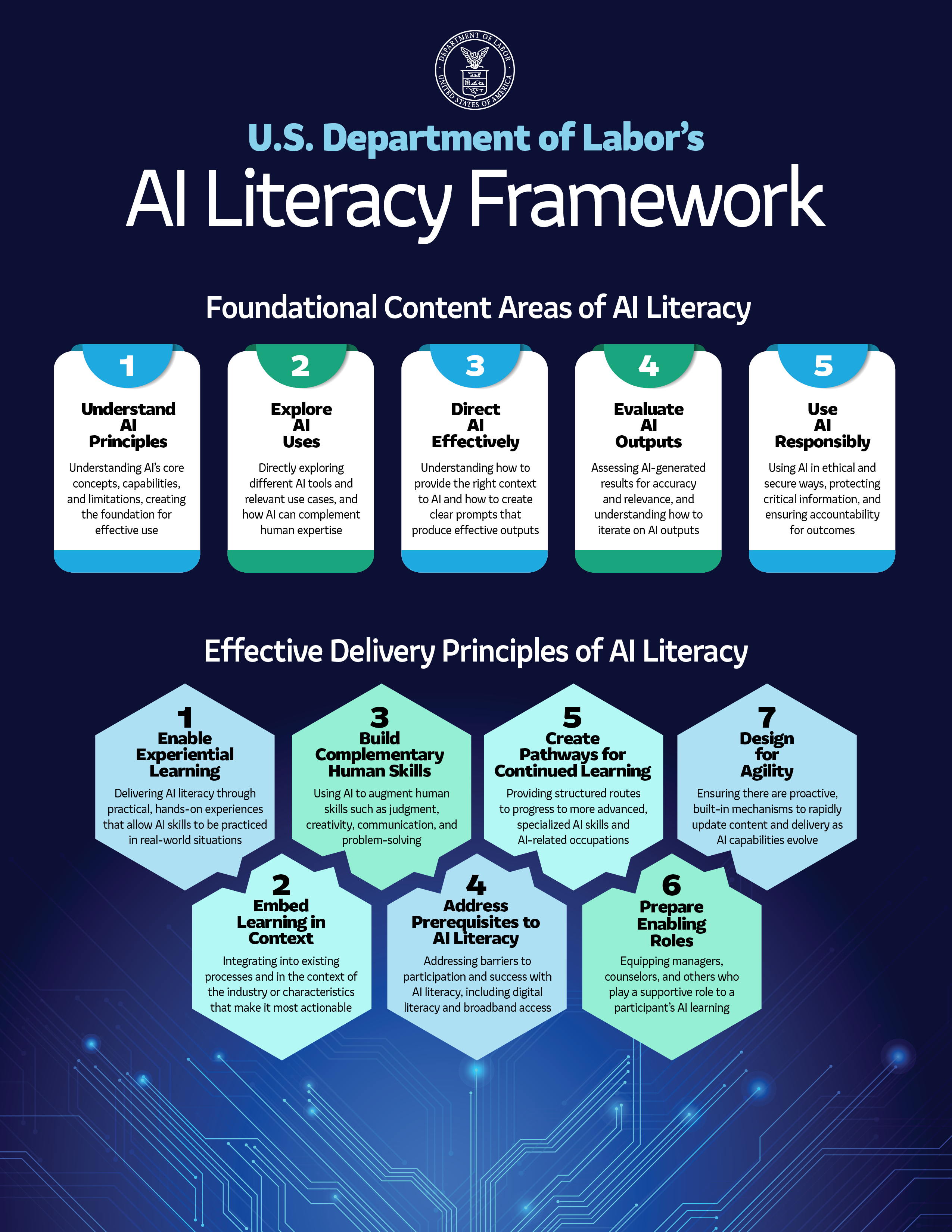
- Strategic Measurement Enables Accountability. Without clear metrics such as ROI or productivity outcomes, institutions risk conflating experimentation with strategy. Leaders should embed AI adoption metrics into broader performance frameworks to assess both costs and benefits.
- Risk Management Is Central. The breadth of perceived risks, from ethical concerns to skill erosion, positions AI governance as a central enterprise-wide risk issue. Cross-functional risk committees that include academic affairs, IT, HR, enrollment management, and compliance should engage in discussions and action items to ensure risk management is managed.
Call to Action: Institutional Next Steps
To build organizational readiness and strategic coherence, institutional leaders should consider taking the following next steps:
- Establish or Strengthen AI Governance Structures
Establish a cross-functional AI advisory council with representation from academic affairs, human resources, information technology, enrollment management, student success, institutional research, and compliance. Charge the council with updating or creating work-related AI policies and ensuring alignment with mission and values. - Develop an AI Workforce Development Plan
Integrate AI literacy and capability development into existing professional learning systems, leadership development programs, performance expectations. Include competency frameworks, credentials, and incentives that align with both role expectations and institutional priorities. - Implement a Structured AI Performance and Impact Evaluation Framework
Design measurable outcomes for AI implementation across administrative and academic domains. Include evaluations of efficiency gains, quality improvements, ethical compliance, and workforce confidence. - Promote Transparent Communication and Training
Ensure that staff and faculty understand not just how to use AI tools, but where policies apply, what risks exist, and how the institution is thinking about both innovation and responsibility.
AI is transforming work in higher education in ways that can no longer be treated as peripherals or experimental. The EDUCAUSE study makes clear that adoption is accelerating across roles and units. Without internal strategy, governance, and investment, institutional risks may outpace realized benefits. Institutional leaders have the opportunity to shape AI adoption intentionally, aligning it with organizational values, workforce development goals, and student success imperatives. The question is no longer whether AI will influence higher education work, but whether institutional leaders will shape that influence with clarity and purpose.
Sources:
EDUCAUSE – The Impact of AI on Work in Higher Education (2026)
Report: https://www.educause.edu/research/2026/the-impact-of-ai-on-work-in-higher-education
Department of Labor – AI Literacy Framework (2026). https://www.dol.gov/sites/dolgov/files/OPA/newsreleases/2026/02/ETA-20260212-hi.jpg
Vickie Cook is the Vice Chancellor for Enrollment and Retention Management and a Research Professor of Education at the University of Illinois Springfield, as well as a Strategic Advisor for UPCEA Research and Consulting. To learn more about UPCEA Research and Consulting, please contact [email protected].
Information and knowledge are growing at an accelerating rate. As we usher graduates out of college, much of their knowledge is useless, already out of date.
On Medium, Futurist Jim Carroll writes “In 1900, knowledge doubled approximately every 100 years. By 1945, this rate accelerated to every 25 years, and by 1982, it was every 13 months. Currently, between 2020 and 2025, some estimates suggest that knowledge is approaching a doubling rate every 12 hours.” That’s merely the time between breakfast and dinner!
Unfortunately, we graduate students with degrees and certificates that once upon a time, we believed certified current and continuing expertise in a given field. It lasted a lifetime. That was true at the turn of the twentieth century, but certainly not now in the Age of AI. As we continue to accelerate the creation of new information, how can we ensure our students in degree or certificate programs are kept up to date with what they need for the ever-changing workplace?
As a Professor of Communication at the University of Illinois Springfield 30 years ago, the accelerating rate of change in my field of Communication Technology was abundantly apparent ahead of many other fields. In teaching my graduate seminar in New and Emerging Technologies in the Electronic Media, I was challenged with getting my students to identify new knowledge and information in order to write literature critiques and research reports. I created a curated reading listserv for students enrolled in the seminar each term. Some of the most dedicated students asked me at the end of the semester if I could keep them on the listserv for the following terms so they could continue to keep up with the cutting edge. When it became available, I moved to a “new” online technology developed by Pyra Labs called web logs or “blogs.” (Later Pyra was acquired by Google as a foundation for blogger.com.) As a result, the curated readings moved to the then new World Wide Web and became available most everywhere around the globe.
The primary purpose of the blogs I developed was to offer students links to key articles as they came out on important emerging topics in electronic media. It was a curated reading list. However, as with much online material, the blogs came to serve many functions around the world; corporate leaders subscribed to keep up with the newest releases, faculty members at other institutions subscribed to have access to updated resources for their own classes and enterprising students elsewhere found this was a good source of new materials for their own analogous seminars that didn’t require digging through periodical guides.
For my own purposes, I began to share the concept at national conferences, such as the annual Distance Teaching and Learning conference in 2007. I referred to the practice as the “Semester without End” in which students could continue receiving updates on course material after they had completed the course. Since I was already doing the blogging for the current class, there was no extra work to share it with others via the blog URL. This approach provides a low or no-budget, tried and true way that a professor can share a curation of links to new and emerging discoveries, theories, practices and applications in any field. As I write this article the much-evolved blog, now named Professional, Continuing and Online Education by UPCEA is on the verge of passing three million page views.
It was also a two-way medium with the option to allow readers to comment and discuss the material that was shared. As such, I believe a version of this curated reading list with associated podcasting can become the backbone of addressing the issue of keeping graduates of degree programs and completers of certificate programs updated on subsequent new materials. The addition of periodic synchronous sessions can provide further professional learning opportunities in the discipline area by bringing in guest speakers to address important developments in practice or those that are anticipated.
Some larger universities offer continuing education aimed specifically at alumni such as the Purdue for Life program that offers more than 200 online or hybrid programs. New York University (NYU) offers $15 “Alumni College” professional certificates and classes through their School of Professional Studies. The University of Michigan offers alumni free access to more than 100 online courses as Continuing Education for Alumni. Other universities offer alumni discounts on their continuing and professional learning programs such as Brown University’s Lifelong Learning and Travel Program, and Duke University offers alumni an assortment of programs and learning opportunities.
These are admirable initial efforts to provide graduates and certificate completers with the opportunity to keep up with the rapidly changing technological environment, the AI-enhanced advancements and the societal context of the evolving complex fourth industrial revolution. We are no longer judged by what we teach in semesters leading up to degrees or certificates online or on campus, but rather by the way in which we support our learners when they enter careers in the workplace. These are careers that may radically change over time, some will become extinct, replaced by agentic AI, embodied robotics and technologies yet to be imagined.
Therefore, we need to continue to grow our efforts to ensure that our learners are not abandoned by employers for lack of preparation in response to those changes wrought by the fourth industrial revolution. Regrettably, we have graduated and certified countless learners over the past decade who are today being confronted with the lack of foresight and skills necessary to advance in their career field.
Who at your university is leading the effort to ensure that all learners are offered free or affordable continuing professional learning opportunities that enable them to successfully advance with their careers in the emerging fourth industrial revolution? Are you prepared to support your students through custom blogs as a lifeline to update their knowledge and skills? This cannot wait another semester, another year; we are certifying learners who are leaving our universities unprepared for the careers that will emerge this year and in 2027.
This column was originally published in Inside Higher Ed.

By Dave Jarrat
For decades, the narrative in higher education has focused on expanding access. While we have made incredible strides in many areas, a quiet but profound crisis has emerged: the vanishing male student.
Across the UPCEA membership, from large public land-grants to private institutions, the data is undeniable. Nationally, women now outnumber men by approximately 60% to 40% across all undergraduate institutions (The Hechinger Report, 2025). They are less likely to enroll, more likely to stop out, and significantly less likely to return to finish their degrees. For leaders in online and professional continuing education, this isn’t just a social issue; it’s a strategic imperative.
If we are to fulfill our mission of serving the workforce and our communities, we must rethink how we recruit, support, and communicate with men. Here is a roadmap for UPCEA members to bridge the gender enrollment gap.
1. Radical Transparency in the ROI
The “Why” matters more than ever. Research suggests that many men, particularly those from working-class backgrounds, view the opportunity cost of a degree with high skepticism. According to Harvard Magazine, since 1979, the real wages of most men have fallen while women’s have risen, leading to a sense of being “left behind” (Harvard Magazine, 2025).
- Move Beyond the Motto: “Lifelong Learning” is a beautiful sentiment, but for a man working a trade or a low-wage service job, it’s too abstract. Marketing must lead with hard data: starting salaries, mid-career earnings, and specific job titles held by alumni.
- The “Debt vs. Duty” Framework: Many men feel an internal pressure to be providers. To them, debt isn’t just a financial burden; it’s a failure of their role. Address this head-on by highlighting employer-aligned tuition assistance and “earn-while-you-learn” models.
2. Bridging the “Inquiry Gap” in Financial Aid
One of the most startling findings in recent years comes from Scholarships360. While the national enrollment gap is roughly 14 points, the “scholarship seeking gap” is a chasm. Only 28% of scholarship seekers are male, compared to 69% who are female (Scholarships360, 2025).
This suggests that men are not just failing to enroll; they are failing to even attempt to find the funding that makes enrollment possible.
- Proactive Financial Counseling: Don’t wait for men to find your scholarships page. Use targeted SMS campaigns or personalized videos to walk them through the FAFSA, institutional, and 3rd-party financial aid.
- Content-Specific Outreach: The Scholarships360 data shows that male engagement spikes in STEM and trade-related scholarship categories. If you are marketing a liberal arts or general business program, consider emphasizing the technical skills or leadership tracks that resonate with these interests.
3. The “Stopout” Opportunity: Bringing Men Back
Research from the American Institute for Boys and Men (AIBM) reveals a critical nuance: men are 29% more likely to stop out than women, and 32% less likely to re-enroll (AIBM, 2025). However, when they do return, they are 17% more likely to complete their credential in the first year back.
This means your “Some College, No Degree” population is a goldmine—if you know how to talk to them.
- Concierge Re-entry: Men often cite “personal or family pressures” (45%) and “work/military/career reasons” (26%) for leaving (AIBM, 2025). Your outreach should not be a “Welcome Back” email; it should be a “Problem-Solving” call.
- Credit for Prior Learning (CPL): Men who stop out often gain significant work experience in the interim. Aggressive CPL policies that turn that experience into credits can shave months off their time-to-degree, making the math of returning work in their favor.
4. Tailored Outreach: The Georgetown and Harvard Lessons
Institutions are beginning to realize that “gender-neutral” marketing is often “gender-blind.” Georgetown and Harvard have increasingly emphasized efforts to attract military-connected students, a population that is disproportionately male. Harvard also found success emphasizing mentorship and structured wraparound support rather than just academic prestige. This shift acknowledges that men are often looking for a clear “playbook” for campus success.
- Military as a Model: Apply the “Military-Connected” playbook to other male-heavy sectors like manufacturing, logistics, and emergency services.
- Peer-to-Peer Representation: If your marketing materials only feature female students (who are, admittedly, your current majority), you are reinforcing the idea that “college isn’t for men.” Use student ambassadors who look and sound like the men you are trying to reach.
5. Modernizing the Admissions Funnel for Men
To engage male prospects, online and professional education divisions must prioritize speed and visibility where these students are most active.
- Respond with Urgency: A 2025 UPCEA study found that 44% of inquiries receive no response; for men seeking immediate ROI, this silence is an invitation to look elsewhere or give up.
- Prioritize RFI Forms: Direct email is a “black hole,” with 62% of messages to staff going unanswered. Use RFI forms to ensure men enter automated nurturing sequences.
- Automate with Heart: Use your CRM to trigger immediate, program-specific follow-ups. If he looks at a Cybersecurity program, he should receive a link to a “Day in the Life” video of a male alum in that field within minutes.
- Optimize for AI Search: With 50% of prospects using AI tools weekly to research programs, your institution must be discoverable in AI-generated overviews of the programs male students search for most.
- Leverage Conversational AI: Implementing AI chatbots provides the instant, personalized answers required to convert high-intent leads before they lose interest.
The Bottom Line
The decline of men in higher education is not an accident of history; it is a response to a system that many men feel no longer serves their specific needs or economic realities. As online and professional continuing education leaders, we are uniquely positioned to fix this. By emphasizing ROI, simplifying the financial aid path, and providing flexible, career-aligned pathways, we can bring men back to the table.
Dave Jarrat serves as a Senior Fellow for UPCEA and as a Strategic Advisor to a broad range of higher education institutions and organizations, including the University of Cambridge, Edquity and Scholarships360. He is a social impact executive focused on improving educational opportunities and outcomes for historically underrepresented populations.
10 Individuals and 6 Programs Receive Association’s Highest Honors
WASHINGTON, February 9, 2026 – UPCEA, the online and professional education association, has announced the recipients of the 2026 Association Awards. The UPCEA Association Awards program includes recognition of both individual and institutional achievement across the UPCEA membership.
Since 1953, UPCEA has recognized its members’ outstanding contributions to the Association and the field, as well as their achievements in innovative programming, marketing and promotion, community development and services, research and publications, and many other areas.
Award recipients will be honored at the 2026 UPCEA Annual Conference, April 15-17 in New Orleans, Louisiana.
“The achievements reflected in this year’s nominations underscore the depth of leadership, creativity, and commitment across the UPCEA community,” said UPCEA Awards Committee Co-Chairs Amy Gaimaro of Molloy University and Aviva Heyn of the University of Delaware. “As we celebrate the 2026 Association Award recipients, we are honored to recognize individuals and teams whose work is advancing online and professional education, expanding access, and setting a powerful example of innovation and impact for the field.”
The recipients of this year’s awards are as follows:
Julius M. Nolte Award for Extraordinary Leadership is given to an individual in recognition of unusual and extraordinary contributions to the cause of professional continuing education on the regional, national, and/or international level.
Recipient: David R. Cillay, Washington State University Global Campus
Ray Schroeder Leadership Award for the Advancement of Digital Learning is given to an individual in recognition of lifetime achievements and professionalism in advancing the cause of online and digital learning in postsecondary education.
Recipient: Nancy Coleman, Harvard University
This award will be presented at the SOLAR 2026, July 29-31, 2026 in Boston, MA.
Phillip E. Frandson Award for Literature recognizes the author and publisher of an outstanding work of continuing higher education literature.
Recipient: Building Collaborative Learning Communities to Drive Student Success, Robin Dhakal, William G. Davis, and Kira Heske, University of Arizona Global Campus
Honorable Mention: The Chief Online Learning Officers’ Guidebook: A Framework for Strategy and Practice in Higher Education, Jocelyn Widmer, Los Alamos National Laboratory and Thomas B. Cavanagh, University of Central Florida
Adelle F. Robertson Emerging Professional Continuing Educator Award recognizes the scholarship, leadership and contributions to the profession of a person who has entered the field within the past five to ten years.
Recipient: Dr. Renee Kruep, University of Missouri
UPCEA Excellence In Teaching Award is presented to individuals who have provided outstanding teaching, course development, mentoring of students, and service to online and professional continuing education.
Recipient: Stephen Scheib, Wilmington University
UPCEA Outstanding Professional, Continuing, And/Or Online Education Student Award: Credit recognizes outstanding student achievement in online and professional continuing education.
Recipient: Maureen Leahey, University of Virginia School of Continuing and Professional Studies
Outstanding Program: Noncredit Award recognizes outstanding professional and continuing education programs that do not offer credit.
Recipient: ITRS Pathways to Professional Advancement, Florida State University
Outstanding Program: Credit Award recognizes outstanding professional and continuing education programs allowing students to earn credit.
Recipient: RRT-BS Degree Advancement Program, Boise State University
UPCEA International Program of Excellence or Innovative Practice Award recognizes a program engaged in activities that promote the exchange of knowledge and ideas of global significance.
Recipient: Professional Certificate in Corporate Entrepreneurship, Furman University – Center for Innovative Leadership
UPCEA Business & Operations Award for Operational Excellence recognizes outstanding individual contributions in operations, entrepreneurial, and intra-preneurial work that moves an institution into a more favorable position, specifically in financial, human, administrative and IT operations in professional, continuing and online units at postsecondary institutions.
Recipient: Jessie Sova, North Carolina State University
UPCEA Outstanding Service in Postsecondary Instructional Design Award recognizes outstanding service to the field of instructional design in one or more of the following areas: modeling and disseminating research (via workshops, webinars, conferences, papers, etc.), best practices, innovative methods, and/or mentorship, all for the betterment of the instructional design community.
Recipient: Dr. Blair Stamper, University of North Carolina at Charlotte
This award will be presented at the SOLAR 2026, July 29-31, 2026 in Boston, MA.
UPCEA Award for Strategic Innovation in Online Education recognizes an institution of higher education that has set and met innovative goals focused on online education and been strategic in the planning, development, implementation and sustainability in line with the institutional mission.
Recipient: CoPILOT: Cohort Program for Innovation and Leadership in Online Teaching, Purdue University
UPCEA Engagement Award recognizes an outstanding mutually-beneficial exchange of knowledge and resources between a UPCEA member institution and one or more external constituents such as local communities, corporations, government organizations, or associations.
Recipients: Community Health Worker Specialized Training Certificate | University of California, Merced Division of Professional and Continuing Education and Merced County Department of Public Health
UPCEA Credential Innovation Award recognizes a higher education institution that has successfully implemented an innovative alternative credential program with positive results.
Recipient: iTEACH Microcredential, UNT Health Fort Worth
# # #
About UPCEA
UPCEA is the online and professional education association. Our members continuously reinvent higher education, positively impacting millions of lives. We proudly lead and support them through cutting edge research, professional development, networking and mentorship, conferences and seminars, and stakeholder advocacy. Our collaborative, entrepreneurial community brings together decision makers and influencers in education, industry, research, and policy interested in improving educational access and outcomes. Learn more at upcea.edu.
CONTACT:
Molly Nelson, UPCEA Vice President of Communications, [email protected]
This post was updated on March 2, 2026.
Community colleges play a vital role in helping learners access affordable education and career-ready training. Students can earn credentials that lead to meaningful jobs quickly, especially in healthcare. Yet for many, financial stress and unmet basic needs make it difficult to enroll or stay enrolled. These barriers often weigh heaviest on part-time, nontraditional, first-generation, and low-income learners — the very students community colleges aim to serve.
Understanding these financial barriers is key to addressing them. Maslow’s hierarchy of needs reminds us that if students are worried about food, housing, or safety, their capacity for learning and achievement suffers. When those foundational needs are met, students are far more likely to stay motivated, persist, and succeed.
1. The Scope of Financial Stress among Community College Students
Basic Needs Insecurity
- Many community college students struggle with food, housing, transportation, and technology insecurity. (Goodman, Weiss, & Partridge, 2025)
- Basic needs insecurity, whether it is food or housing, has been reported by 59% of students. (Goodman, Weiss, & Partridge, 2025)
- Non-tuition expenses, such as housing, food, transportation, and childcare, often outweigh the cost of tuition. (Goodman, Weiss, & Partridge, 2025)
- Additional costs — textbooks, uniforms, certification fees, or access to software — can make completing a program even harder.
Impact on Academic and Mental Health Outcomes
- 59% percent of students cite financial stress as a reason they’ve considered dropping out. (Ellucian Health, 2024)
- 61% say it hurts their academic performance, and 78% link it to mental health challenges. (Ellucian Health, 2024)
- In one study, nearly half of Texas community college students said personal finances affected their ability to concentrate on coursework. (Mowreader, 2024)
2. How Financial Stress Affects Enrollment and Persistence
Financial strain forces students to make trade-offs that often delay or derail their goals, such as:
- Reduced course loads: Students may take fewer credits to save money, which lengthens time to completion and may affect financial aid eligibility.
- Higher dropout/stopout (pausing attendance) rates: Recurring financial shocks or resource gaps can lead students to pause their studies or drop out entirely.
- Lower re-enrollment: Once students leave, debt, job demands, and lost momentum often keep them from returning.
- Equity gaps: These challenges disproportionately affect first-generation, low-income, and minority students — compounding disparities in obtaining an education.
For continuing education and program leaders, these patterns translate directly to enrollment instability and lower program completion rates, which are key drivers of institutional funding and reputation.
3. Strategies to Reduce Financial Stress and Support Student Success
Below are practical strategies community colleges can do to reduce financial barriers and improve retention — especially in costly, high-demand fields like healthcare.
|
Strategy |
Description / Examples |
Implementation Considerations |
|---|---|---|
| Emergency funds | Provide small, flexible cash grants to address short-term crises (car repairs, rent, technology, medical costs). | Keep criteria simple and promote awareness broadly. |
| Basic needs hubs | Create centralized offices or “one-stop” centers connecting students to food pantries, childcare, housing aid, and transportation support. | Coordinate partnerships across campus and community organizations. |
| Predictive analytics & early alerts | Use LMS engagement, attendance, and payment data to identify students at risk and proactively intervene. | Protect privacy while promoting trust and transparency. |
| Flexible scheduling | Offer evening, weekend, hybrid, and online courses to reduce conflicts with work and family obligations. | Especially critical for healthcare and HIM programs where students often balance caregiving with education. |
| Course material assistance | Adopt open educational resources (OER), course reserves, or textbook lending programs to reduce material costs. | Faculty buy-in, library coordination, and funding are needed. |
| Childcare support | Provide on-site or subsidized childcare, or partner with trusted community providers to reduce a significant barrier for parenting students. | Navigate licensing, scheduling, and staffing logistics early. |
| Paid internships & work-study programs | Expand campus employment, workstudy, paid internships, or microjobs to help students earn while enrolled. | Ensure positions are flexible, relevant, and don’t conflict with academic goals. |
| Streamlined financial aid & advising | Streamline FAFSA and offer “just-in-time” financial aid advising, or auto-award small institutional grants to simplify the process. | Use clear, student-friendly communication. |
| Tuition guarantee programs | Lock in tuition rates to offer cost predictability. | Advertise early to influence enrollment decisions. |
| Re-enrollment outreach | Contact stop-outs and offer re-enrollment incentives (fee waivers, financial counseling, etc.). | Maintain an alums/dropout database, and ensure the messaging is empathetic. |
4. Key Metrics to Monitor
Tracking results helps institutions measure what’s working and where to focus resources:
- Rates of food, housing, and technology insecurity
- Frequency and amount of emergency fund disbursements
- Enrollment trends (new, returning, and dropouts)
- Retention from semester to semester
- Average credit load per student
- Time taken to complete a credential or degree
- Utilization rate of support services
5. Conclusion and Recommendations
Supporting students through financial hardship isn’t just the right thing to do — it’s essential to institutional success and workforce development. By stabilizing students’ financial and basic needs, community colleges strengthen retention, boost completion rates, and expand the local talent pipeline.
Recommendations at a glance:
- Launch emergency funding and wraparound basic needs support.
- Simplify financial aid processes and provide proactive advising.
- Offer flexible delivery modalities (online, hybrid, evening) for more options.
- Partner with local service organizations to expand resources.
- Monitor outcomes and scale initiatives that drive retention and completion.
For continuing education and healthcare program leaders, these efforts strengthen both student success and the skilled workforce your community depends on.
Kelli Squire, BSHIM, RHIT, CPC, CPMA, COC, CPC-I; Program Director; Associate Professor, Chattanooga State Community College, has served as Program Director and Associate Professor of the Medical Coding & Billing Program at Chattanooga State for more than a decade, where she led the redesign of its HIM associate degree into a credential-integrated program that prepares graduates to be workforce-ready. With over 35 years in Health Information Management and medical coding, she brings deep expertise across specialties including anesthesiology, emergency medicine, radiology, surgery, and E/M services. Kelli holds a BS in Health Information Management and credentials including RHIT, CPC, CPMA, COC, and CPC-I.
About AAPC
As the gold standard for medical coding and billing, an AAPC certification is the healthcare industry’s official recognition of expertise and achievement. Our education solutions facilitate high pass rates by providing learning materials that prepare students for their certification exams and equip them for their future roles. With offerings like curriculum licensing, bootcamps, instructor certification, and classroom software and materials, we support institutions in preparing their students for successful careers in healthcare. Learn more by visiting aapc.com/partner.
Nineteen of the twenty-three Top 20 Ranked Institutions are UPCEA Members
WASHINGTON, D.C. (February 5, 2026) — UPCEA, the online and professional education association, is pleased to congratulate the many UPCEA members recognized in the 2026 U.S. News & World Report Best Online Programs rankings.
U.S. News rankings include nearly 1,850 online programs, covering bachelor’s and graduate programs across a variety of fields. The U.S. News rankings focus on degree-granting programs designed to be completely online. Using information provided by participating institutions, the ranking methodologies include factors such as student engagement, services and technologies, and faculty credentials and training.
“UPCEA members continue to drive institutional transformation that meets the needs of today’s learners. Postsecondary online enterprises are leading the way,” said Julie Uranis, Senior Vice President of Online and Strategic Initiatives for UPCEA.“U.S. News & World Report’s annual rankings bring attention to the progress institutions are making to expand access, quality, and relevance in postsecondary education.”
“We’re proud to see Embry-Riddle Worldwide recognized among the nation’s top online bachelor’s programs once again,” said Dr. Dean Goon, Dean of Academic Innovation at Embry-Riddle Aeronautical University Worldwide. “These rankings reflect our commitment to delivering rigorous, industry-aligned online programs that serve a global and military-affiliated student population through innovative technologies, flexible learning models, and real-world application.”
Nineteen of the twenty-three top 20 ranked institutions are members of UPCEA:
1 – University of Florida
4 – The Ohio State University
4 – University of North Carolina–Charlotte
6 – Arizona State University
6 – Oregon State University Ecampus
6 – University of Central Florida
9 – CUNY School of Professional Studies
10 – University of Tennessee–Knoxville
11 – Embry-Riddle Aeronautical University
11 – Texas A&M University
11 – Washington State University
15 – University of Arizona
15 – University of North Carolina–Wilmington
17 – Colorado State University Global
17 – University of Massachusetts–Amherst
17 – Utah State University
20 – Indiana University
20 – University of Kentucky
20 – University of Massachusetts, Lowell
“At the University of Central Florida, we are proud to have had our online bachelor’s programs ranked in the top ten in the nation for the past five years. This kind of external recognition is a testament to the hard work of our faculty, instructional designers, media team, success coaches, and everyone who supports UCF’s online enterprise,” said Dr. Thomas Cavanagh, Vice Provost for Digital Learning, University of Central Florida. “However, the rankings themselves are not the goal. Continuous improvement is part of our culture, whether that’s refining how we support faculty, enhancing the student experience, or rethinking how programs are structured to meet today’s workforce demands.”
“Our presence on these national lists underscores the University of Kentucky’s unwavering dedication to academic excellence, support for military-affiliated students, and focus on advancing the Commonwealth of Kentucky and beyond,” said Dr. Brandi Frisby, Associate Provost for Academic Affairs, University of Kentucky. “We’re proud of what our faculty, staff, and online learners have accomplished and energized by what lies ahead as we look to best serve our students.”
“UF is honored that U.S. News & World Report has once again ranked UF Online as the No. 1 online bachelor’s degree program in the nation, including top honors for our business program and excellence in serving veterans,” said Melissa Allen, Director of UF Online, University of Florida. “This recognition reflects the impact of intentional, learner-centered online design and sustained commitment to quality, affordability, and student success — values that resonate deeply across the online and professional education field.”
Congratulations to all of the UPCEA members recognized in this year’s rankings!
About UPCEA
UPCEA is the online and professional education association. Our members continuously reinvent higher education, positively impacting millions of lives. We proudly lead and support them through cutting edge research, professional development, networking and mentorship, conferences and seminars, and stakeholder advocacy. Our collaborative, entrepreneurial community brings together decision makers and influencers in education, industry, research, and policy interested in improving educational access and outcomes.
When I make presentations about AI, I am most often asked, “What can I do now to ensure that AI doesn’t take my job?”
And, that’s a challenge to answer. We do not know just how, and how quickly, AI will roll out. However, a Gallup Poll released last week showed nearly one-quarter of American workers use AI at least a few times each week. We know that Agentic AI is different from Generative AI. Generative AI is the transactional, commonly chatbot mounted, question and answer form that we saw first in ChatGPT by OpenAI a couple of years ago. That remains a powerful tool. Agentic AI enables AI to reason, research, plan, control other digital tools, conduct actions on your behalf and complete multiple smart steps. It is capable of taking on a role delivering outcomes. That’s much like what a person is hired to do. In our jobs, we often are expected not to merely respond to individual questions, but to accomplish outcomes and results, and then, when possible, to revise our methods to do the job better.
On January 23, I posed the concern over being replaced by AI to Gemini 3 Pro in order to get AI’s perspective on the topic. Citing a podcast from There’s An AI For That (January 21, 2026), Gemini suggested that “The narrator argues that the biggest mistake people make is trying to stay relevant by becoming faster at completing tasks or learning more of the tools of that trade.” Gemini went on to respond “that true security in the AI era comes from shifting your focus from ‘output value’ (the things you make) to ‘outcome value’ (the results you deliver and the responsibility you take). To remain irreplaceable by 2026, the video identifies three critical human advantages: choosing the right problems to solve, making decisions under uncertainty, and owning accountability. Instead of being a ‘task machine,’ you should aim to be an ‘operator’ who uses AI as leverage to manage systems and drive real-world business goals like revenue and growth.”
In most cases, the decision for implementing AI solutions to complete tasks that previously have been done by humans, simply comes down to operating costs on the bottom line. AI applications work 24 hours a day, don’t require insurance benefits, take no vacation or sick leave time and are able to concurrently do a variety of unrelated tasks. Those characteristics make it more likely that over time AI will cost less to operate than paying the indirect costs of human labor. Ultimately, value in the workplace will shift away from technical execution and instead toward judgment, taste, and the ability to turn AI-generated outputs into useful outcomes. Humans remain in the loop as what some sources call an operator position and others call an orchestrator position. This emerging human position is responsible for overseeing agentic AI tools, ensuring accuracy, timeliness and effectiveness.
The U.S. Career Institute in May 2023 identified 65 career tracks that appear to be less susceptible to embodied AI disruption, that is replacement by AI robots based on the abilities, knowledge, skills, and activities that are required to perform the job well. Nurse Practitioners, Choreographers, and Physician Assistants top the list with anticipated human employee growth rates of more than 25% by 2032. Teachers, Instructors and School Administrators were also high on the list. In general, the Institute suggested that social skills, emotional intelligence, and interpersonal relationships would take longer to reliably perfect in an AI environment than many others with an emphasis on quantitative skills such as Accounting where the transition is already underway.
For those in the job market, it will be best to regularly monitor such lists as the one from the U.S. Career Institute of job categories showing increases and those fields in which employment appears to be decreasing due to the lower costs of AI. Continuing and professional education may become more important than ever before. As AI accelerates the advancement of work outcomes, the question arises what can we in higher education do to ensure our learners remain relevant and valuable in the workforce.
I again turned to Gemini 3 Pro for insight into how we can provide learning that is relevant and will help keep workers/learners prepared for what is coming next. Gemini 3 recommends for students entering college now, “the goal is to choose fields where human judgment, empathy, and physical intervention are the primary value-adds.” Those are represented best by labor projections such as the U.S. Career Institute mentioned above and the U.S. Bureau of Labor Statistics (BLS).
However, for those who are already committed to a field, Gemini raised the possibility of colleges and universities offering dual tracks. “We are entering an era of ‘Domain + AI.’ A degree in ‘just’ Business or ‘just’ Communications is becoming riskier; the most resilient students will be those who combine a traditional discipline with AI Orchestration skills.” Operationalizing this concept may be best done by adding certificate programs in the key AI orchestration, or operator, skills that can be paired with discipline-based degree or other certificate programs.
Gemini 3 then turned to a podcast by an avatar of Jensen Huang, Founder and CEO of NVIDIA, who shared advice on staying relevant in the AI era. “Individuals must shift their focus from mastering specific tools to developing high-level human judgment and domain depth. Because AI commoditizes technical skills and general knowledge, the value shifts to those who can navigate the “what” and the “why” rather than just the “how.” Jensen Huang has suggested a four-layer strategy for staying indispensable: achieving deep domain mastery where your judgment becomes rare, grounding yourself in “evergreen” fundamentals like systems thinking and physics, mastering the art of asking high-quality questions, and maintaining the emotional resilience to pivot quickly when outdated practices fail. Ultimately, the goal is to become a “learning system” rather than just a holder of a specific job title.
How is your university preparing to provide learning opportunities that meet the expectations of the AI era? Are your leaders conversant with the role of AI Orchestration and the four-layer strategy outlined above? Can you contribute to developing a plan for enabling your degree and certificate completers to develop the skills, abilities and inspiration to remain relevant in the coming AI workforce?
This column was originally published in Inside Higher Ed.
National study from Collegis Education and UPCEA highlights opportunity for institutions to strengthen student persistence through better alignment of strategy, systems, and support
WASHINGTON, D.C. and CHICAGO, IL – February 4, 2026 — As adult learners account for a growing share of higher education enrollment, colleges and universities face increasing pressure to sustain persistence in online programs. A new national study, “The Retention Disconnect: What Learners Need and What Institutions Miss,” released by UPCEA and Collegis Education, examines where institutional assumptions about retention diverge from learners’ lived experiences—and how realigning support strategies can improve outcomes, protect revenue, and better meet students where they are.
The study found that 48% of institutional leaders cannot confidently report their online retention rate, indicating a visibility gap that makes it harder to evaluate which approaches are most effective for learners. As institutions face enrollment pressure tied to demographic shifts and slower net-new growth, retention is increasingly viewed as a critical lever for stability. The findings underscore the need not for more activity, but for clearer insight into what actually supports persistence.
Surveying 1,015 online learners and 54 institutional leaders, the research reveals that while 75% of learners say it is “easy” to stay enrolled, nearly one in five has still considered stopping out. The gap suggests that persistence hinges less on online learner motivation and more on how effectively institutions anticipate, support, and align with students’ academic and life realities.
Left unaddressed, these misalignments carry meaningful consequences. Attrition is estimated to cost institutions millions in lost tuition revenue annually, particularly in graduate and online programs where retention is central to long-term growth.
Key Research Findings:
- Many institutions lack a consistent measurement of online retention, limiting informed decision-making.
- Learners prioritize self-service and visibility: 87% rate progress dashboards highly valuable, while institutions tend to emphasize staff-driven interventions.
- Retention risks vary significantly by life stage, reinforcing the limits of one-size-fits-all strategies
- Career advancement is the leading enrollment driver, yet learners frequently report misalignment between coursework and professional goals
- Financial pressure, work demands, and caregiving responsibilities remain the top reasons learners consider stopping out
“Retention today is less about adding more touchpoints and more about intentional design,” said Tracy A. Chapman, Chief Academic Officer at Collegis Education. “Institutions seeing progress are those that align their strategies around how learners actually move through education—creating clarity, relevance, and timely support that helps persistence scale.”
The research also found that while many institutions invest heavily in alerts and structured outreach, learners place greater value on flexibility, autonomy, and transparency. When these preferences are not reflected in institutional design, retention efforts can miss critical moments that influence whether students persist.
“Adult learners are reshaping expectations across higher education, and institutions are under increasing pressure to demonstrate outcomes,” said Emily West, Senior Market Research Analyst at UPCEA. “This research shows that improving retention isn’t about doing more—it’s about understanding professional learners better and meeting their needs.”
Implications for University Leaders
The findings highlight an opportunity for institutions to strengthen persistence by improving visibility into retention outcomes and aligning support with different learner profiles and life stages. Programs that provide clearer pathways, relevant coursework, and timely guidance are better positioned to sustain momentum. In a competitive environment, retention increasingly reflects institutional design as much as student effort.
UPCEA will host a webinar on February 11 at 1 pm EST to explore the research findings and actionable strategies. Registration details are available at: https://collegiseducation.com/insights/the-retention-disconnect-webinar/
About UPCEA
UPCEA is the online and professional education association. Our members continuously reinvent higher education, positively impacting millions of lives. We proudly lead and support them through cutting-edge research, professional development, networking and mentorship, conferences and seminars, and stakeholder advocacy. Our collaborative, entrepreneurial community brings together decision-makers and influencers in education, industry, research, and policy interested in improving educational access and outcomes. Learn more at upcea.edu.
About Collegis Education
As a mission-oriented, tech-enabled services provider, Collegis Education partners with higher education institutions to help align operations to drive transformative impact across the entire student lifecycle. With over 25 years as an industry pioneer, Collegis has proven how to leverage insights, systems, and expertise to optimize institutions’ business processes that enhance the student experience. With the strategic capabilities that rival the leading consultancies, a full suite of proven service lines, including marketing, enrollment, retention, IT, and its world-class Connected Core® platform, Collegis helps its partners enable impact and drive revenue, growth, and innovation. Learn more at CollegisEducation.com.
Media Contacts:
Collegis Education
Alyssa Miller
973-615-1292

By Jim Fong
As my retirement last year eases into a stage of semi-retirement or what some have labeled as “micro-retirement,” I have had eight months of reflection on my nearly four decades of doing research. After a few months of total abstention, I could no longer keep myself away from the higher education field that I so loved. I slowly eased myself back in by casually reading articles, blogs, and research papers. Then, I read the UPCEA Secret Shopping Benchmarking Report and went down a rabbit hole I should not have.
I started reflecting on my early market research career, some of which included corporate mystery (or “secret”) shopping analyses. I remember sending teams of people to hotels for check-ins, malls for shopping experiences, restaurants for dining and service engagements, and to car dealerships to test the customer service process. For every client, despite each having a strong plan or strategy, either something was broken or the competition was outperforming them. More recently, I remember the institution that called me on average three times a day for three months to see what my interest was in a data analytics degree.
Secret shopping is still relevant, as it unmasks problems, shortcomings, and opportunities. While it is a simple concept, given the amount of disruption in higher education and the lack of true knowledge regarding generational behavior, secret shopping and understanding the consumer purchasing process is probably more critical today as it would have been decades ago. Today, we are in a market that is shrinking by some definitions, while pre-Millennium was a major growth market for higher education and mistakes could be made.
The UPCEA report is important because customers and students are a precious asset, the lifeblood for colleges and universities. Every long-term profitable student and potential student lead should matter. While I am sure to irk the purest academic, “profitability” does not always mean dollars and cents in every case. Every profitable student helps contribute toward a long-term sustainable model. One important statistic from the UPCEA study is that 44% of inquiries go unanswered. This is a lost opportunity, impacting not only profitability, but institutional reputation.
Responding to the inquirer and potential student is also important given the technology and artificial intelligence tools upstream or at the top of the enrollment funnel. In numerous articles and blogs, Will Scott of Search Influence points out that many colleges and universities are getting leads driven to them through AI-enhanced search or other tools. As a result, we no longer have the luxury of a three-strikes-before-you’re-out approach. We need to understand the potential student immediately. We need to engage them more efficiently and effectively. As a result of upstream AI, they are likely to be more informed and a better match for the institution and thus more prepared and ready to make a faster purchase decision. This is further supported by a recent EducationDynamics study that shows that potential students apply to two schools on average. Shockingly, 45% apply to just one. This implies either greater readiness or frugality. Institutions need to be ready to not only persuade the searcher, but also to close the deal with the more informed.
The UPCEA report shows some shocking numbers regarding institutional follow-up using technology or via a human response. For example, nearly two thirds of email inquiries went unanswered, as compared to 37% originating through a request for information (RFI) form. It also highlights the numbers and percentages of those using advanced enrollment tools, as well as response times. As compared to past UPCEA studies, response times have gone in the wrong direction, increasing from just over 7 hours in 2023 to 14 hours in 2025. Every college or university, especially those serving adult and corporate learners, should have a plan or goal for how they respond, how fast they should respond, what metrics are considered good and what their goals and aspirations should be. We are in a time of chaos right now, with many factors out of our control. Managing the lead generation and nurturing process should not be one of them. We have the capability and resources to manage our own processes and should do so with intention and strategy.
For 2026, what can institutions do?
For starters, an institution should consider shopping itself with the intent of fixing processes. However, when doing this, the institution needs to be careful and not weaponize the data. The impact of secret shopping can be significant, but also destructive if not managed correctly. When institutions embark on a secret shopping initiative, those managing the process will be eager to immediately fix things and react, often forgetting about the impact to individuals. UPCEA can help you manage your own secret shopping initiative and guide you through the process.
Another consideration would be to secret shop the competition to better understand their approach and strategy. This too is an area to avoid weaponization. I’ve seen College A do this and run to staff or leadership saying “University XYZ does it this way and we should as well.” While it may be true, it may be off strategy for College A.
Upon completing a secret shopping initiative, key staff need to objectively map out the results and identify process improvements. Before, during and after process improvements are being put in place, metrics and realistic goals need to be put in place.
Secret shopping, on the surface, seems easy, but can have meaningful, long-lasting results if done correctly. A successful secret shopping initiative can strengthen an institution’s efforts, improve student relationships and lead to a more streamlined process.
Jim Fong is the Chief Advisor for Research, Strategy, and Innovation and a Strategic Advisor for UPCEA Research and Consulting. To learn more about UPCEA Research and Consulting, please contact [email protected].