
Reflections on 2018 Predictions: Playing the Long Game
Predictions are one individual’s hunch based on the information at hand. Rarely do long-term predictions come true in just one year. Many of my 2018 predictions continue to head in the anticipated direction, some faster than others. However, what is clear is that, as happened to the music industry ten years ago, transportation (Uber, Lyft, Turo, etc.), lodging (Airbnb, VRBO, HomeAway, etc.), and more recently, higher and continuing education, is experiencing significant change.
- 2018 Prediction #1: Millennials will find their voice and increase their influence. I predicted that Millennials would find their voice and they are growing in power and with influence. They played a major role in the mid-term elections, were the driving generation of the #metoo movement, and were inspired by the Parkland movement. Millennials were criticized for their inactivity in the last presidential election, as well as the midterm in 2014. Millennials are coming of age and are quickly becoming the managers and leaders in the workforce.
- 2018 Prediction #2: Alternative credentials will rise as a result of Millennial influence. This prediction should continue rising over the next few years. While there is very little direct data on the full spectrum of alternative credentials in either 2017 or 2018, NCES reports that credit certificates continue to rise with at least eight consecutive years of growth, with the last reporting year being 2015-2016. Class Central also reported that 101 million users enrolled in a MOOC. While this number declined from the past year, the number of paid users increased as well as gross revenues to MOOC providers.
- 2018 Prediction #3: Business and higher education will become better partners. Change continues to happen regarding employers and higher education. The balance of power appears to be shifting more toward employers as the economy shifts with higher education showing signs of weakness. The National Student Clearinghouse in its latest report (Spring 2018) showed that higher education enrollments declining by 1.3% from spring 2017. Also, since 2016, more than a hundred colleges and universities have closed. My next blog will show industries with anticipated growth for 2019 and 2020.
- 2018 Prediction #4: Business and industry will push for more STEM degrees and graduates, but with that comes opportunity in other disciplines. While IPEDs and NCES data is not out for 2018, Campus Technology and the National Student Clearinghouse shows enrollments in computer and information science degrees, as well as science technologies, have grown significantly from fall 2016 to 2017. Coding bootcamp providers are also reporting growth in their noncredit intensive programs.
- 2018 Prediction #5: Focus on enrollment, retention and inquiry management as marketers figure out major technology and traditional marketing shifts. The focus on enrollment management is a long-term strategy, one that we believe continues its importance. There is very little longitudinal data on whether PCO marketers and enrollment managers are shifting their attention and resources to support CRM, dashboard, conversion, and other enrollment management tactics, but we feel that units still value these principles more and that they are needed to show ROI and demonstrate budget transparency.
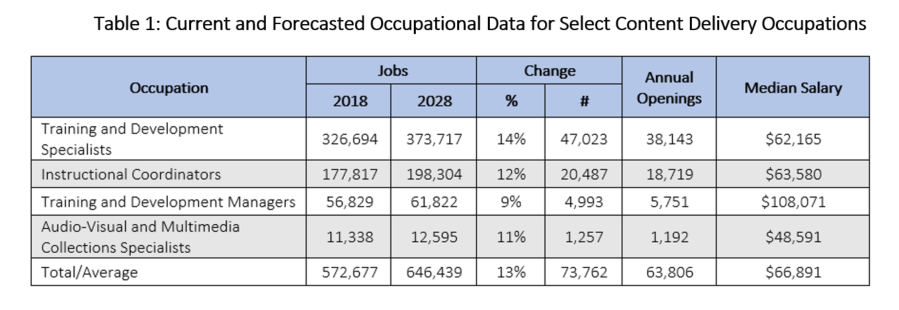
- 2018 Prediction #6: Content will become closer to the customer through technology. Content and knowledge was predicted to be more easily accessible and not necessarily residing in the mind and experiences of a professor. This long-term trend will require skilled professionals such as an instructional designer, multimedia specialist, content developer, or training professional to help connect more readily-available or instant content or experiences to pedagogy. In fact, colleges and universities, as well as K-12 educators and corporate trainers will continue to seek these professionals. These professionals are forecasted to see a growth rate of 13% between 2018 and 2028, which translates into 73,762 new well-paying jobs (see Table 1).
- 2018 Prediction #7: Competition will force higher education to explore previously ignored, underleveraged or untapped markets. 2018 was just one year in this prediction, which we feel will span multiple years. However, many corporations announced in 2018 that some of their jobs may not necessarily require a degree and that other factors would be considered. This statement alone should have higher education providers rethinking their strategy to potentially unbundle existing education products or create new certificates that might better prepare a candidate for one of these jobs. Some higher education institutions also announced new “lifelong” engagement strategies aimed at better serving alumni and other stakeholders, including local or regional employers or K-12 audiences.
From a prediction standpoint, 2019 won’t be that different from 2018, except that Millennials and Generation Z are slowly, but consistently finding their voice and becoming power players in the new economy. They should continue to accelerate some of the predictions. In the past year, the world saw major advances in artificial intelligence (AI) and robotics; autonomous and electric vehicles; unmanned aerial vehicles (UAV), such as drones; financial technology (we use less physical money and more digital money!); health technology and other industries. In 2018, we also saw the introduction of many new tax changes, announcement of new facilities by Amazon and Google, increases and new technologies related to gaming and virtual reality, the legalization of cannabis in some areas, and greater global adoption of green energy sources, all of which should have implications for higher education and professional and continuing education.
Authored by
Learn more about UPCEA's expert consultants.
Do you need help with your PCO unit or campus? We can help. Contact UPCEA Research and Consulting for a brief consult. Email [email protected] or call us at 202-659-3130.
Trusted by the nation's top colleges and universities, UPCEA Research and Consulting provides the best value in the industry today. UPCEA's industry experts have years of experience in Online and Professional Continuing education - put them to work for you!
UPCEA Research and Consulting offers a variety of custom research and consulting options through an outcomes-focused pricing model. Find the option(s) that best suit your institution.
Learn more about UPCEA Research & Consulting
The UPCEA Difference
Unmatched Experience: For more than 100 years, UPCEA consultants have exclusively served the needs of online and professional continuing education programs. UPCEA consultants leverage their extensive industry expertise to expedite solutions, anticipate upcoming shifts, and offer distinct best practices, effectively aiding clients in achieving their goals.
Cost Effectiveness: As a nonprofit, member-serving organization, we provide unmatched value, allowing you to maximize limited research and consulting budgets.
Action in Motion: Our cadre of experienced, skilled authorities and expert practitioners propels you forward, translating research and consulting into impactful implementation, a distinctive hallmark of UPCEA. Our team of current and former institutional leaders will support you, turning research and consulting into action.
Mission Alignment: Like you, our mission is to enhance and expand educational opportunities and outcomes for adult and other non-traditional learners. We share your values and work in partnership with you to advance access and excellence in education.