
Millennial Managers: The Gateway Toward Alternative Credentials
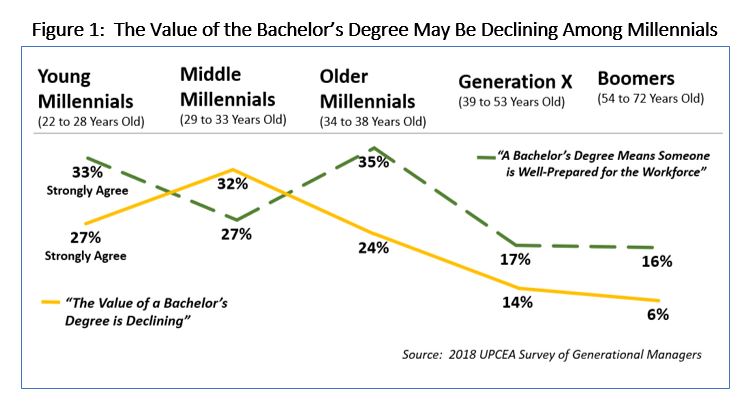
Society has jeered Millennials (those born between 1981 and 1994 or roughly being between 22 and 37 years of age) for their differences, as opposed to appreciating their unique qualities and strengths. Many entered the economy after earning their bachelor’s degree only to find the economy in a recession and Baby Boomers (those born between 1946 and 1964) choosing to postpone retirement. As a result, under or unemployment breached 40%. Given the promise of success after graduating and that the debt they incurred would be well worth the investment, would Millennials issue an economic or political payback to higher education institutions? Figure 1 shows that there may be some animosity toward higher education or that elements of the bachelor’s degree need to change, as the value of the bachelor’s degree appears to be losing value, especially among Millennials who experienced the heart of the 2008 recession.
Millennials will seize power by 2020. They currently outnumber Baby Boomers[1] overall and have recently passed them in terms of numbers in the workforce.[2] Millennials are now becoming managers in roles that are critical to professional, continuing and online education units. They will become directors or managers of human resources, training and talent retention. They will also be unit managers, managing teams of engineers, nurses and analysts and will have decision-making authority as to training and continuing education. In fact, in a recent UPCEA survey, 35% of Millennials employed full-time have that authority, managing teams or controlling a budget for education.
With the perceived value of the bachelor’s degree in potential decline, will this open up new alternatives to learning? Will higher education improve the bachelor’s degree or over time, will Millennials begin to favor alternative credentials to meet employee needs? Figure 2 shows that Millennial managers are certainly more open to new ways of learning and as a result, this finding could be a foundation for PCO units to build upon as they re-engineer or re-design their bachelor’s degree programs. The figure shows that Millennials are more likely to support alternative credentials as compared to their predecessors in Generation X (those born between 1965 and 1980) and Baby Boomers.
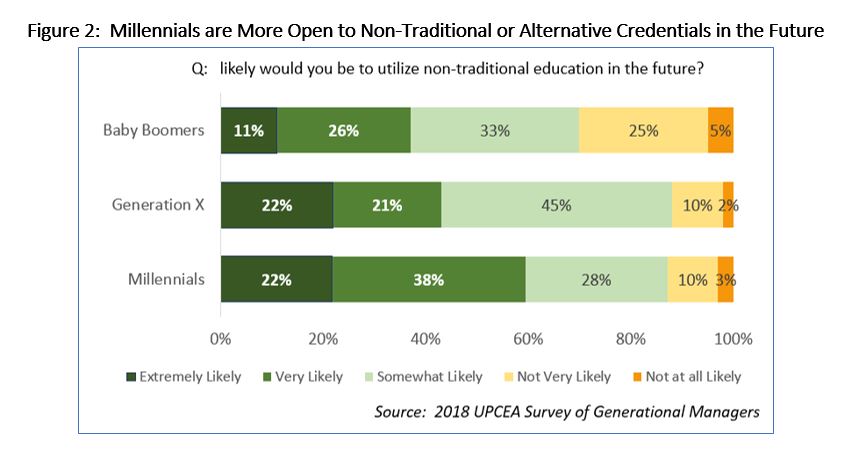
Additional research reports and future presentations and webinars on UPCEA’s Survey of Generational Managers will also show greater support for MOOCs, badges and certificates.
[1] https://www.census.gov/newsroom/press-releases/2015/cb15-113.html
[2] Pew Research 2018
Learn more about UPCEA's expert consultants.
Do you need help with your PCO unit or campus? We can help. Contact UPCEA Research and Consulting for a brief consult. Email [email protected] or call us at 202-659-3130.
Trusted by the nation's top colleges and universities, UPCEA Research and Consulting provides the best value in the industry today. UPCEA's industry experts have years of experience in Online and Professional Continuing education - put them to work for you!
UPCEA Research and Consulting offers a variety of custom research and consulting options through an outcomes-focused pricing model. Find the option(s) that best suit your institution.
Learn more about UPCEA Research & Consulting
The UPCEA Difference
Unmatched Experience: For more than 100 years, UPCEA consultants have exclusively served the needs of online and professional continuing education programs. UPCEA consultants leverage their extensive industry expertise to expedite solutions, anticipate upcoming shifts, and offer distinct best practices, effectively aiding clients in achieving their goals.
Cost Effectiveness: As a nonprofit, member-serving organization, we provide unmatched value, allowing you to maximize limited research and consulting budgets.
Action in Motion: Our cadre of experienced, skilled authorities and expert practitioners propels you forward, translating research and consulting into impactful implementation, a distinctive hallmark of UPCEA. Our team of current and former institutional leaders will support you, turning research and consulting into action.
Mission Alignment: Like you, our mission is to enhance and expand educational opportunities and outcomes for adult and other non-traditional learners. We share your values and work in partnership with you to advance access and excellence in education.