
Marketing in a Post-Pandemic World
Marketing budgets and staffing have significantly increased from pre-pandemic levels
I once heard that when faced with trauma or chaos, humans consider a number of options … fight, flight (or flee) or freeze. Institutions and their leadership make similar choices when faced with economic adversity. Based on the 2022 UPCEA Marketing Survey, institutions of higher education and especially their professional, continuing and online (PCO) education units are apparently choosing to fight, as marketing budgets and staffing have significantly increased from pre-pandemic levels. Freezing for PCO units would mean keeping marketing budgets and staffing levels at par to pre-pandemic levels or waiting for traditional learners to return. This would also mean maintaining the same product or service and using similar processes in place pre-pandemic. Flight or fleeing for an institution of higher education or a PCO unit would mean a ceasing of operations or a merger with another institution or department.
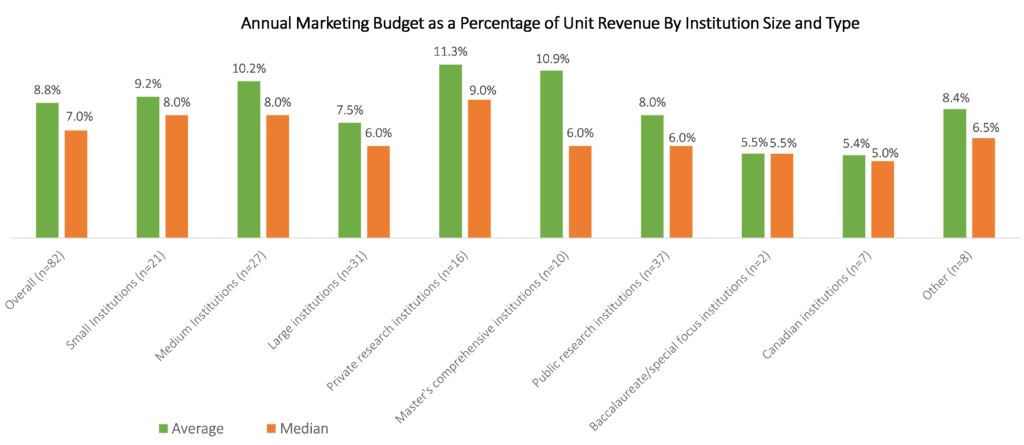
Institutions and their PCO units appear to be choosing “fight” as their option, as they are investing in enrollment generating activities, as opposed to business-as-usual approaches. Evidence of this can be found in the 2021-2022 UPCEA Marketing Survey of 153 institutions. The survey shows that professional, continuing and online education units are devoting more resources to marketing. The average marketing budget is now 8.8% of gross revenues compared to 5.1% in 2020. One explanation of this could be that institutions are eager and concerned about lost revenue and enrollments due in part to the impending demographic cliff and increased competition, as well as disengaged or disenfranchised students to higher education. Another explanation could also be that PCO units are now marketing a more expansive portfolio that not only includes staples such as fully online graduate degrees, but also online baccalaureate programs, credit and noncredit certificates and other alternative credentials.
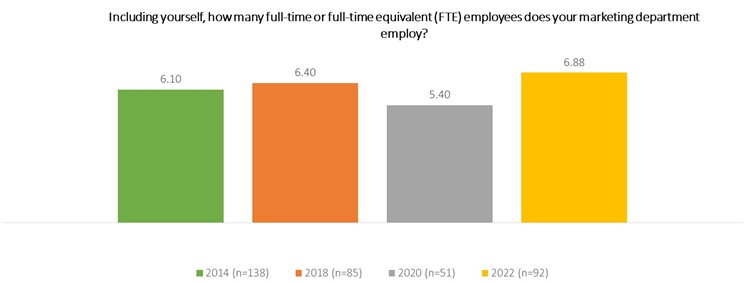
Units are spending 43% of their marketing budget on media, 25% on staffing and 20% on outsourced services. The average marketing department employs 6.88 full-time equivalent (FTE) marketing staff or using the median, as opposed to the average, 5.25 FTE marketers. This is a significant increase since 2020, up 1.4 FTEs on average during this timeframe. The increase may signify a desire to more aggressively enter a potentially more competitive, post-pandemic marketplace and/or to address changes to an institution’s portfolio, such as with a greater emphasis on alternative credentials.
It would appear that a lot is at stake and that institutions overall appear to be choosing to fight, relying heavily on their PCO units to reach lost or disenfranchised traditional students, traditional students seeking convenience, busy professionals seeking fully online degree programs, and skill seekers and career enhancers seeking shorter training or microcredentialing options. As part of this process, PCO units will need to address other issues and not just “throw money at it.” They will need to redesign and evaluate processes to be more user-centric and better strategize their enrollment management process to convert inquiries at the highest level possible. They will also need to address marketing organizational structure and talent acquisition, as well as retention, as marketers will be highly sought-after post-pandemic. These marketers may also benefit from increased salary and flexible work benefits, as the profession is well-suited for remote work situations.
Learn more about UPCEA's expert consultants.
Do you need help with your PCO unit or campus? We can help. Contact UPCEA Research and Consulting for a brief consult. Email [email protected] or call us at 202-659-3130.
Trusted by the nation's top colleges and universities, UPCEA Research and Consulting provides the best value in the industry today. UPCEA's industry experts have years of experience in Online and Professional Continuing education - put them to work for you!
UPCEA Research and Consulting offers a variety of custom research and consulting options through an outcomes-focused pricing model. Find the option(s) that best suit your institution.
Learn more about UPCEA Research & Consulting
The UPCEA Difference
Unmatched Experience: For more than 100 years, UPCEA consultants have exclusively served the needs of online and professional continuing education programs. UPCEA consultants leverage their extensive industry expertise to expedite solutions, anticipate upcoming shifts, and offer distinct best practices, effectively aiding clients in achieving their goals.
Cost Effectiveness: As a nonprofit, member-serving organization, we provide unmatched value, allowing you to maximize limited research and consulting budgets.
Action in Motion: Our cadre of experienced, skilled authorities and expert practitioners propels you forward, translating research and consulting into impactful implementation, a distinctive hallmark of UPCEA. Our team of current and former institutional leaders will support you, turning research and consulting into action.
Mission Alignment: Like you, our mission is to enhance and expand educational opportunities and outcomes for adult and other non-traditional learners. We share your values and work in partnership with you to advance access and excellence in education.