
New report from UPCEA – 2024 Staffing & Structure Survey Results
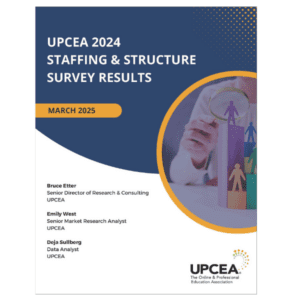 The 2024 UPCEA Staffing & Structure Survey examines the structure, staffing, enrollment, and financial operations of online and PCE units of 108 institutions of varying sizes and types. Public research institutions and large to medium-sized institutions dominate the sample, with online and PCE units often housed within the provost’s office or as standalone entities. Staffing levels range from small teams to larger units, supporting thousands of credit and non-credit enrollments annually. Financially, online and PCE units generate significant gross and net revenues, with budgets primarily allocated to staff salaries. Revenue-sharing models vary, with many units sharing a percentage of revenue with other departments. These insights reveal the critical role that online and PCE units play in providing flexible educational opportunities and driving institutional revenue.
- Forty-four percent of institutions have an online and PCE unit that resides in the provost’s office, 22% have a standalone unit, and 17% are nested within multiple academic units.
- Nearly a third (32%) of online and PCE units have under 10 FTE staff in their unit, while 27% have between 21 to 50. On average, online and PCE units have 43 FTE staff, with a median of 20.
- The average unduplicated headcount for credit enrollments is 5,539 and the average number of credit hours is 146,563. The average unduplicated headcount for non-credit enrollments is 3,340 and the average number of non-credit registrations is 7,653.
- On average, online and PCE units have a total gross revenue of $16.8M with a median of $6.0M and a total net revenue of $8.9M with a median of $1.0M.
- Fifty-nine percent of respondents said their online and PCE unit shares a percentage of revenue with other departments at their institution, while 12% share a flat fee, and 37% have “Other” revenue sharing agreements.
- Thirty percent of respondents have an online and PCE unit with an operating budget between $1M-$5M, while 23% have an operating budget under $1M. Online and PCE units have an average overall operating budget of $9.4M with a median of $2.8M.
- On average, online and PCE units allocate 61% of their budget to staff salaries with a median of 65% and an average of 27% to operational expenses with a median of 25%.
Authored by
Learn more about UPCEA's expert consultants.
Do you need help with your PCO unit or campus? We can help. Contact UPCEA Research and Consulting for a brief consult. Email [email protected] or call us at 202-659-3130.
Trusted by the nation's top colleges and universities, UPCEA Research and Consulting provides the best value in the industry today. UPCEA's industry experts have years of experience in Online and Professional Continuing education - put them to work for you!
UPCEA Research and Consulting offers a variety of custom research and consulting options through an outcomes-focused pricing model. Find the option(s) that best suit your institution.
Learn more about UPCEA Research & Consulting
The UPCEA Difference
Unmatched Experience: For more than 100 years, UPCEA consultants have exclusively served the needs of online and professional continuing education programs. UPCEA consultants leverage their extensive industry expertise to expedite solutions, anticipate upcoming shifts, and offer distinct best practices, effectively aiding clients in achieving their goals.
Cost Effectiveness: As a nonprofit, member-serving organization, we provide unmatched value, allowing you to maximize limited research and consulting budgets.
Action in Motion: Our cadre of experienced, skilled authorities and expert practitioners propels you forward, translating research and consulting into impactful implementation, a distinctive hallmark of UPCEA. Our team of current and former institutional leaders will support you, turning research and consulting into action.
Mission Alignment: Like you, our mission is to enhance and expand educational opportunities and outcomes for adult and other non-traditional learners. We share your values and work in partnership with you to advance access and excellence in education.