
Consensus Achieved on New Accountability Metrics at AHEAD Negotiated Rulemaking | Policy Matters (January 2026)
Major Updates
Education Department AHEAD Negotiated Rulemaking Wraps Up; Consensus Achieved on New Accountability Metrics
The Department of Education’s AHEAD negotiated rulemaking committee has now wrapped its winter work with consensus language on the program accountability portion, following the committee’s earlier consensus on Workforce Pell regulatory text. Now that consensus has been reached, ED is positioned to move from negotiated language into one (or likely two or more) Notices of Proposed Rulemaking (NPRMs), with a public comment period expected soon. This matters because the negotiated package is designed to implement major statutory changes adopted in the One Big Beautiful Bill Act (OBBBA), with ED moving on an accelerated timeline toward a July 1, 2026 effective date rather than the usual “final rule by November 1” cadence of the federal calendar.
Substantively, the consensus framework is built around a sector-neutral “do no harm” earnings comparison that would apply broadly across Title IV-eligible programs (not just “gainful employment” programs). Programs would be evaluated on whether completers’ earnings meet or exceed the earnings of an identified comparison group (generally working adults ages 25–34 without the same level of education). Importantly, this comparison is calculated without accounting for the previously known debt-to-earnings ratio. Programs that fail the earnings comparison in 2 out of 3 consecutive years would lose eligibility for Direct Loans, creating a materially higher stakes, outcomes-based compliance environment for institutions.
For campus leaders, the immediate to-dos are less about waiting for final thresholds and more about building readiness: identify programs that could be vulnerable under an earnings-based test (initial draft calculations were issued by the Department). Also plan internal governance now—finance, registrar, institutional research, career services, and program leadership will all need aligned processes for monitoring outcomes and responding quickly if a program is trending toward failure as the proposed rules move through notice-and-comment. Read more.
Resources:
- Webinar Recording | Decoding Workforce Pell and the New Program Accountability Framework
UPCEA has a recording and slides available that walk through what negotiators debated on Workforce Pell for short-term credentials as well as the discussions and regulations on the emerging, earnings-based accountability framework. For administrators tracking both program expansion opportunities and Title IV risk, it’s a useful “single-stop” resource to compare the statutory parameters Workforce Pell must follow and the requirements that will apply to almost all programs as part of the new earnings metrics required from OBBBA. Watch the webinar and access the slide deck.
- Analysis on Accountability Changes from Ricky LaFosse from the University of Michigan (& UPCEA Senior Policy Fellow).
Department of Education Seeks Info on State Authorization Student Location Reporting – (Public Comment Deadline March 16th)
ED (Federal Student Aid) has opened a public comment period (due March 16, 2026) on the information collection tied to state authorization requirements under 34 CFR § 600.9. The notice asks for data collection insights on institutions that determine the state in which a student is located when enrolled in distance education/correspondence (including when operating under a reciprocity agreement). This is a good prompt for institutions to review their student-location determination process, documentation practices, and how those workflows map to multi-state authorization/reciprocity obligations—then consider submitting operational feedback during the comment window. Read more and submit a comment.
Accreditation, Innovation, and Modernization (AIM) Committee: Rulemaking Committee Announced
The Department of Education has formally launched a new 2026 negotiated rulemaking process, the Accreditation, Innovation, and Modernization (AIM) Committee, to pursue potential regulatory changes. The committee’s first negotiating session is scheduled for April 13–17, 2026 in Washington, DC (ED headquarters), with livestreaming available and a second session planned for May 18–22, 2026; registration for attending sessions is noted as “coming soon.” For universities, this is an early signal to issue recommendation for nominators, as well as flag likely accreditation-related regulatory issues that could impact institutional strategy (including oversight, innovation pathways, and modernization efforts), and prepare to engage,either by attending/livestream participation and/or shaping positions for the eventual public comment stage. Read more about the upcoming rulemaking here.
Other News
- Higher Education Litigation Summary: January 2026 (Thompson Coburn LLP)
- Trump’s next plan for the US education system: Lots and lots of rules (Politico)
- Senate advances bills rejecting Trump’s efforts to slash research funding (Higher Ed Dive)
- Webinar Recording | Online Education Goes Global: Navigating Policy and Legal Issues for Enrolling Internationally-Located Students
Policy Matters: Primers and Insights
Helping you navigate policy frameworks critical to higher education in the United States.
Access our resources providing an introduction to foundational topics in federal legislation and regulations impacting online and professional continuing education for universities and colleges. Read more.
UPCEA is a proud founding and steering committee member of the Today's Students Coalition.
UPCEA 2025-2026 Policy Committee
Corina Caraccioli, Loyola University New Orleans, Co-Chair
Abram Hedtke, St. Cloud State University, Co-Chair
Bridget Beville, University of Phoenix
Curtis Brant, Bowling Green State University
Kristen Brown, University of Louisville
Amy Collier, Middlebury College
Ilona Marie Hajdu, Indiana University
Laura Hendley, Stevenson University
Gloria Niles, University of Hawaii System
Kelly Otter, Georgetown University
Erika Swain, University of Colorado Boulder
Craig Wilson, University of South Carolina
Get Involved with UPCEA
Professional development isn't just about attending sessions. Get involved with UPCEA to meet members from other institutions, share the great work your institution is doing, and hone your own skills. From submitting a session proposal for a conference or an article for a publication to serving as a volunteer on a conference planning committee, there are as many ways to engage with us!
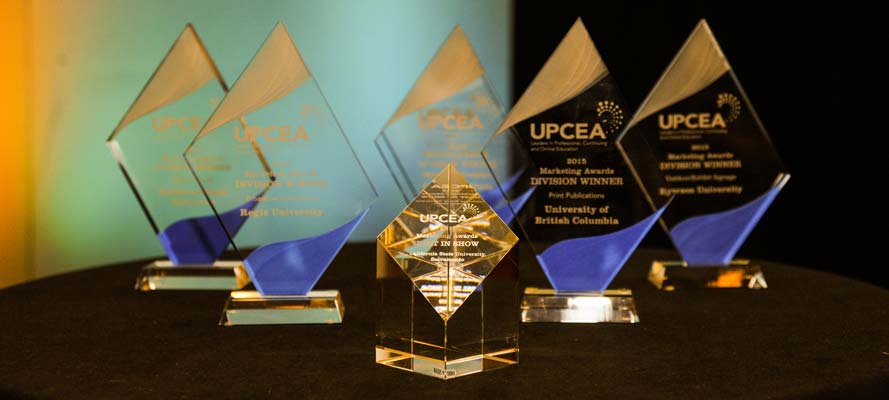
Awards of Excellence
Since 1953, UPCEA has recognized its members' outstanding contributions to the Association and the field, as well as their achievements in innovative programming, marketing and promotion, community development and services, research and publications, and many other areas.