
The student journey has changed — and expectations are rising.
Students today are moving faster, arriving more informed, and expecting experiences that feel responsive and personalized. Research behaviors are shifting, and AI is increasingly shaping how prospective students discover and evaluate programs. The path to enrollment is becoming more complex and more personalized, and students are less tolerant of generic or delayed communication.
At the same time, institutions are facing continued pressure to improve enrollment performance while strengthening student outcomes. Many are working to create experiences that are faster, more flexible, and more supportive, often with constrained staffing and increasingly complex technology environments.
The challenge isn’t a lack of commitment. It’s that delivering modern engagement at scale requires something many institutions don’t yet have: a unified, usable view of the student.
The challenge behind personalization at scale
Most institutions have more student and prospect data than ever before. But much of that information lives in separate systems across admissions CRMs, financial aid systems, marketing platforms, student information systems (SIS), learning systems (LMS), advising tools, and other services.
When data is fragmented, it becomes difficult to:
- Understand student intent and readiness
- Coordinate outreach across teams and channels
- Identify who needs support and when
- Act quickly and confidently without manual effort
This problem is becoming even more visible as institutions invest in AI-enabled engagement. Data quality matters. Disconnected or incomplete data weakens outcomes, while first-party data and integrated systems create better signals for personalization and timely decision-making.
Building an institution’s connected core helps bridge these gaps by creating a shared foundation across teams and platforms. It does not require replacing every system, but it does require connecting them in a way that makes student insight usable, timely, and consistent.
Enter the “student digital twin”
One idea gaining traction in higher education is the concept of a student digital twin. This is a virtual representation of a learner built from connected signals across the lifecycle.
In simple terms, it’s a way to turn scattered student data into a clearer and more actionable picture. The purpose isn’t to add complexity; it’s to make engagement feel more human and more relevant by giving teams better context and better timing.
A student digital twin helps institutions shift from fragmented, manual approaches to more proactive engagement that is informed by real student needs. By connecting key signals across the learner journey, it becomes easier to deliver timely support, align outreach across teams, and make decisions with greater consistency.
In practice, this means institutions can bring together insights from inquiry and application through enrollment, persistence, and completion, creating a clearer picture of what each learner may need next. Ultimately, the value is simple: humanizing data, one student at a time.
Different students, different pathways, different needs
Many institutions serve diverse student populations with distinct motivations, constraints, and expectations. A one-size-fits-all experience does not reflect reality.
Consider two examples:
- Emily, an online graduate prospect, is balancing a full-time career and looking for a program that fits into a demanding schedule. She values purpose-driven education, but she also needs clear information and fast answers.
- James, an adult degree completer, is focused on practical outcomes and long-term stability. He may be weighing cost, confidence, and time-to-completion while navigating work and family responsibilities.
Both students need guidance, but not in the same way.
Personalization at scale doesn’t require institutions to create an entirely unique journey for every learner. But it does require the ability to recognize differences in motivation, readiness, and barriers — and respond accordingly.
Making personalization practical at scale
Many institutions assume personalization requires rebuilding their entire tech stack or adding new tools. In reality, progress often starts with a more practical foundation: connected insight and better orchestration across what already exists.
Here are four high-level ways institutions can begin moving toward a more personalized model:
1. Focus on unified insight, not more complexity
The first step isn’t “more data.” It’s a clearer view of the data you already have — across systems and teams — so that decisions and outreach aren’t happening in silos.
2. Prioritize the moments where students stall
Institutions don’t need to personalize everything at once. Many can start by identifying high-impact friction points, such as:
- Inquiry to application
- Application to admit
- Admit to deposit
- First-term persistence or re-enrollment
3. Combine human touch + automation
Students want speed, but they also want connection. In most cases, the right approach is human outreach + automation, working together.
This can look like:
- Faster follow-up when intent is high
- Tailored content when confidence is low
- Escalation to an advisor when signals indicate risk
4. Build trust through relevance and clarity
In a crowded market, brand and content matter. Students are more likely to engage when communication feels helpful, specific, and credible, and when it arrives at the right time.
Keeping student engagement secure and transparent
As institutions pursue more connected and personalized engagement, trust must remain central. Responsible personalization depends on the following:
- Secure and integrated data practices
- Transparency and governance around how information is used
- A clear purpose: improving outcomes and student support
When done thoughtfully, connecting learner signals can help institutions deliver experiences that feel less transactional and more supportive, without compromising privacy or integrity.
The future of enrollment and student success is connected
Industry shifts are reshaping how students connect with institutions, and expectations will continue to rise. To drive growth in 2026 and beyond, institutions will need the ability to unify lifecycle data and deliver experiences that are faster, more relevant, and more supportive. This must include the right mix of self-service and human outreach.
The institutions that win won’t necessarily be the ones with the most systems. They’ll be the ones that can create clear, connected insight and turn it into smarter journeys for every learner.
Collegis Education partners with colleges and universities to strengthen enrollment, student success, and institutional outcomes. We help institutions improve the student experience across the full lifecycle by aligning data, technology, and specialized expertise.

By Dave Jarrat
The higher education landscape is arguably the toughest it has been in a generation, marked by economic instability, demographic decline, and the constant imperative for greater efficiency. The 2026 Landscape of Higher Education Report confirms this volatile reality: beginning in 2026, many institutions will face a sustained decline in traditional-aged undergraduates. Enrollment growth is now concentrated in new markets, such as adult learners seeking rapid reskilling and the millions of Americans with “some college, no credential”.
Despite these pressures, the budget picture for online enterprises is not entirely bleak. The Benchmarking Online Enterprises (BOnES) Report highlights an opportunity, noting that median budgets and revenues for online enterprises increased markedly between 2024 and 2025. The money is being spent, but it’s shifting to areas that promise a clear return on investment. To succeed in 2026, partners must pivot from pitching “nice-to-have” services to positioning themselves as essential solutions that directly address the core institutional pains of revenue generation and operational efficiency.
The AI “Gold Rush” is Here (But It’s Specific)
Artificial Intelligence has swiftly moved from experimental technology to an operational necessity. Data from UPCEA and Search Influence reveals that many prospective students are already using AI-powered tools on a daily or weekly basis to research education programs. For online enterprises, the focus is squarely on efficiency: the BOnES Report shows that AI use is most concentrated in teaching and administrative functions.
Partners should stop selling generic “AI features” and instead focus on delivering quantifiable value in two key areas: visibility and efficiency. This means pitching AI search optimization that ensures a school’s programs rank prominently in AI-generated overviews. It also means offering AI-powered solutions like advanced chatbots that can handle prospective student queries at 3 a.m., reducing the need for additional administrative staff and plugging holes in the student journey.
The “Leaky Bucket” of Inquiry Management
One of the most immediate and fixable drains on institutional revenue is the “leaky bucket” of poor inquiry management. The Enrollment Process Review Secret Shopper Analysis shows that response rates declined across most inquiry types in 2025. This lack of responsiveness represents a massive amount of lost revenue potential.
Partners have a clear path to becoming essential by offering solutions that directly plug these revenue holes. This includes full CRM optimization, automated lead nurturing sequences, and “mystery shopper” audits to diagnose the specific breakdowns in an institution’s process. The core of the pitch must be fixing the “speed to lead” problem by transforming poor responsiveness into a seamless, modern, and personalized engagement experience.
Staffing vs. Outsourcing: The “Nested” Unit Opportunity
Institutional structure is a major driver of spending and inefficiency. The BOnES Report highlights a complex web of governance, with most institutions operating on an academically decentralized model and nearly an even split between administratively decentralized and centralized operations. Decentralization can enable responsiveness, but it often creates overlapping responsibilities and competing priorities.
Corporate Partners must tailor their pitch based on this structure. “Standalone” units are focused on revenue maximization, while “Nested” or highly decentralized units require tools for coordination, efficiency, and managed services to manage internal chaos. Managed services can fill critical staffing gaps, particularly for specialized roles like instructional design. Offering “fractional” staffing or managed services can provide the quick, high-impact efficiency gains these decentralized units desperately need.
The “Career Outcomes” Mandate
Public skepticism about the value of higher education continues to deepen. In this environment, the connection between education and immediate career outcomes has become a mandate for institutional survival. The BOnES Report notes that program portfolios remain anchored by graduate degrees and certificates, but many institutions are also sustaining broad adoption of microcredentials.
Any partner offering content, curriculum development, or labor market data must tie their solution directly to employability. The goal is to help institutions rapidly launch the high-demand, career-aligned programs—such as those in healthcare or business—that they are desperate to develop to replace enrollment declines in other areas.
The “Some College, No Credential” Market
The single most significant growth opportunity available to institutions is the massive, untapped “Some College, No Credential” market. The 2026 Landscape of Higher Education Report identifies millions of Americans who have some college experience but no degree as a significant scalable opportunity for growth.
These adult learners represent a student population that is already familiar with higher education but requires specific, targeted support to re-enroll and complete their degree. Partners should focus their pitches on retention and re-enrollment solutions. This means offering services that are designed to help institutions find, bring back, and, most importantly, keep these adult learners through flexible, career-focused, and student-centric support.
Conclusion
The days of being a “nice-to-have” vendor are over. The modern higher education budget is reserved for partners who can demonstrate a clear and immediate return on investment, whether through direct revenue generation or operational efficiency.
As you review your 2026 sales strategy, ask yourself: Does your pitch speak to the efficiency imperative, address revenue protection gaps, and directly solve the challenges of serving the complex “Modern Learner”? The partners that will survive and thrive in the coming years will be the ones that have proven themselves essential.
Dave Jarrat serves as a Senior Fellow for UPCEA and as a Strategic Advisor to a broad range of higher education institutions and organizations, including the University of Cambridge, Edquity and Scholarships360. He is a social impact executive focused on improving educational opportunities and outcomes for historically underrepresented populations.
As we look at Artificial Intelligence in teaching and learning, we must look beyond facts, figures and formulas to ensure that the skill of perceiving and managing feelings, emotions and personalization are engaged in the process.
Looking back on my lifelong history of learning experiences, the ones that I would rank as most effective and memorable were the ones in which the instructor truly “saw” me, understood my motivations and encouraged me to apply the learning to my own circumstances. This critical aspect of teaching and learning is included in most every meaningful pedagogical approach. We commonly recognize that the best practices of our field include a sensitivity to and understanding of the learner’s experiences, motivations, and goals. Without responding to the learner’s needs, we will fall short of the common goal of internalizing whatever learning takes place.
Some might believe that AI as a computer-based system, merely addresses the facts, formulas and figures of quantitative learning rather than emotionally intelligent engagement with the learner. In its initial development that may have been true, however, AI has developed the ability to recognize and respond to emotional aspects of the learner’s responses. In September 2024, the South-East Europe Design Automation, Computer Engineering, Computer Networks and Social Media Conference included research by four professors from the University of West Attica, Egaleo, Greece, Theofanis Tasoulas; Christos Troussas; Phivos Mylonas; Cleo Sgouropoulou titled Affective Computing in Intelligent Tutoring Systems: Exploring Insights and Innovations. The authors described the importance of including affective engagement into developing learning systems:
Integrating intelligent tutoring systems (ITS) into education has significantly enriched personalized learning experiences for students and educators alike. However, these systems often neglect the critical role of emotions in the learning process. By integrating affective computing, which empowers computers to recognize and respond to emotions, ITS can foster more engaging and impactful learning environments. This paper explores the utilization of affective computing techniques, such as facial expression analysis and voice modulation, to enhance ITS functionality. Case studies and existing systems have been scrutinized to comprehend design decisions, outcomes, and guidelines for effective integration, thereby enhancing learning outcomes and user engagement. Furthermore, this study underscores the necessity of considering emotional aspects in the development and deployment of educational technology to optimize its influence on student learning and well-being. A major conclusion of this research is that integration of affective computing into ITS empowers educators to customize learning experiences to students’ emotional states, thereby enhancing educational effectiveness.
In a special edition of the Journal of Education Sciences, MDPI, published in August 2024, Jorge Fernández-Herrero writes in a paper titled Evaluating Recent Advances in Affective Intelligent Tutoring Systems: A Scoping Review of Educational Impacts and Future Prospects:
Affective intelligent tutoring systems (ATSs) are gaining recognition for their role in personalized learning through adaptive automated education based on students’ affective states. This scoping review evaluates recent advancements and the educational impact of ATSs, following PRISMA guidelines for article selection and analysis. A structured search of the Web of Science (WoS) and Scopus databases resulted in 30 studies covering 27 distinct ATSs. These studies assess the effectiveness of ATSs in meeting learners’ emotional and cognitive needs. This review examines the technical and pedagogical aspects of ATSs, focusing on how emotional recognition technologies are used to customize educational content and feedback, enhancing learning experiences. The primary characteristics of the selected studies are described, emphasizing key technical features and their implications for educational outcomes. The discussion highlights the importance of emotional intelligence in educational environments and the potential of ATSs to improve learning processes.
Notably, agentic AI models have been assigned tasks to monitor and provide adaptations to respond to the changing emotions of learners. Tom Mangan wrote last month in an EdTech article titled “AI Agents in Higher Education: Transforming Student Services and Support” :
Agents will be able to gather data from multiple sources to assess a student’s progress across multiple courses. If the student starts falling behind, processes could kick in to help them catch up. Agents can relieve teachers and administrators from time-consuming chores such as grading multiple-choice tests and monitoring attendance. The idea is catching on. Andrew Ng, co-founder of Coursera, launched a startup called Kira Learning to ease burdens on overworked teachers. “Kira’s AI tutor works alongside teachers as an intelligent co-educator, adapting in real-time to each student’s learning style and emotional state,” Andrea Pasinetti, Kira Learning’s CEO, says in an interview with The Observer.
We are no longer limited to transactional chatbots that respond to questions from students without regard to their background, whether that be academic, experiential or even emotional. Using the capabilities of advanced AI, our engagements can analyze, identify and adapt to a range of learner emotions. These components are often the hallmark of excellent, experienced faculty members who do not teach only to the median of the class but instead offer personalized responses to meet the interests and needs of individual students.
As we look ahead to the last half of this semester, and succeeding semesters, we can expect that enhanced technology will enable us to better serve our learners. We will be able to identify growing frustration where that may be the case or the opportunity to accelerate the pace of the learning experience when learners display comfort with the learning materials and readiness to advance at their own pace ahead of others in the class.
We all recognize that this field is moving very rapidly. It is important that we have leaders at all levels who are prepared to experiment with the emergent technologies, demonstrate their capabilities, and lead discussions on the potential for implementations. The results can be most rewarding with a higher percentage of learners more comfortably reaching their goals. Are you prepared to take the lead in demonstrating these technologies to your colleagues?
This column was originally published in Inside Higher Ed.
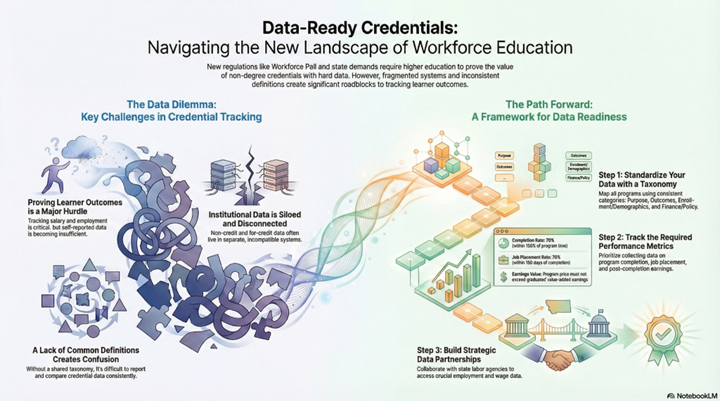
The expansion of Pell Grant eligibility to short-term, non-degree programs—commonly known as Workforce Pell—has become a defining moment for credential innovation. In a strategic conversation hosted by UPCEA in December 2025, higher education leaders made one thing clear: access to Workforce Pell is not primarily a policy challenge. It is a data challenge.
As institutions rush to prepare for Workforce Pell, the conversation revealed both a sense of urgency and a sobering reality. While the opportunity to expand access to federal aid for learners in short-term programs is transformative, many colleges and universities are not yet equipped to meet the data demands that come with it.
Workforce Pell as a Catalyst for Data Urgency
Workforce Pell introduces stringent federal “guardrails” that fundamentally change expectations for non-degree programs. To be eligible, programs must meet specific requirements around length, labor market alignment, credential value, and (most critically) outcomes. Institutions must demonstrate:
- A 70% completion rate
- A 70% job placement rate within 180 days
- Positive earnings outcomes that must exceed published tuition and fee costs
- The above are just a few requirements alongside Workforce Pell’s other program eligibility metrics
These metrics are not aspirational; they are mandatory. As one participant put it, the data required to tap into Workforce Pell funding “will be critical for all of us.” For many institutions, this marks the first time noncredit programs are subject to accountability standards comparable to degree programs.
The Outcomes Data Problem No One Has Solved (Yet)
The most significant barrier to Workforce Pell readiness is outcomes data, especially employment and earnings. Historically, noncredit programs have relied heavily on self-reported alumni surveys. That approach is no longer sufficient.
Leaders agreed that self-reported data will not meet federal verification standards, particularly for earnings. The path forward increasingly points toward integration with State Longitudinal Data Systems (SLDS) and federal wage records. While these systems offer more reliable data, they also introduce new complexities, including data-sharing agreements, cross-agency coordination, and the controversial reintroduction of Social Security number collection.
For many institutions, this raises serious concerns about privacy, compliance, and technical capacity. Systems that were never designed to track learners beyond program completion must now support long-term outcomes reporting.
Beyond Metrics: The Challenge of Proving Impact
Even with access to wage data, leaders questioned whether outcomes metrics alone can tell the full story. Proving that a specific credential directly caused a raise, promotion, or job change is inherently difficult. Career trajectories are shaped by many variables, making causality “messy” at best.
Some institutions are experimenting with alternative indicators of success such as job interviews secured, employer engagement, or learner confidence, but these qualitative measures sit uncomfortably alongside federally mandated quantitative metrics. The tension highlights a broader challenge: aligning compliance-driven reporting with learner-centered definitions of success.
Institutional Silos Are the Hidden Risk
Before institutions can report outcomes externally, they must first confront internal fragmentation. A recurring theme was the deep divide between credit and noncredit data systems, which are often entirely disconnected. This separation makes it nearly impossible to create a comprehensive learner record or track stackable credentials over time.
Governance issues compound the problem. As non-degree credentials become more embedded in academic pathways, questions of data ownership (who collects it, manages it, and reports it) are becoming politically charged. Add in third-party providers and online platforms, and visibility into credential activity becomes even more limited and manual.
Underlying all of this is a more fundamental issue: the lack of a shared language. Without consistent definitions and taxonomies for alternative credentials, institutions struggle to align systems, compare outcomes, or tell a coherent story to policymakers and the public.
A System-Level Challenge, Not Just a Campus One
For institutions operating near state borders, outcomes tracking becomes even more complex. Learners may train in one state and work in another, complicating access to wage records and placement data. These realities underscore the need for interstate coordination and stronger data partnerships with workforce agencies, an area where many institutions are just getting started.
Frameworks Pointing the Way Forward
Despite the challenges, the conversation surfaced practical tools that institutions can use to move forward:
- UPCEA’s Workforce Pell Readiness Checklist helps institutions assess readiness across data systems, governance, compliance, and strategy.
- Rutgers’ Noncredit Data Taxonomy 2.0 offers a detailed framework with consistent definitions and more than 90 recommended data elements.
- Credential Engine’s Equity Data Tiers provide a phased approach to publishing data, starting with foundational metrics and building toward next-generation indicators of social mobility.
Together, these resources emphasize that progress is possible but only with intentional planning.
Start Small, Tell the Right Story, Build Coalitions
Perhaps the most important takeaway was philosophical rather than technical. Leaders urged institutions not to be paralyzed by the scale of the challenge. Instead:
- Start with the data you can control.
- Be clear about the story you want your data to tell.
- Build cross-campus coalitions that include registrars, financial aid, workforce leaders, and academic leadership.
- Stay engaged in national conversations as Workforce Pell policy continues to evolve.
Workforce Pell is forcing higher education to confront long-standing gaps in how non-degree learning is defined, tracked, and valued. Institutions that treat this moment as a compliance exercise may struggle. Those that see it as a catalyst for building learner-centered, outcome-driven data systems may emerge stronger and better prepared for the future of credential innovation.
Read the full briefing from the event here.
Julie Uranis, Ph.D., is UPCEA’s Senior Vice President for Online and Strategic Initiatives.
Amy Heitzman, Ph.D., is UPCEA’s Deputy CEO and Chief Learning Officer.
Melissa Peraino is UPCEA’s Director of Content Development and Volunteer Leader Management.
Stacy Chiaramonte is UPCEA’s Senior Vice President of Strategy and Operations for Research and Consulting.
Content for this resource was refined with the assistance of ChatGPT, an AI language model. All text has been thoroughly reviewed, edited, and approved by UPCEA staff with subject matter expertise. References and links have been verified for accuracy and reliability.

By Amy Claire Heitzman, Ph.D.,
Deputy CEO and Chief Learning Officer, UPCEA
As questions about the value, cost, and structure of a traditional bachelor’s degree continue to intensify, higher education leaders are confronting a reality that has remained largely unchanged for decades: the 120-credit-hour degree is more a historical artifact than a learner-centered design choice. During a recent conversation with UPCEA Institutional Representatives, panelists and participants explored what it might mean to thoughtfully reimagine undergraduate degrees below 120 credits—without eroding quality, mission, or trust.
The discussion made clear that reduced-credit degrees are not about subtraction for its own sake. Rather, they represent an opportunity to re-center degrees around purpose: clearer outcomes, stronger alignment with employer expectations, and faster, more affordable pathways to economic mobility. Panelists pointed to international models, such as three-year degrees common across Europe, and to post-pandemic learner realities, where time-to-completion and debt burden increasingly shape enrollment decisions.
At the same time, participants raised critical cautions. Innovation must be driven by the right reasons, not simply revenue pressures or superficial course cutting. Institutions must ask hard questions about what is gained and what may be lost: How do we preserve broad learning outcomes? How do faculty define “wins” in new degree models? How do accreditation, financial aid, and enrollment management structures need to evolve in tandem?
Audience questions underscored the operational and ethical complexity of this work. Leaders grappled with state and accreditor approval processes, the role of prior learning assessment, impacts on financial aid eligibility, and the risk of designing degrees for markets that may not require them. Yet there was also a shared recognition that standing still carries its own risk. As skepticism about higher education grows, institutions that fail to adapt may unintentionally exclude learners who need more flexible, focused pathways.
What emerged was not a single model to replicate, but a call for disciplined experimentation: pilots grounded in data, labor market insight, and institutional mission. Reduced-credit degrees, panelists emphasized, should be additive, not replacements; tools for expanding who higher education serves and how responsibly it does so.
Key Considerations for Institutions Exploring Reduced-Credit Degrees
Drawing on panel insights and audience dialogue, the following considerations may help guide institutional decision-making:
Who
How will we validate learner demand and define the target audience for this degree? What personas are we designing for (recent high school graduates, adults with some college and no credential, career switchers, veterans, or working professionals) and how do modality, maturity, and prior experience shape program design?
Why
What learner and societal outcomes does this degree enable? How will we measure success in terms of employment outcomes, persistence, time-to-completion, and economic mobility, and for whom?
What
What competencies distinguish this reduced-credit degree from existing credentials? How might AI-assisted curriculum mapping help clarify expectations, integrate core learning outcomes, and communicate value to learners, faculty, and employers?
How
What role will credit for prior learning, veterans’ pathways, experiential learning, or long-running internships play in ensuring rigor while reducing time and cost? How do these pathways uphold institutional responsibility to learners’ trust and investment?
Cost
What enrollment thresholds are required for sustainability, and how do they align with documented labor market demand? How will financial, enrollment management, and faculty incentive structures support (not undermine) this model?
Reduced-credit degrees are not a shortcut; they are a design challenge. For institutions willing to engage that challenge thoughtfully, they may also be a powerful expression of stewardship of learners’ time, money, and aspirations at a moment when higher education’s relevance is under intense scrutiny.
Amy Heitzman is Chief Learning Officer and Deputy CEO of UPCEA, leading work at the intersection of research, policy, and innovation in professional, continuing, and online education.
Content for this resource was refined with the assistance of ChatGPT, an AI language model. All text has been thoroughly reviewed, edited, and approved by UPCEA staff with subject matter expertise. References and links have been verified for accuracy and reliability.
Introduction
Higher education is at a crossroads, marked by declining public trust, diminishing enrollments, substantial budget cuts, and increased scrutiny on post-college outcomes. Recent research from UPCEA underscores growing skepticism about the value of traditional degrees, driving institutions and learners alike to explore innovative educational pathways and revenue models (UPCEA, 2025). To address these challenges and future-proof both institutions and students’ careers, consider these five strategies.
1. Diversify Educational Offerings
In a survey published by Inside Higher Ed, 73% of high schoolers reported viewing a certificate program as good or greater in value as a college degree. In response to shifting student expectations and workforce demands, institutions must expand beyond traditional degree programs. Specialized certifications and microcredentials offer learners practical skills in shorter timeframes, appealing to students seeking immediate employability.
This national conversation has gained momentum with the April 2025 White House Executive Order on Preparing Americans for High-Paying Skilled Trade Jobs of the Future. The order underscores the need for flexible, career-focused training pathways that can accelerate entry into high-demand fields. By diversifying program portfolios to include stackable credentials, trade-focused certificates, and industry-aligned microcredentials, colleges and universities can both respond to federal priorities and attract learners who value practical outcomes. Institutions that act quickly will strengthen their relevance and broaden their appeal to non-traditional learners, adult upskillers, and workforce partners alike.
2. Prioritize Affordability And Accessibility
Affordability remains a top concern for today’s students, and addressing it is essential to improving access and retention. The State of Continuing Education 2025 report highlights how cost sensitivity is pushing learners toward alternatives outside degree pathways. Paired with disruptions to FAFSA and financial aid processes, many students are left questioning whether higher education is worth the investment.
Institutions that can reduce cost and time barriers — without compromising quality — will be better positioned to meet student needs and expand their reach. Flexible payment options, accelerated pathways, and programs designed to minimize debt are increasingly crucial.
Institutions that ignore the affordability crisis risk losing students not just to competitors, but to the growing number of learners who opt out of higher education altogether.
3. Enhance Career Readiness
Students increasingly prioritize programs that align with real career opportunities and equip them with in-demand skills. Embedding real-world training, tools, and industry connections into educational offerings ensures graduates are prepared to excel in competitive job markets. UPCEA’s Accreditation and Skill-Based Learning policy brief points to a national shift toward skills-first approaches, where success is measured less by degrees awarded and more by post-college employment outcomes.
To remain competitive, institutions must embed practical experiences, workforce tools, and employer engagement directly into curricula. Structured externships, applied learning labs, and access to industry-standard technology can differentiate programs. Institutions that fail to integrate career readiness into the student experience risk declining enrollments as learners migrate to providers who guarantee stronger career connections.
4. Leverage Industry Partnerships
Strategic partnerships with industry stakeholders are critical to aligning academic programs with market demands. The Accelerating Institutional Capacity for Employer Engagement in Credential Innovation report emphasizes that employer partnerships are no longer optional — they are essential. Schools that establish strong employer relationships can more effectively tailor curriculum and directly connect students with job opportunities.
Higher education institutions that embrace partnership models, whether through formal employer advisory councils, industry-recognized credential programs, or sector-specific workforce alliances, position themselves as hubs of talent development. By bridging the gap between academia and industry, colleges can ensure graduates are not just educated but employed, equipped with the skills to succeed in dynamic, evolving job markets.
5. Embrace Non-Traditional Revenue Streams
Budget cuts and declining enrollments are straining institutional finances. According to UPCEA’s State of Continuing Education 2025 report, professional and continuing education units are often the most financially efficient divisions within higher education, with some generating $5 in gross revenue for every $1 invested.
The healthcare sector provides a particularly strong opportunity. Lightcast projects a 10% growth in certified medical coder demand through 2035. Financial sustainability in higher education increasingly depends on diversified revenue sources that can withstand enrollment and funding fluctuations. Workforce-aligned programs offer opportunities to generate new revenue while serving growing segments of learners.
Conclusion
Institutions that embrace these strategies will be better positioned to weather industry disruption, maintain relevance in a competitive marketplace, and meet the evolving needs of learners and employers alike. Leveraging partnerships with organizations can offer proven pathways to deliver industry-recognized credentials, attract diverse learners, and ensure graduates are ready for career success.
About the Author
Leonta Williams, MBA, MHA, RHIA, CCS, CDIP, CPC, CPCO, CRC, CEMC, CHONC, is senior director of education at AAPC. She holds multiple credentials across several professional organizations and has more than 20 years of health information management experience as a coding director, auditor, educator, trainer, practice manager, and mentor. Williams is founder and past president of the Covington, Georgia local chapter and served as secretary on AAPC’s 2018-2021 National Advisory Board.
Agentic AI is no longer merely an interactive tool we talk to; it is a colleague that acts for us.
In a very active and highly competitive environment, AI has grown at breakneck speed. As with so many technologies, business and industry have moved far faster than academe to embrace the cost savings, capability expanding and wholly innovative aspects of AI. Fraught with our own industry-specific challenges such as enrollment downturns, sharp drops in perceived value, the striking “math cliff” in higher ed and a rapidly changing regulatory policy shift in state and federal administration, our field has been cast into a sea of pressing priorities for changes.
This year is likely to be the one where we begin to implement institution-wide AI-powered solutions to help us move forward with agility and effectiveness in adapting to the changing environment. As Aviva Legatt writes in Forbes’ “7 Decisions That Will Define AI in Higher Education in 2026”,
“Over the past year, the shift from AI as a tool to AI as institutional infrastructure has become unmistakable. Students have already integrated AI into daily academic workflows, vendors are pushing enterprise deployments, federal and accreditation expectations are rising and labor-market volatility is forcing colleges to rethink how learning connects to opportunity. At the same time, agentic AI is moving from experimentation to execution, reshaping how advising, enrollment, learning support and operations can be delivered. In 2026, these threads converge: institutions that operationalize AI will widen their performance gap, while those that don’t will inherit a shadow system they can’t control.”
Yet, where these changes will take place within the field, how these changes will impact our higher education workforce and the extent to which we can change in time to meet our market demand by producing knowledgeable and skilled employees for the economy at large remains in question. For those of us in early and midcareer positions, pressing questions arise: “Will I still have a job? How will my position description change? Will I be prepared? What should I do now to ensure I remain a valuable asset to my university?” It is my purpose in this brief column to identify some of the areas in which changes seem most likely to take place in this new year.
To date, we have made significant progress in developing chatbot-hosted, transactional generative AI in which the user inputs questions and answers to the bot. One of the many high-quality examples is the Khan Academy’s Khanmigo. These have been effective in hosting tutors, study apps, curricular design and much more.
The use of generative AI continues to expand in new ways. Meanwhile, the development of AI agents is driving the expansion and efficiency of AI. In the agentic AI models, we have tools that are capable of reasoned assessment of what is needed to accomplish a goal, aligning a series of stacked tasks and completing those tasks without direct supervision in an efficient way, much like a human assistant would perform a series of tasks to achieve desired outcomes. For example, this often includes data collection, analysis of the data, identifying and implementing ways in which to accomplish the goals, documenting the findings, and finding better ways to accomplish the outcomes.
This opens the possibility that portions of individual position descriptions can be offloaded from humans and integrated into agentic AI duties. This results in fewer overall employees; lower indirect costs such as insurance, vacation and sick leave; and a more cost-efficient operation. Beginning now, institutions are moving from scattered pilots to governed, agentic workflows that will define the next decade of ensuring student success and operational efficiency.
I asked my virtual digital assistant, Gemini 3 Deep Research, on Dec. 28 to suggest some of the implementations we will most likely see broadly implemented to address the student lifecycle. Gemini suggested that the work will be “personalized, proactive and persistent.” Gemini 3 Thinking mode predicted we will see a wide range of implementations in 2026, including:
- The 24/7 Digital Concierge (Recruitment): Beyond simple FAQs, agents now manage the entire “nurturing funnel,” handling complex credit transfer evaluations and scheduling campus tours via multichannel SMS and web interfaces. Source: 2026 Higher Education Digital Marketing Trends (EducationDynamics)
- Socratic Tutors for Every Learner: AI tutors that don’t just give answers but engage in Socratic dialogue, scaffolding difficult concepts and generating infinite practice problems based on real-time course performance. Source: AI Tutors and the Human Data Workforce 2026 Guide (HeroHunt)
- Mental Health First Responders: AI agents serving as low-barrier triage points, offering immediate coping strategies for anxiety and seamlessly escalating high-risk cases to human counselors. Source: How AI Chatbots Are Transforming Student Services (Boundless Learning)
- Predictive Intervention for Gatekeeper Courses: Using “behavioral trace data” from LMS platforms to identify students struggling in high-risk introductory courses (e.g., College Algebra, Gen Chem) before the first midterm. Source: Predictive Analytics in Higher Ed: Promises and Challenges (AIR)
- Admissions Document Verification Agents: Autonomous systems that verify international credentials, flag missing forms and check for eligibility in milliseconds, reducing the time to decision from weeks to minutes. Source: AI Agents for Universities: Automating Admissions (Supervity)
Gemini 3 Thinking mode continued with examples of back-office efficiencies that AI will provide to universities that are early adopters of an agentic AI approach:
- Automated University Accounting: AI agents that handle invoice processing, general ledger coding and “smart” expense management, ensuring policy compliance without manual entry. Source: 5 Use Cases for AI Agents in Finance (Centric Consulting)
- Grant Management and Writing Assistants: Agents that scan federal databases (Grants.gov) to match faculty research with funding, draft initial narratives and manage postaward financial reporting. Source: AI Grant Management: Driving Efficiency (Fluxx AI)
- Dynamic Enrollment Marketing Agents: “Search everywhere optimization” (GEO/AEO) tools that ensure the university appears in AI-generated best-of lists and voice-search results on platforms like TikTok and Reddit. Source: Transitioning to the Agentic University 2026–27 (UPCEA)
- Procurement and Spend Analysis: Agents that continuously monitor contract compliance and supplier health, identifying hidden savings that can be reallocated to student scholarships. Source: How AI Agents Change Procurement Work in 2026 (Suplari)
- Regulatory Reporting and Audit Agents: Systems that autogenerate audit-ready reports for state and federal compliance, reducing the administrative burden on institutional research offices. Source: FINRA 2026 Oversight Report: The Reckoning for Autonomous AI (Snell & Wilmer)
- HR and Benefits Support: 24/7 staff-facing agents that answer complex questions about leave policies, payroll and benefits, freeing HR staff for strategic culture-building work. Source: Agentic AI: Top Tech Trend of 2025/2026 (Gartner/EAB)
- The “AI-First” Curriculum Redesign: Moving beyond academic integrity to “AI fluency” as a graduation standard, where agents help faculty redesign assessments to focus on process rather than product. Source: 2026 Predictions for AI in Higher Education (Packback)
Of course, there will be many comparable efficiencies implemented in other areas of universities. These are examples that demonstrate the cost and time efficiencies that can be realized through thoughtful implementation of agentic AI. In the Nov. 12 issue of this column, “Transitioning to the Agentic University 2026–27,” I detail an approach to begin the administrative agentic AI transition.
Although there is less mention publicly about direct instruction by AI, this is inevitable in coming years. Most likely AI-led instruction will begin in noncredit offerings, but ultimately no teaching task will be out of reach. It will come at a significantly lower cost, greater personalization and instant updating with every new development in the field as it happens. How can we best prepare our colleagues in higher education for the changes that are coming this year and each successive year?
This article was originally published on Inside Higher Ed.

By Bruce Etter
There’s a moment from my college days I remember more clearly than any midterm I ever took.
I had stepped away from my bachelor’s degree at Penn State because I wanted to live a little. I’d grown up in the same town that I went to college and I just needed an extended reprieve, something dripping with excitement, intrigue, and exercise. That’s how I ended up at the southern terminus of the Appalachian Trail, staring at a white blaze and an overstuffed backpack that definitely weighed more than the school bag I’d abandoned.
The trail is a long journey, encompassing roughly 2,200 miles and 14 states. On the trail you meet all sorts of characters from across the globe. Some are seeking adventure, some are running from something, some are there to learn about themselves, and others are just looking to have fun. Regardless of a hiker’s motivations, completing the entirety of the trail in one go – a thru hike – is a daunting task. In fact, roughly only 20%, one out of five, of the individuals that start their journey actually accomplish the goal of hiking from Georgia to Maine (or Maine to Georgia if you’re a rebel).[1]
There isn’t any single reason that individuals have to quit their hikes. Some get injured or have family health issues to deal with. Some run out of motivation. Others run out of money. Sound familiar? Enrolling in (and finishing) a degree is its own long-distance hike. Each year, millions of learners step onto the higher ed trail, and millions quietly step off. The National Student Clearinghouse’s Some College, No Credential report estimates that 37.6 million Americans under the age of 65 have some college credits but no credential.[2] Just like hikers, they still desire to complete their goal but have hurdles that are impeding their ability to do so.
No matter where a student steps onto the enrollment trail, the sun is going to set and they’ll reach for whatever “lights” they trust: Google, YouTube, an AI chatbot, your website. UPCEA’s research with Search Influence shows traditional search still dominates, but AI tools are now a major part of how prospects discover and evaluate programs, surpassing social media in usage for program research. While social media has generated considerable investment from many institutions, AI deserves, at minimum, the same strategic attention institutions have historically given social media.[3]
That means visibility today isn’t just being findable, it’s being recommendable. If your program pages aren’t readable, trustworthy, and structured for both humans and AI, it’s like hiding your trailhead behind an unmarked side road. Students can’t choose what they can’t find. We need to build pages with clear, “chunked” content (headings, bullets, direct language) and reinforce credibility with citations and links, because in an AI-shaped search world, trust is part of the path, not a bonus feature.
Another twist in the trail: a lot of the weight students carry is our fault, not theirs. UPCEA’s new 2025 secret shopper benchmarking study, based on 1,000 inquiries to member institutions, found that 44% of inquiries placed went unanswered by institutions. This percentage is the highest over the last five years that UPCEA has been collecting data, higher than the tail end of the pandemic in 2021 (42%). This is particularly troubling as 84% of learners inquire to 3 institutions or fewer, and 68% enroll at the institution that admits them first.[4] In a time where institutions are scratching and clawing for every enrollment, investing considerable time and resources to obtain that elusive inquiry only to not respond is incredibly damaging. Imagine hiking for days or even weeks, finally reaching a shelter, and finding the door locked and the lights off. That’s the experience higher education is currently offering.
While there are plenty of trails that can get a learner to your program, some are a well-marked path and others feel like bushwhacking at dusk. In UPCEA’s 2025 secret shopper work, inquiry routes that started with an RFI form outperformed email in the way that matters most: 63% of RFI inquiries received a response, compared to 50% of email inquiries. The follow-through gap is even more glaring, with 78% of RFIs receiving promotional content versus just 2% of the 500 email inquiries. Even when a learner does get an email response, it’s too often a quick flashlight flicker because the inquiry never makes it into a system that keeps their path visible and their feet moving forward. That’s why this datapoint is so damaging; it doesn’t just frustrate students, it wastes already-limited staff capacity and resources. Processes are paramount. Every inquiry, even the ones that arrive via email, needs to be routed into a CRM so engagement doesn’t end after one touchpoint and learners don’t get lost between the blazes.
When we do this right, we are not just being more responsive. Routing every inquiry into a CRM is first mile work. It is basic trail maintenance that keeps people moving instead of second guessing the route. If we want to respect staff capacity and still respect the learner, we need systems that do the remembering for us. Otherwise, choice turns into churn. And right now learners have plenty of choices. Our map tells us that we have a crowded market that is rewarding students with more choice but stretching institutional talent and budgets thin. Our compass points to today’s learners being pragmatic—seeking relevance, flexibility, and proof of outcomes. To meet those needs, we must pack wisely. The most effective enrollment funnels carry less weight with prompt and personal responses and simplified paths that turn curiosity into commitment. That long trek of sustainable growth depends on shared structures, actionable data, and responsible AI that amplify human support rather than replace it. Every institution can move forward by focusing on clarity, speed, and trust in the first mile of the student journey.
I eventually found my way back to the classroom, but I never forgot what it felt like to stand on that trail with more questions than answers and more weight than I could comfortably carry. Our learners feel that way, too. If we want them not just to start the journey but to actually reach their version of a credential Katahdin, we have to carry our own weight and improve our enrollment funnels.
Bruce Etter serves as the Senior Director of Research and Consulting at UPCEA, where he leads the development and management of research initiatives for UPCEA’s Research and Consulting division and its clients.
[1] https://thetrek.co/appalachian-trail/why-75-of-at-thru-hikers-wont-make-it-spoits-complicated/
[2] https://nscresearchcenter.org/some-college-no-credential/
[3] 2025 AI Search In Higher Education Research Study – Search Influence
[4] https://insights.educationdynamics.com/modern-learner-report-2025.html?utm_campaign=modern-learner-2025&utm_source=eddy+news&utm_medium=release&utm_term=report&utm_content=download&_gl=1*16nru0o*_gcl_au*MTY5ODUwMDU1NS4xNzU2ODM4NzQ3*_ga*NjA0MTY5NTY1LjE3NDU4NDQ3MTI.*_ga_GCCXZQJL6Z*czE3NTgyMTk0OTckbzIwJGcwJHQxNzU4MjE5NDk3JGo2MCRsMCRoMA..
Is your online and professional continuing education unit looking for ways to improve job-market outcomes for graduates and alumni? Are you exploring strategies that better align your program portfolio with the skills business and industry leaders say they need both for new hires and for upskilling current employees?
Recent employer data provides a clear signal that high-demand employees are ones with verified AI skills and practical experience. A 2025 article by Donadel identified three skill areas employers now view as critical.
- Nine out of ten employers reported that artificial intelligence (AI) is an essential skill for graduates.
- Three in four employers emphasized the importance of internships or other forms of experiential learning embedded within education programs.
- More than eight in ten employers also indicated they are seeking evidence of specific skill attainment, such as certificates, badges, or other non-degree credentials (Donadel, 2025).
Collectively, these findings underscore a familiar message for online and professional continuing education leaders: employability increasingly depends on applied skills, demonstrated competence, and adaptability.
When we look more closely at employer expectations related to AI, an important question emerges: what specific AI skills are employers seeking? A review of workforce reports and job postings suggests demand generally falls into two complementary categories: AI technical skills and AI literacy with operational competence. Both represent significant opportunities for online and professional continuing education units to take the lead.
AI Technical Skills
The first area of employer demand centers on AI technical skills. Employers are seeking employees who understand how AI models are built and have expertise in areas such as programming, machine learning, data analysis, and machine learning operations (MLOps). Employees with these skills understand the mathematical foundations behind the models and can build custom AI models to solve complex challenges, innovating beyond existing off-the-shelf AI tools, they fill roles such as data scientist, machine learning engineer, and AI specialist.
AI Literacy and Operations Management
The second category, AI literacy and operations management, is equally critical and often reaches a broader population of learners. Employers increasingly value professionals across functional areas (i.e. HR, marketing, finance, operations, etc.) who can use generative AI tools strategically to improve productivity, decision-making, and organizational effectiveness. This goes beyond basic tool familiarity to include AI fluency: understanding how, when, and why to apply AI responsibly in real-world contexts.
Prompt engineering has quickly emerged as a foundational employee capability, particularly in generative AI environments where effectiveness depends on the ability to design, test, and refine prompts that produce reliable outputs. In addition, AI-literate professionals must be able to evaluate outputs, test assumptions, recognize limitations, and validate results. These skills align closely with critical thinking and professional judgment. These skills are capabilities employers continue to prize.
Ethical and responsible AI use is another core component of AI Literacy. Many organizations are still developing governance frameworks, and new hires may be expected to contribute to these efforts. Programs that address issues such as bias, data privacy, transparency, and accountability prepare learners to navigate both technical and organizational complexity. Understanding the leadership and governance dimensions of AI equips graduates to operate effectively at the intersection of technology and people.
AI literacy also extends into operations and leadership. As AI becomes embedded across functions, professionals must learn how to integrate human teams and AI-enabled workflows. Continuous learning, communication, and change management are increasingly essential. Strong human-centered skills including analytical reasoning, creativity, ethical judgment, and adaptability remain central to success in AI-infused enterprises.
For online and professional continuing education units, the strategic question is not whether to offer AI technical programs, but how to do so in a way that remains responsive to employer needs. Modular, stackable, and employer-informed offerings allow institutions to adapt quickly as tools and platforms evolve. Equally important is sustained engagement with industry advisors to understand which AI tools employers are actively deploying and where skill gaps exist within their workforce. These conversations often lead to customized training partnerships that benefit both learners and employers while strengthening institutional relevance and revenue.
Experiential learning is especially powerful in this context. Programs that include applied projects, simulations, employer-sponsored challenges, and hands-on labs allow learners to demonstrate technical proficiency while building portfolios that signal readiness to employers. For many organizations, this applied evidence matters as much as the credential itself.
Conclusion
For online and professional continuing education units, these trends present a timely opportunity. Employers are signaling clearly that AI capability, experiential learning, and verifiable skills matter and that they expect education providers to respond quickly. By intentionally designing programs that integrate AI technical skills, AI literacy, applied learning, and stackable credentials, online and professional continuing education can serve as a bridge between rapidly evolving workforce demands and lifelong learners seeking relevance and resilience.
UPCEA member institutions are particularly well positioned to lead this work. With strong employer relationships, flexible program models, and a mission centered on adult learners and workforce impact, online and professional continuing education units can help shape not only employability outcomes, but the future of work itself.
Reference
Donadel, A. (2025) Here are 3 qualities that make graduates better job candidates. University Business. https://universitybusiness.com/here-are-3-qualities-that-make-graduates-better-job-candidates/
Dara Crowfoot is the Assistant Vice Chancellor for the Extended Campus at the University of Illinois Chicago
Vickie Cook is the Vice Chancellor for Enrollment and Retention Management and a Research Professor of Education at the University of Illinois Springfield, as well as a Strategic Advisor for UPCEA Research and Consulting. To learn more about UPCEA Research and Consulting, please contact [email protected].