
Major Updates
Workforce Pell Grants for Short-Term Programs: A Primer and Update from Negotiated Rulemaking: Consensus Reached – What’s in the Draft Regulations
We’ve developed a blog that provides a primer and overview of the recent negotiated rulemaking work on Workforce Pell Grants for Short-Term Programs, focusing on the first week of sessions held by the Department of Education’s Accountability in Higher Education and Access through Demand-Driven Workforce Pell (AHEAD) committee. Negotiators reached consensus on draft regulations governing the new Workforce Pell program and related Pell eligibility issues. These draft regulations will serve as the basis for the Department’s proposed rule that will go out for public comment, although public feedback could still shape the final text. The blog underscores that this negotiated language reflects statutory requirements for eligible short-term programs, including duration, alignment with in-demand industries, job placement and completion rates, and a value-added earnings test.
For administrators planning for institutional readiness, the blog highlights key elements of the draft Workforce Pell framework that universities and colleges should focus on. Eligible programs must meet specific criteria (e.g., 150–600 clock hours, alignment with defined industry needs, recognized credentials, and thresholds for completion and employment) and also satisfy new financial and earnings criteria tied to value added. Governors play a central role in certifying programs at the state level, and institutions will need to understand pathways for compliance, data reporting, and cross-state participation. The article will help campus teams engage with the evolving regulatory landscape as the implementation timeline toward July 1, 2026 continues.
In January (5-9) the committee will shift to negotiating regulations on program accountability metrics. To help you unpack everything that was discussed during these sessions, UPCEA will be hosting a webinar, “Decoding Workforce Pell and the New Program Accountability Framework: Negotiated Rulemaking Insights and Implementation Guidance,” on January 28 at 2:00 p.m. ET, and you can register here. Read our blog for more information.
Department of Education Launches New Institutional Earnings Indicator as Part of FAFSA
The U.S. Department of Education has announced the launch of a new earnings indicator embedded in the FAFSA process, designed to give prospective students and families clearer insight into post-graduation earnings outcomes at the institutions they are considering. Using existing, publicly available Department data, the FAFSA will now display average earnings information for each selected institution and generate a “lower earnings” disclosure when an institution’s graduates earn less, on average, than high school completers. The Department positions this addition as a transparency measure amid growing public concern about the value of a college degree and rising student loan debt, noting that more than 2 percent of undergraduates attend institutions with earnings outcomes below the high school benchmark, even as those institutions receive significant federal aid.
For higher education institutions and student support professionals, the indicator is part of a broader federal effort to make postsecondary outcomes more visible at key decision points. The Department emphasizes that the metric is intended to inform student choice and should be considered alongside other factors such as cost, mission, location, and individual goals. Counselors and college access staff are encouraged to use the indicator, in combination with tools like the College Scorecard, to support informed decision-making. Check out these FAQs from our partner Thompson Coburn LLP on the new indicator. The underlying data are now available through the FSA Data Center and will be updated as new earnings information becomes available, signaling continued federal focus on outcomes and value in higher education. Read more.
Other News
- Department of Education seeks Public Comment on Third Party Servicer Data Collection; Comments Due February 27 (Federal Register)
- Trump’s Higher-Ed Policy Fight – Will the administration try to strong-arm college accreditors? (The Chronicle of Higher Education)
- New Insights for 2025: How States Are Funding and Expanding Short-Term Credential Pathways (HCM Strategists)
What Online and Professional Continuing Higher Education Leaders Should Know
In early December, the Department of Education kicked off negotiated rulemaking with the Accountability in Higher Education and Access through Demand-driven Workforce Pell (AHEAD) committee, focusing most of its efforts in the first week on new Workforce Pell regulations and loss of Pell eligibility as created by the One Big Beautiful Bill Act (OBBBA). [For those of you who are new to negotiated rulemaking, and are wondering what it is and how it works, check out our UPCEA Policy Matters: Primers and Insights article – An Introduction to Negotiated Rulemaking for Higher Education.]
The AHEAD committee’s focus has been separated into three buckets:
- Loss of Pell eligibility when a student’s non-federal grant/scholarship aid equals or exceeds cost of attendance (COA)[1]
- Workforce Pell for short-term programs
- Accountability changes (“Do No Harm”, Financial Value Transparency, Gainful Employment) to be addressed in the January (more details, including how to register to watch those sessions are available here).
The Department set an unusual protocol for this committee: a separate consensus vote at the end of each week, rather than what had been done in past negotiated rulemaking sessions, which included either topic-based consensus votes, or an overall vote on all language during rulemaking. The committee did reach consensus at the end of the first week on the Pell-related topics (items 1 and 2 above) with all but one negotiator (state higher education officers’ representative) providing a thumbs up on the draft language. That matters because, under the Department’s stated approach, consensus language becomes the basis for the Department’s proposed rule.
The December session was the first of two within this rulemaking, however the Department chose to bifurcate the Loss of Pell due to non-federal aid, and Workforce Pell work during the December session, while reserving the January session for work on accountability frameworks like “Do No Harm,” Gainful Employment (GE), and Financial Value Transparency (FVT).
Additionally, while the Department has agreed to the consensus draft regulations, they also discussed changing some items discussed during the final day that may not yet be reflected in the the last draft available to negotiators. And while this draft language is likely to be very close to what the Department releases for public comment in the coming months, there are still opportunities for this language to change before becoming the final regulatory text. The Department can still revise provisions in the final rule based on public comments, even where negotiators reached consensus.
While we have provided an overview of certain topics within the consensus reached on Workforce Pell changes below, please attend our webinar on January 28th at 2-3PM ET “Decoding Workforce Pell and the New Program Accountability Framework: Negotiated Rulemaking Insights and Implementation Guidance” for more information on Workforce Pell, and also the details which will be focused on accountability metrics during the January rulemaking.
What are Statutory Requirements of Workforce Pell Programs?
To start, it is helpful to frame what the broad statutory requirements for Workforce Pell programs are based on the requirements enacted in OBBBA. The law restricted the Department and negotiators in what they could tweak within the regulations as part of the negotiations[2]. To be eligible for Workforce Pell, a program:
- Must be offered by eligible institutions of higher education.
- Must be at least 150, but less than 600 clock hours of instruction, with a minimum of 8 weeks, and less than 15 weeks of instruction.
- Must be aligned with high-skill, high-wage, or in-demand industry or occupation, which are defined by a state’s governor.
- Must meet programmatic eligibility for the 12 months immediately preceding the certification for inclusion in Workforce Pell
- Must meet a 70% job placement rate (as measured in the draft regs by employment in the second quarter after completion, with additional occupation‑matching requirements after the initial transition period).
- Must meet a 70% completion rate, within 150% of the normal time for completion.
- Must satisfy a value‑added earnings cap: published tuition and fees may not exceed value‑added earnings (median earnings adjusted by Bureau of Economic Analysis[3] regional price parity minus 150% of the poverty line)
- Must provide a recognized postsecondary credential that is stackable and portable across more than one employer, or prepares students for employment in an occupation for which there is only one recognized postsecondary credential.
- May be a distance education program, however correspondence courses are not eligible.
- May not be offered to a student who is enrolled, accepted for enrollment, or has attained a graduate credential.
- May not be offered concurrently with Pell for any other educational program (including another Workforce Pell program).
What Types of Programs are Workforce Pell Programs?
The Department shared a document outlining what they see to be the most likely programs that will fit into the Workforce Pell framework. Their examples included:
- Health-Related Programs (Nursing Assistants/Aides; Phlebotomy Technicians; EMT Paramedics);
- Commercial Driver’s License & Vehicle Operation Programs;
- Career & Technical-Related Programs (Welding Technology/Welders; Automotive Mechanics; Fire Prevention/Fire Safety; Computer & Information Sciences);
- Child Care-Related Programs (Child Care Providers; Early Childhood Education Teachers).
The Department noted it was difficult for them to ascertain the data to figure out which programs could receive Workforce Pell Grants. This is because these programs are generally not captured as part of ED datasets because almost none receive Title IV federal financial aid. Among the reasons the Department noted in the document for what their limitations were included:
- Federal data may overcount certain programs because it includes programs that are between 1-7 weeks in length.
- Federal data may undercount certain programs because it does not include programs between 12-14 weeks in length and does not include non-credit programs.
- Federal data also may overcount certain programs because we are unable to layer on the other WFP eligibility requirements.
So, they turned to two states to provide more data to inform the negotiators and themselves about what programs may qualify, with California and Virginia being the examples shown. However, even those datasets proved difficult to get a full picture as they did not contain information on for-profit institutions. And, because these two states offer robust data, and not all states do, it was difficult for the Department to extrapolate this because needs will vary across states based on the labor markets of that region.
The Department was also asked about the existing pathway programs which are similar and eligible for federal student loans, and they stated that out of the thousands of American institutions, that only 79 programs currently take part.
Based on their analysis, the Department assesses that overall, there could be as little as several hundred programs to up to a few thousand programs which could currently qualify for Workforce Pell and more may be added as Federal funding opens up.
How Much Will a Student Be Receiving Based on Workforce Pell?
The Department also provided an analysis during the rulemaking about the amount of money that a student could get for these programs, which is prorated off the overall Pell Grant maximum (currently $7,395 for 2025-2026). The Department analyzed the maximum and minimum amounts that a Workforce Pell Grant would be. On the upper bound, the most a Workforce Pell recipient would receive would be approximately $3,980; and on the lowest end, the minimum is approximately $123[4]. The Pell maximum award amount is a congressional appropriation, and in recent years, it has ticked up a small amount each year. However, it is important for institutions to note, there have been recent proposals, including from the Trump Administration FY 2026 presidential budget to lower the current Pell maximum amount from $7,395 to $4,650
A Congressional Budget Office (CBO) estimate projected that by 2034, there would be approximately 100,000 Workforce Pell recipients receiving an average of about $2,200 each.[6]
What Did Negotiators Discuss?
While we won’t do a full review of all the topics that negotiators discussed, we want to highlight those that may be most relevant to the UPCEA community and members.
- There were many discussions about how financial aid will be distributed.
- In the first day, negotiators discussed the new statutory OBBBA requirement for all Pell Grant programs to lose Pell eligibility for a student when non-federal grant/scholarship aid equal or greater than COA(cost of attendance).
- The Value-Added Earnings requirement was a topic of much discussion. This requirement is such that programs will not be able exceed the amount of the total tuition and fees when calculating the difference between what the Secretary/Department of Education has determined are the median earnings of students and the state and metro area price parities and 150% of the poverty line. If the institution is found to be offering a program that fails this metric, they will need to lower the tuition and fees of that program.
- Governors (often in coordination with state workforce entities) are critical to the approval of these programs. The negotiated language requires Governors to:
- Determine that the program:
- Provides an education aligned with the requirements of high-skill, high-wage (as identified by the State pursuant to section 122 of the Carl D. Perkins Career and Technical Education Act (20 U.S.C. 2342)), or in-demand industry sectors or occupations;
- Meets the hiring requirements of potential employers in the sectors or occupations;
- Either leads to a recognized postsecondary credential that is stackable and portable across more than one employer; or prepares such students for employment in an occupation for which there is only one recognized postsecondary credential and provides such students with such a credential upon completion of the program
- Prepares students to pursue one or more certificate or degree programs at one or more eligible institutions (which may include the eligible institution providing the program), including by ensuring:
- Upon completion of the program and enrollment in such a related certificate or degree program, will receive academic credit for the program that will count toward the related credential.
- Create a written, publicly available policy for the criteria the Governor will use to determine if a program meets each of the requirements including:
- The State’s methodology to determine and periodically review which occupations and industry sectors are high-skill, high-wage, or in-demand
- Whether the expected competencies for which the recognized postsecondary credential intends, align with the competencies needed in such high-skill, high-wage, or in-demand sectors and occupations
- Incorporates direct input from employers, which may be secured from the state board and local workforce development boards, industry or sector partnerships, sponsors of Registered Apprenticeship programs, joint labor-management partnerships, or through other methodologies established by the State
- If a credential is stackable and portable, including documented connections to additional credentials, and considers, if available, data showing whether students have obtained additional credentials through career pathways, real-time labor market information, and includes a process for employer validation
- For institutions to establish that an eligible workforce program will ensure the award of academic credit towards a certificate or degree program upon a student’s successful completion of the eligible workforce program and enrollment in such certificate or degree program, and that such credit will be accepted at one or more eligible institutions through written agreements, including established articulation agreements, transfer-of-credit agreements, consortium or partnership agreements, or similar arrangements
- Determine that the program:
Distance Education and Workforce Pell – What Happens with Online Education and Out-of-State Students? Does SARA Apply?
For distance education, for those students located within the state in which the institutions are located and the governor has offered approval for the program, they may partake in the Workforce Pell program like any other on-campus student. For those students who are out of state, the draft language notes that the governors of the state in which the institution is located, and the state in which the student is located are allowed to enter into a bilateral agreement in which they both recognize the program meets the state-based requirements of Workforce Pell. Separately, institutions will still need to meet the separate regulatory professional licensure requirements (if they are a licensure program) [7], and also meet all of the necessary approval processes with Workforce Pell.
While institutions may be taking part in SARA, and that may provide that their institutions may be authorized to administer programs in another state, that does not mean that they are automatically eligible for Workforce Pell if the two states governors have not collaborated to provide approval specifically on the programs which could be Workforce Pell eligible.
This concept, according to the Department’s example, is to allow for distance education programs from an out-of-state (State A) institution, such that another state (State B) could receive programs for students residing in State B may not have the capacity to provide those programs, but have a high need for them. It will also help in states which metropolitan areas where there is significant overlap between one or more states and students can easily work and live in multiple states.
One of the other regulatory draft changes included that if more than 50 percent of students included in the value-added earnings calculation are not located in the State in which the institution offering the program is located, the Department will not adjust the program’s median earnings by the State and metropolitan area regional price parities of the Bureau of Economic Analysis.
The Department did clarify, that institutions still may provide workforce programs to students in other states, meaning out‑of‑state students can still enroll in the online program, but cannot receive Pell for that Workforce Pell program absent the bilateral governor agreement mechanism.
Other Interesting Notes and Take-Aways
- Written arrangements with an ineligible entity will be allowed up to 25% or less of an eligible Workforce Pell program.
- For credit‑hour eligible workforce programs, institutions may not count noncredit or reduced‑credit remedial coursework (including ESL) toward enrollment status/COA. However, noncredit programs may be eligible within a clock hour format.
- Direct assessment programs are not eligible.
- Study abroad programs are not eligible.
- An eligible student enrolled in an eligible workforce program is only eligible for Federal financial assistance under the Federal Pell Grant program and no other title IV, HEA program.
- Programmatic approval from the Governor can last as long as the Program Participation Agreement with the Department of Education.
- Pathway vs. Workforce Program, isn’t it both? According to the Department, while there is a statutory requirement for stackability, that does not align nicely with the overarching goal of getting completers into jobs. The Department stated the overarching congressional intent for these programs was workforce development. And as such, the job placement rate would be negatively affected by a student who continues in education, but does not get employment. This would generally discourage institutions from trying to make these programs pathway programs to make sure they retain their 70% job placement rates.
- The Department frequently noted that there are still many specifics to work out in terms of where earnings data will be pulled from, how data systems will be put into place, and the overall short timeline to get to the July 1, 2026 implementation date.
- The Department worked to conform Workforce Pell definitions and processes as best as possible with those that had been established within the existing WIOA and Perkins frameworks.
- Alignment included a continuous review process for Governors in which they will need to assess high-skill, high-wage, or in-demand occupations and the competencies needed for such at least every two years, in conjunction with requirements set in WIOA.
- Loss of Eligibility Details
- Two‑year lockout: If the Department determines a program fails the completion and/or job placement requirements (or it’s voluntarily discontinued while failing), the institution can’t re‑establish it, or a “substantially similar” program with the same 4‑digit CIP and identical SOC codes, for two years.
- Regaining eligibility after a governor‑approval loss: A program can come back only after the Department receives a new governor certification and the Secretary determines the program again meets the eligibility criteria.
- Value‑added earnings reinstatement is a process (not automatic): If a program loses eligibility because tuition/fees exceed value‑added earnings, reinstatement requires (1) new governor certification, (2) documentation + attestation that tuition/fees were reduced and will remain less than or equal to recalculated VAE, and (3) an ED recalculation request.
What Else? And What Should Institutions Be Doing Next for Workforce Pell Implementation?
While this post is not exhaustive (but perhaps it is for you reading it?), we encourage institutions to review the regulatory draft text with your institutional teams, since there are many details around the ins and outs of the program and how it will be administered. UPCEA will also be offering more details and review in a January 28th webinar from 2-3PM ET “Decoding Workforce Pell and the New Program Accountability Framework: Negotiated Rulemaking Insights and Implementation Guidance” covering the AHEAD committee work from both the December Workforce Pell session and January session focusing on accountability – so register today to attend. UPCEA has also developed a “Workforce Pell Readiness Checklist – For Four-Year Colleges & Universities” to help guide your efforts.
[1] https://studentaid.gov/help-center/answers/article/what-does-cost-of-attendance-mean
[2] https://www.congress.gov/bill/119th-congress/house-bill/1/text
[3] https://apps.bea.gov/itable/
[4] https://www.ed.gov/media/document/2025-ahead-calculation-of-federal-pell-grant-eligible-workforce-program-112683.pdf
[5] https://www.whitehouse.gov/wp-content/uploads/2025/05/appendix_fy2026.pdf
[6] https://www.cbo.gov/publication/61412
[7] https://www.ed.gov/laws-and-policy/higher-education-laws-and-policy/certification-procedures-questions-and-answers#ldr
Jordan DiMaggio is the Vice President of Policy and Digital Strategy for UPCEA. He comes from a background in non-profit organizations and public service with a career spanning federal policy, data infrastructure, web design, and collaborative communications. His focus is in higher education and federal policy reform, as well as technology-focused organizational structure and strategy. Currently UPCEA’s federal advocacy and governmental relations liaison, working on advancing policies that support online and nontraditional students as well as the universities which serve them. Before joining UPCEA, Jordan worked on Capitol Hill for former U.S. Senator Jeff Bingaman (NM) as Systems Administrator and Legislative Aide. Prior to that, he served in the Second Judicial District Court of New Mexico in their criminal, civil, and domestic relations divisions.
The Replication Dilemma
Today, higher education leaders face intense pressure: prove the value of credentials, raise attainment rates for adult learners, and do it all on shrinking budgets. We have access to high-leverage frameworks—like integrated student support or the guided pathways model—which identify proven principles for success often derived from successful regional or national initiatives.
The Framework vs. The Blueprint
The challenge of adult learner engagement and success lies not in the framework, but in the method of replication.
- A Framework (or Pattern) is a set of research-backed principles (e.g., connecting learning to real-life goals).
- A Blueprint (or Model) is a more focused, step-by-step instruction manual for replication that assumes similar local contexts.
When action frameworks are treated as inflexible blueprints, institutions prioritize costly, exact replication over strategic adaptation. This approach drains resources and is ultimately ineffective because the core principles are not connected to the unique systemic context and assets of the local place.
Instead of relying on the blueprint’s fragile, single-point structure, we must build a resilient system. That system is the rhizome: a decentralized, underground root network that spreads horizontally. If one part is severed, the network is not only resilient, but it finds new ways to connect and grow. The place-based rhizome is the necessary resilient support system for adult learners, built by connecting existing community assets.
Challenging the Blueprint Mentality: From Deficit to Asset
The blueprint mentality often relies on a deficit model: identifying all the problems (barriers, poverty, lack of resources) and believing the institution must build expensive, new programs to fill the gaps. This mentality prevents the decentralized, resilient growth of the rhizome by focusing on what is missing rather than what already exists.
A more powerful pathway involves adopting the Asset-Based Community Development (ABCD) framework, which centers on recognizing and connecting existing strengths. This approach is fundamentally relationship-oriented and place-based—the two elements that fuel the rhizome’s connectivity.
The strategic institutional task is not to build what the best practice framework requires, but to find and connect the existing local assets (the rhizome’s roots) that can fulfill the framework’s function.
Three Practical Steps to Activate the Place-Based Rhizome
For the busy practitioner, the shift from blueprint replication to rhizome activation is manageable and budget-conscious. Here are three practical steps to adapt regional or national patterns using local assets:
1. Stop Building Blueprints, Start Mapping Assets
- The Problem: Frameworks demand specific services (e.g., non-academic support).
- Action: Re-task staff for low-cost asset mapping to identify non-traditional community nodes (faith groups, libraries, local organizations) that already provide support services.
- Example: Utilizing a simple asset directory to leverage existing local social services rather than funding a new, duplicative service center on campus, as demonstrated by early efforts in programs like Rhode Island College’s L4L.The college becomes the connector, not the sole provider.
2. Shift Staff Time: From Program Creation to Network Connection
- The Problem: Budget-constrained staff try to build complex, integrated support systems themselves, leading to staff overwhelm and fragile programs.
- Action: Reallocate time from program creation to building reciprocal relationships to share the load. The staff’s value shifts from being the provider to the facilitator of the resilient rhizome.
- Example: Utilizing models for co-location and shared service delivery with non-profit partners to create resilient, decentralized support nodes, similar to the strategies employed by Skyline College and Central New Mexico Community College in their financial stability centers.
3. Embed Reciprocity: Make the Place an Investor in Adult Learner Success
- The Problem: While connecting with employers is common advice, it often leaves the adult learner shouldering all the financial and logistical risk of education, threatening completion.
- Action: Transition the employer/community connection from basic curriculum review to a commitment to reciprocal investment in the learner’s journey. This builds a resilient system of shared risk.
- Examples of Reciprocity: Implementing stipends for stackable credentials (financial reciprocity) and establishing employer/community-subsidized childcare/transportation (logistical reciprocity). This systemic approach goes deeper than standard workforce alignment; it shares the financial and logistical burden across the rhizome, ensuring resilience.
Conclusion: Cultivating Local Roots
Systems change for adult learner attainment is an act of local cultivation and adaptation. The most successful institutions will be those that transition from being replicators of blueprints to becoming expert connectors who activate the robust, resilient rhizome already embedded in their unique place.
Dr. Stacy Townsley-Kestin has over 20 years of experience as a higher education leader and strategist. She recently served as the inaugural Associate Commissioner for Adult Strategy at the Indiana Commission for Higher Education, where she led key initiatives, including the development of the state’s first credit for prior learning (CPL) model policy guidance and a statewide initiative recognizing military student support efforts. Stacy is also a Strategic Advisor for UPCEA Research and Consulting. To learn more about UPCEA Research and Consulting, please contact [email protected].
WASHINGTON, December 12, 2025 – UPCEA, the online and professional education association, is pleased to announce the election of new officers and new directors to serve on the UPCEA Board of Directors. Elected in November, these individuals will assume their roles at the conclusion of the 2026 UPCEA Annual Conference in New Orleans, La. on April 17, 2026.
“On behalf of the Governance and Nominations Committee and my colleagues across the association, I am honored to welcome this exceptional group of leaders to their new roles,” said Asim Ali, Ph.D., Executive Director of the Biggio Center for the Enhancement of Teaching & Learning at Auburn University; 2025-2026 UPCEA Board President-Elect, and Chair of the UPCEA Governance and Nominations Committee. “Their diverse expertise, forward-thinking perspectives, and deep commitment to the transformative impact of education will strengthen our community and propel UPCEA’s mission in powerful ways.”
“Our new Board members and committee leaders assume their roles at a pivotal and promising moment, not just for UPCEA but for the rapidly evolving field of online and professional continuing education,” said Bob Hansen, UPCEA CEO. “Their strategic vision and dedication to expanding engagement and opportunity will help drive meaningful progress as we navigate an increasingly dynamic landscape together.”
UPCEA welcomes three officers, one committee chair, and six Directors At-Large to the 2026-2027 Board of Directors:
 Tatum Thomas, Ph.D., Dean, School of Continuing and Professional Studies at DePaul University, will serve as Board President-Elect for a one-year term (2026-2027) and then ascend to the role of Board President (2027-2028). Dr. Thomas provides strategic leadership for a multi-modal academic unit offering undergraduate, graduate, and non-degree programs. Under her leadership, SCPS has strengthened academic governance, expanded partnerships, and launched workforce-relevant initiatives serving learners across various life stages. Prior to joining DePaul, Dr. Thomas held leadership roles at Columbia University and New York University. Her work focuses on credential innovation, institutional alignment, and mission-driven strategy to advance nontraditional models within higher education.
 Annie Taylor, Ph.D., Senior Assistant Dean for Distance Learning and Director of the John A. Dutton Institute for Teaching and Learning Excellence in the College of Earth and Mineral Sciences at the Pennsylvania State University will serve as Network Senate Chair for a two-year term (2026-2028). Dr. Taylor has worked in distance education since 1991, focusing on learning design and faculty development. She guides the College’s strategic vision and planning for online learning. She serves on University committees focused on strategic planning, policies, and procedures and, as a full Teaching Professor, was an active member of the University Faculty Senate for 17 years. Dr. Taylor shares her work as a public speaker and author.
 Charles Iacovou, Ph.D., Dean of School of Professional Studies, Vice Provost for Charlotte Programs, and a professor of management at Wake Forest University will serve as Secretary-Treasurer for a two-year term (2026-2028). He leads Wake Forest’s expansion in Charlotte, advancing new academic programs, cross-school collaborations, and strategic partnerships across the region. A seasoned higher education leader, Dr. Iacovou has shaped institutional strategy, governance, and market-aligned program development, while strengthening partnerships with leading business and community organizations. He also serves on national and regional boards, including UPCEA and the Charlotte Regional Business Alliance. Passionate about innovation and growth, he is committed to expanding access to transformative professional and graduate education.
 Julie Thalman, Ed.D., Vice Provost at the University of Cincinnati, will serve as Membership Committee Chair for a two year term (2026-2028). She leads the university’s online programs, overseeing enrollment, retention, marketing, and instructional design. She collaborates with deans and senior leaders to launch new degrees and align programs with professional higher education needs. Previously, she served as Assistant Provost for Online and Continuing Professional Education at West Virginia University, where she spent 16 years advancing online learning initiatives. Thalman holds an Ed.D. in Applied Learning Sciences from the University of Miami, an MBA from Boise State, and graduate and undergraduate degrees from West Virginia University. Her research centers on nontraditional learners and machine learning.
 Will Scott, CEO and Co-Founder at Search Influence, will serve as Corporate Partner Representative for a one-year term (2026-2027). Scott is a recognized leader in digital marketing, credited for coining the phrase “barnacle SEO” in 2008. A founding faculty member of Local U, Will is a contributor to some of the most recognized online journals and is frequently invited to present at conferences hosted by marketing and industry associations and organizers. With a Master of Architecture from Tulane University, Will is a professionally trained problem solver whose eye is always on the bigger picture. Naturally curious, Will has yet to meet a business or a person whom he’s not interested in learning more about. Since putting his first website online in 1994, Will has led teams responsible for creating thousands of websites for business, building hundreds of thousands of pages in online directories, and delivering millions of visits from searches.
The following individuals will serve as at-large directors for two-year terms (2026-2028):
 Ryan Anderson is the Senior Director of Instructional Design and Media at Universities of Wisconsin, helping shape the future of online learning as part of the senior leadership team at the University of Wisconsin’s Office of Online & Professional Learning Resources. Drawing on experience leading corporate e-learning at Epic and teaching at both Madison College and in K–12, he blends technology and instructional design to create dynamic learning experiences. Honored with UW–Madison’s Shauna Schullo Best Distance Teaching Practices Award, he thrives on collaboration and innovation. His team works with faculty to reimagine teaching through cutting-edge approaches including VR, gamification, adaptive learning, competency-based education, microcredentialing, and the use of Generative AI.
 Tom Cavanagh, Ph.D., is the Vice Provost for Digital Learning at University of Central Florida, overseeing the distance learning strategy, policies, and practices of one of the nation’s largest universities. A national leader in digital education and academic innovation, he has been recognized with numerous awards from organizations such as the Online Learning Consortium, the United States Distance Learning Association, 1EdTech/IMS Global Learning Consortium, and the WICHE Cooperative for Educational Technology. He is a frequent speaker at industry conferences and often consults with other institutions regarding academic innovation. He is active in the higher education community and serves on a number of national advisory boards. Tom’s research interests include e-learning, technical communication, and the societal influence of technology on education, training, culture, and commerce and he has published extensively in both peer-reviewed and popular outlets. He is also an award-winning author of several mystery novels.
 James DeVaney is Special Advisor to the President, Associate Vice Provost for Academic Innovation, and Founding Executive Director of the Center for Academic Innovation at the University of Michigan. He provides leadership at the intersection of lifelong learning, AI and education, online learning, alternative credentials, and workforce development. James also directs Michigan Online, advancing U-M’s life-changing education mission and engaging millions of learners across Michigan and worldwide. With global experience in higher education strategy, he has advised more than 75 universities and numerous edtech companies across 15 countries, shaping the future of learning and innovation.
 Luke Dowden, Ed.D., was recently promoted to Vice Chancellor for Digital Learning and Transformation at Alamo Colleges District in San Antonio, Texas after serving 7.5 years as the District’s Chief Online Learning Officer. Dr. Dowden founded the Office of Distance Learning at the University of Louisiana at Lafayette in 2010 and served as its Director for 8 years. The Online Learning Consortium named Dr. Dowden as a member of their distinguished 2022 Class of Fellows. WCET – WICHE Cooperative for Educational Technologies – honored Dr. Dowden with the Dick Jonsen & Mollie McGill Award in fall 2024.
 Susan Seal, Ph.D., is the inaugural Dean of Mississippi State University’s College of Professional and Continuing Studies, established in 2023. She previously served as Executive Director of Mississippi State Online, now housed within the College. With over 28 years of leadership experience spanning higher education, private industry as VP/General Manager, and international non-profit work as Director of Outreach, Dr. Seal champions adult education and workforce development. She has served as Co-Chair of UPCEA’s Council of Chief Online Learning Officers and Chair of its South Region, and she is currently president of Mississippi’s largest Rotary Club in Starkville.
 Jocelyn Widmer, Ph.D., is Dean for Weapons Learning Transformation at Los Alamos National Laboratory where she leads the mission-focused learning strategy. Her 15+ years of higher education experience include serving as Chief Online Learning Officer at Texas A&M University; various faculty and administrative roles at the University of Florida and Virginia Tech in her home disciplines of architecture and public health; and an international research agenda spanning 18 countries that integrates technology to build capacity. Jocelyn is active nationally on advisory boards and recently co-authored The Chief Online Learning Officer’s Guidebook (Routledge), advancing thought leadership in online learning strategy and practice.
Additionally, UPCEA is pleased to announce the selection of two new members of the Engagement & Opportunity Committee, two new members of the Finance Committee, two new members of the Membership Committee, and five new members of the Policy Committee. In their roles on these Board-level committees, these individuals are undertaking critically important work for the association and the field.
 Denise Fitzpatrick, Director of Marketing and Communications at the University of Pennsylvania, joins the Engagement & Opportunity Committee as a member for a one-year term (2026-2027). She is a seasoned marcom professional with experience in higher education across. Prior to joining CETLI, she worked in enrollment marketing and communications at Temple University’s Fox School of Business and School of Sport, Tourism and Hospitality Management. She also gained a wide array of external affairs experience when serving as Assistant Athletic Director with both Penn Athletics and Temple Athletics. Denise has led teams that have been nationally recognized for their work in branding and attendance campaigns. She holds a bachelor’s degree in Sport Management from SUNY Cortland and earned her MBA from Temple University.
 Whitney Kilgore, Ph.D., Co-Founder and Chief Academic Officer of iDesign joins the Engagement & Opportunity Committee as a member for a one-year term (2026-2027). Dr. Kilgore has spent her career championing equitable, scalable, and human-centered online learning models. As co-founder and Chief Academic Officer of iDesign, she has partnered with hundreds of institutions to build high-quality online programs that preserve faculty autonomy while meeting the needs of diverse learners. Her work prioritizes access and alignment, particularly for adult learners, rural students, and those in historically underserved communities. Her scholarship in care theory and trust-building in online design speaks directly to UPCEA’s mission of improving digital learning policy and practice. She is highly respected in the online education community with her authentic personality, warm sense of humor and genuine care for people.
Fitzpatrick and Dr. Kilgore will serve alongside Doragnes Rivera Bradshaw, Assistant Dean at Rollins College and Brad Washington, Equity in Design Lead at Western Governors University, who served 2025-2026 terms on the Engagement & Opportunity Committee and have been renewed for second terms. Their final terms on the committee will conclude in 2027.
 Carmin Chan, Ph.D., Vice Provost for NAU Online at Northern Arizona University, joins the Finance Committee as a member for a one-year term (2026-2027). Dr. Chan leads Instructional & Creative Design, Program Operations, Success Coaching, and Personalized Learning. Dr. Chan is a staunch advocate for implementing institutional change necessary to make college inclusive of the needs of post-traditional students. She is an online education subject matter expert, and has served as Co-Chair of the Council of Chief Online Learning Officers (C-COLO) and Chair of the Online Administration (OA) Network within UPCEA, faculty for OLC’s IELOL program, an invited author and guest speaker, and on the AZ-SARA Council.
 Nicole Westrick, Ph.D., Assistant Vice President and Dean of the College of Interdisciplinary and Continuing Studies at Morgan State University, joins the Finance Committee as a member for a one-year term (2026-2027). As Assistant Vice President and Dean, Dr. Westrick leads innovative degree and continuing education programs that expand access for adult learners. A founding member and past Chair of UPCEA’s Business and Operations Network, she most recently served as Chair of the Mid-Atlantic Region. Dr. Westrick brings deep expertise in academic finance, strategic operations, and organizational leadership. A committed advocate for adult and online learning, she advances sustainable, student-centered models that strengthen institutional capacity and fiscal stewardship across higher education.
Dr. Chan and Dr. Westrick will serve alongside Sherri Whaley, Director of Finance and Operational Services at Washington University in St. Louis, who served the 2025-2026 term on the Finance Committee and has been renewed for a second term. Her final term on the committee will conclude in 2027.

Kristen Brown, Ed.M., Director of Online Learning & Digital Access Initiatives at the University of Louisville, joins the Membership Committee as a member for a one-year term (2026-2027). Brown oversees and provides strategic direction for the planning, marketing, recruiting, student success, budgeting, compliance, data analysis and reporting for online programs. Since 2011, she has grown UofL’s online enrollment to 3,400 students in 70+ programs. Kristen’s team is a five-time UPCEA Marketing Award winner and three-time WCET State Authorization Network SANsational Award winner. She recently served on the UPCEA Policy Committee. She holds a B.A. in English from Miami University and an Ed.M. in Adult and Higher Education from Oregon State University.
 Jasmeial “Jazz” Jackson, Ed.D., Vice Provost and Chief Student Success and Experience Officer at Thomas Edison State University, joins the Membership Committee as a member for a one-year term (2026-2027). He leads advising, career services, faculty, military and veteran support, accessibility, tutoring, mental health, equity, and academic integrity, ensuring a holistic and intentional student experience. Within UPCEA, Dr. Jackson has served as Director at-Large for the association’s Board of Directors, Engagement and Opportunity Committee Co-Chair, and as both New England Region Chair, and Communication Chair. His career spans private, for-profit, and public institutions. He holds an Ed.D. in Higher Education Administration, an MBA, and a B.S. in Construction Engineering, guided by Gandhi’s words: “Live as if you were to die tomorrow. Learn as if you were to live forever.”
Brown and Dr. Jackson will serve alongside Justin Louder, Ed.D., Associate Vice President for Academic Innovation at Anthology, who served the 2025-2026 term on the Membership Committee and has been renewed for a second term. His final term on the committee will conclude in 2027.
 Holly Anderson, Director of Operations and Industry Pathways for OU Online at the University of Oklahoma, joins the Policy Committee as a member for a one-year term (2026-2027). Anderson leads process improvement, policy development, and workforce initiatives that expand access to online and continuing education. With nearly 20 years of experience in higher education, Anderson has advanced adult degree completion, distance learning, and industry- aligned partnerships that strengthen career outcomes. She is currently pursuing her Ed.D. in Higher Education Leadership, where her research focuses on developing a comprehensive microcredential policy for a public R1 research university.
 Johnna Denning-Smith, Ed.D., Director of Online Partnerships and Professional Studies at Marian University, joins the Policy Committee as a member for a one-year term (2026-2027). Dr. Denning-Smith leads the design and growth of innovative online programs and strategic partnerships that expand access for adult learners. A scholar-practitioner with a doctorate in Organizational Leadership, she specializes in curriculum design, enrollment strategy, and community collaboration to advance student success. Johnna has partnered with global organizations including Toyota, IBM, and AstraZeneca to deliver leadership development and design-thinking workshops. She resides in Indiana with her husband and two dogs and enjoys supporting her two children—one a college graduate and one currently pursuing her degree.
 Sean Doyle, Ph.D., Professor and Course Lead at Purdue University Global, joins the Policy Committee as a member for a one-year term (2026-2027). Dr. Doyle is an academic leader and consultant with over two decades of experience in higher education. As a Professor and Course Lead at Purdue University Global, he has spearheaded academic innovation, curriculum design, and faculty development, with a focus on integrating emerging technologies like AI. He is a founding member and chair of the Institutional AI Taskforce and the Future Thinking Committee. Dr. Doyle also has extensive professional experience in business, real estate, and hospitality, including roles as a licensed realtor and business consultant, bringing a practitioner’s perspective to his academic work.
 Michele Gribbins, Ed.D., Associate Provost for Institutional Research and Effectiveness at the University of Illinois-Springfield, joins the Policy Committee as a member for a one-year term (2026-2027). As Associate Provost, she leads strategic initiatives in accreditation, data-informed decision-making, and institutional improvement. With over 29 years in higher education, she has advanced online learning through leadership, research, and faculty development. Her work has been published in leading journals including the British Journal of Educational Technology and Online Learning Journal. Michele recently served on UPCEA’s Finance Committee and previously held leadership roles in the Online Administration Network and Central Region. She is an Online Learning Consortium Fellow and recipient of ICCHE’s Past-Presidents’ Award for Service.
 Michelle Singh, Ph.D., Vice President for Strategic Educational Alliances at the University of North Texas, joins the Policy Committee as a member for a one-year term (2026-2027). Dr. Singh is a transformative leader in higher education with over two decades of experience revolutionizing learning, access, and opportunity. As Vice President for Strategic Educational Alliances at the University of North Texas and former Assistant Commissioner of Texas Higher Education Coordinating Board’s Digital Learning Division, she architects comprehensive change through digital transformation, AI, and open education. Her national influence includes leadership roles with WCET and SREB. Recognized with induction into the Texas Digital Learning Association Hall of Fame and the USDLA International Outstanding Leadership Award, her unique background in computer science, counseling, and educational leadership drives institutional transformation nationwide.
The 2026-2027 members of the Policy Committee will serve alongside Curtis Brant, Ph.D., Executive Director Online and Professional Programs at Bowling Green State University; Amy Collier, Ph.D., Associate Provost for Digital Learning at Middlebury College; Ilona Marie Hajdu, Senior Associate Director, Compliance at Indiana University; Laura Hendley, J.D., Executive Director, Office of Online Education at Wake Forest University; Gloria Niles, Ph.D., Director of Online Learning for the University of Hawaii System; Kelly Otter, Ph.D., Dean of the School of Continuing Studies at Georgetown University; and Erika Swain, Assistant Director of Academic Compliance and Authorization at the University of Colorado Boulder, who served 2025-2026 terms on the Policy Committee and have been renewed for second terms. Their final terms on the committee will conclude in 2027.
# # #
About UPCEA
UPCEA is the online and professional education association. Our members continuously reinvent higher education, positively impacting millions of lives. We proudly lead and support them through cutting edge research, professional development, networking and mentorship, conferences and seminars, and stakeholder advocacy. Our collaborative, entrepreneurial community brings together decision makers and influencers in education, industry, research, and policy interested in improving educational access and outcomes. Learn more at upcea.edu.
This post was updated on January 15, 2026.
AI in Higher Ed Will Come Slowly, Until All of a Sudden!
Higher education is, by nature, very slow to change. So it is with embracing Artificial Intelligence (AI). Yet, when it finally comes, the changes will come in an avalanche.
In discussions with faculty and staff, I have encountered some reluctance to take AI seriously. Often, they scoff when I suggest that significant changes are coming that will impact their jobs. Large scale integration will take about two years of careful consideration, planning and preparation. Meanwhile enrollments will decline, revenues will drop and a range of forms of competition will ramp-up. Then, likely in 2027-28, major changes will come all of a sudden to many universities. The changes will not be uniform across institutions, but they will be pervasive, impacting policies, practices and people.
Let’s look at some of the key factors that will prompt changes. Perhaps the overriding factor is the decline in the perceived value of college degrees. In an increasingly difficult economy, this perception is plummeting. NBC News released the results of a nationwide poll on November 28, 2025:
Americans have grown sour on one of the longtime key ingredients of the American dream. Almost two-thirds of registered voters say that a four-year college degree isn’t worth the cost, according to a new NBC News poll, a dramatic decline over the last decade. Just 33% agree a four-year college degree is “worth the cost because people have a better chance to get a good job and earn more money over their lifetime,” while 63% agree more with the concept that it’s “not worth the cost because people often graduate without specific job skills and with a large amount of debt to pay off.” …. The eye-popping shift over the last 12 years comes against the backdrop of several major trends shaping the job market and the education world, from exploding college tuition prices to rapid changes in the modern economy – which seems once again poised for radical transformation alongside advances in AI.
With only one-third of the American public believing college is worth the investment, it is becoming increasingly difficult to convince families to take on the debt that is incurred by most in the process of completing a college degree. The NBC report goes on to note that the cost of tuition has risen far faster than inflation over the same period of time: “While there have been some small declines in tuition prices over the last decade, when adjusted for inflation, College Board data shows that the average, inflation-adjusted cost of public four-year college tuition for in-state students has doubled since 1995. Tuition at private, four-year colleges is up 75% over the same period. Poll respondents who spoke with NBC News all emphasized those rising costs as a major reason why the value of a four-year degree has been undercut.”
Another factor to consider is the change in federal policy regarding international students. One of the more lucrative revenue streams at public universities comes from international students. Their tuition rates can be three times that of an in-state student. Recently federal policies have put significant restrictions on international students. In addition, international public opinion of safety and security in America seems to have declined. Nathan M. Greenfield writes in World University News that these policy changes have prompted a drop in international students in American universities this fall.
In this year’s Global Enrolment Benchmark Survey (GEBS), American colleges reported a 6% decline in international undergraduates, erasing the 6% increase in the 2024 GEBS. The 19% decline in masters students, by far the largest category of international students in the country, enrolled in the 201 American universities reporting, was more than three times the size of last year’s decline. Canadian numbers can be compared to a snowball going downhill. After last year’s decline of 27% for undergraduates reported in last year’s GEBS, Canadian universities reported a further 36% decline, making a cumulative decline since 2023 of 53%. The 35% decline in international graduate students follows on last year’s reported decline of 30%.
Meanwhile, an increasing number of smaller colleges and universities are closing their doors due to financial crises. With smaller enrollments, they are more vulnerable to more modest factors such as the “Demographic Cliff” that is to affect the number of high school graduates over the next few years. Robert Kelchen, Dubravka Ritter and Douglas Webber, writing in Education Next report on increasing college closures:
While some of the estimated increases [of closures] might seem small at the national level, they would be significant for the handful of localities predicted to experience college closures in a given year. It is important to reiterate that most institutions that close are somewhat smaller than average, with the median closed school enrolling a student body of about 1,389 full-time equivalent students several years prior to closure. That said, for institutions located in small towns, these colleges are still one of the largest employers in the region. This means that many (if not all) of these additional predicted closures are likely to be at the sorts of local institutions that are significant economic engines and act as community anchors.
Nic Mitchell, who writes often for University World News, addresses the topic of the impact of AI on university faculty and staff positions. In his article “AI is coming for your work, expert warns university staff” Mitchell digs into the ways in which AI may be able to perform better and more efficiently than humans:
With management consultants predicting that up to one-third of work done today will be automated in the next five years – and universities under pressure to cut costs and do more with less – artificial intelligence offers a cheaper and more efficient way to keep higher education institutions running smoothly, claims an international higher education strategy expert. Instead of trying to fight to protect traditional roles and jobs, Dr Ant Bagshaw, deputy chief executive of the Australian Public Policy Institute in Canberra, Australia, urges universities to embrace the unstoppable march of generative AI and accept that it is “more harmful to keep people in jobs that could be done better by robots”. In his chapter in the new HEPI report, Bagshaw cited research by McKinsey, the international strategy and management consultants, which claimed that 30% of hours worked today could be automated by 2030…. Roles likely to see the biggest productivity gains, according to McKinsey’s research, include professionals in STEM (science, technology, engineering and mathematics) and education and workforce training, closely followed by creatives and arts management, and business and legal professionals and managers.
Lest you think this premise that AI will overtake humans in performing university faculty and staff roles is newly constructed in the current fervor of a small handful of AI enthusiasts, NAXN – also known as Nic Newman – writes in Medium that teaching and learning will soon be transformed at universities:
Robots will replace teachers by 2027. That’s the bold claim British education expert Anthony Seldon made in 2018. He may have been the first to put a date on it, but plenty of others are doubling down on the principle, such as Bill Gates, who believes that AI-powered chatbots will become as good as any human tutor, and Khan Academy’s founder Sal Khan, who opened his 2023 Ted Talk by arguing ‘we’re at the cusp of using AI for probably the biggest positive transformation that education has ever seen’. When ChatGPT made its public debut two years ago, the CEO of OpenAI predicted that it ‘will eclipse the agricultural revolution, the industrial revolution, the Internet revolution all put together’.
To those who hold the belief that the professoriate and associated support positions are untouchable, I urge you to carefully follow the news and trends in both higher education and AI. It is not that AI is slow, rather it’s that we humans in higher education are slow. The infrastructure, policy, personnel and budget discussions are slow, giving us a false sense of security in our positions. However, the steady erosion of value perception and the rise in less expensive competition from multiple quarters, will continue to mount to a tipping point at which the whole system will transition very rapidly. Reduced cost and personalization will create marketplace advantages for those who are agile. Some colleges will close their doors due to dropping enrollments and revenue; others will cut faculty and staff to remain tuition competitive. The question for every professor isn’t “Will AI impact my career?” Rather, “Will I have the required skills before the system is forced to change around me in 2027-28?” What are you doing to prepare your department and yourself for the tipping point?
This column was originally published in Inside Higher Ed.
Online programs are no longer a nice-to-have. They are essential, with many schools looking to online as their primary growth lever amid market headwinds. A strong portfolio of online programs can allow institutions to grow enrollment, reach new student populations, and future-proof their offerings. But building, launching, and sustaining a successful online program operation requires a certain expertise that many internal teams lack. And even if your team has the right skills, you have to ask, “Do they really have the capacity to take on one more thing?”
Given that time and budget are often finite, and the deep digital expertise needed to launch, scale, and sustain competitive online programs, it’s easy to see why traditional Online Program Management (OPM) providers would seem like a turn-key solution. At first glance, this revenue-share OPM model appears to check all the boxes: no upfront cost, faster time to market, and a larger team to shoulder the workload. It makes sense why the model feels appealing.
But there is no easy button in higher ed. When something appears to be too good to be true on the surface, chances are high that it is. What seems like a low-risk solution today can turn into a strategic liability tomorrow. Beneath the surface of many revenue-share OPM agreements are hidden costs, inflexible contracts, and a loss of institutional control that only becomes clear once you’re locked in.
When institutions realize the model isn’t working
We’ve had more than a few partners come to us waving the white flag. They’re stuck in contracts that overpromised and continue to under deliver. But with little-to-no insight into the daily operations, data, and marketing strategy, it becomes increasingly difficult to find a way out that doesn’t jeopardize what’s already in motion or stall the programs still in planning. Said plainly, this is not the symbiotic relationship they were sold.
And more and more institutions are catching on. Since 2021, new revenue-share deals have declined by nearly 50% as colleges and universities opt for fee-for-service agreements that offer transparency, flexibility, and allow schools to retain long-term control. A fee-for-service partnership puts both the school and its strategic partner in the front seat to work together to get to the final destination (the driver) and best way to get there (the navigator). And in some cases, these partnerships can be a stop gap, ensuring what is in motion stays in motion while schools work to build their own internal OPM, eventually being able manage their own online programs autonomously.
The punchline is you have options. “OPM” is not synonymous with revenue-share. Enablement-based partners now deliver the same services without taking over your strategy or forcing you to relinquish control.
10 reasons to rethink the revenue-share OPM model
The challenges with traditional OPM contracts aren’t always obvious upfront. It’s only after the ink dries that many institutions realize the trade-offs run deeper than expected — disrupting operations and long-term strategy. As more institutions reconsider their approach to online growth, it’s essential to understand what’s really at stake.
So before you lock your school into an OPM’s golden handcuffs and sign a revenue-share agreement, here’s what you need to know.
1. You’re not just outsourcing — you’re giving up control
There is a big difference between external support and ceding control entirely. The traditional OPM model assumes ownership of key functions like marketing and enrollment, resourcing decisions, and budget allocation. That’s not collaboration; it’s surrendering some of your biggest strategic levers to an outside vendor whose priorities are often centered on enrollment volume, not institutional mission. And once you’ve given up that control, getting it back is not easy.
2. OPM’s “no upfront cost” has a high long-term price tag
The traditional OPM pitch (no upfront fees and no budget approvals) sounds like a win. But many institutions end up giving away 50–80% of tuition revenue for up to a decade or more. That’s funding that could be reinvested in faculty, student support, or academic innovation. Without that revenue, it becomes even harder to build internal teams or expand capabilities, leaving you stuck with the same constraints that pushed you toward an OPM in the first place. It’s a cycle that’s tough to break.
And because these contracts often lack transparency, the full financial impact isn’t clear until it’s too late. Every year in a revenue-share agreement can mean more value slipping through your fingers.
3. The promised results don’t always materialize
Even after giving up a significant share of tuition revenue, many institutions report underwhelming enrollment growth, unclear ROI, and limited visibility into performance. Add to that the cultural disconnects between OPM teams and on-campus leadership (different priorities, processes, and communication styles) and frustration can quickly mount.
When that much is at stake, institutions deserve meaningful outcomes, aligned strategies, and a partner that’s fully invested in their success.
4. OPM contracts are built to keep you in them
OPM agreements are intentionally rigid and extremely difficult to exit. The OPM wants to increase your dependency on them and often includes tail clauses, auto-renewals, and other provisions that make it challenging to walk away. Even if the partnership underperforms, you may still be stuck paying for services you no longer want or need while the market moves on without you.
5. You lose control of your data and rely on systems you don’t own
With revenue-share models, the tech stack is owned by the OPM and often lives outside your ecosystem. That means your access and visibility is limited to what the OPM is willing to share. This lack of transparency into performance data slows decision-making and leaves you dependent on tools you don’t control or fully understand. For a modern institution, that dependency is downright dangerous.
6. There are reputational risks in programs built for scale and not students
Revenue-share OPMs are financially incentivized to prioritize enrollment growth over educational outcomes. That often results in generic courses, diluted rigor, and aggressive marketing — especially toward vulnerable student populations. One high-profile partnership between a university and its OPM provider made headlines when tuition was set high, outcomes lagged, and questions emerged about who was truly being served.
And because the OPM is essentially invisible to students, your institution bears the full weight of any backlash — whether it’s from prospective students, faculty, or the public. The long-term impact? Lower student satisfaction, reduced faculty trust, and reputational damage that’s hard to repair.
7. You’re accountable for compliance
The Department of Education and several states are scrutinizing tuition-share deals. If regulations change or compliance gaps emerge, your institution will bear the legal and financial consequences. Unlike your vendor, you can’t opt out of oversight — your name, your accreditation, and your funding are all on the line.
8. Your brand and mission take a back seat
Speaking of brand integrity, when traditional OPM vendors control your messaging, your communications, and your marketing funnel, your voice starts to disappear. The student experience and institutional identity can quickly diminish and become disjointed. What’s left is often little more than your logo on a landing page, detached from the values and mission that set your institution apart.
9. The path to independence is steep (and costly)
Revenue-share OPMs aren’t structured to make independence easy. Even if you’ve built internal capabilities over time, you may not have access to the data, systems, or strategic insight needed to take control. Without a clear runway to transition, institutions often feel forced to renew, because picking up the ball and running with it isn’t possible when you can’t see the full playbook.
10. There are better options and true partnership models
Enablement-based, fee-for-service models let you control the pace, scope, and strategy. You keep your data, you own your student experience, and you build sustainable capacity to grow on your terms.
Sustainable growth starts with ownership
If your goal is to build a mission-aligned, financially sustainable online portfolio, outsourcing core capabilities may not be the answer. Traditional OPM models once helped institutions enter the online space, but today, they’re more likely to hold you back.
Don’t give away your tuition dollars. Don’t give up your data. And don’t sign away your flexibility.
Report highlights the accelerating transformation of higher education, from AI-driven infrastructure to lifelong learning pathways.
WASHINGTON (Dec. 8, 2025) – UPCEA, the online and professional education association, today announced the release of its “Predictions 2026: Insights for Online & Professional Education.” This year’s report brings together expert perspectives from across the association to examine the trends reshaping higher education as institutions confront demographic pressures, financial constraints, technological disruption, and growing expectations for workforce relevance.
The 2026 report outlines more than two dozen predictions across eight critical areas: AI & Technology, Credentials & Pathways, Enrollment & Demographics, Funding & Finance, Global Trends, Teaching & Innovation, Policy & Regulation, and Workforce & Employer Needs. Together, they offer a forward-looking view of a sector operating in a moment of profound transformation.
Key Predictions from the Report Include:
AI & Technology:
AI will move from a set of tools to the core operating infrastructure of higher education. Agentic AI systems (those capable of planning, executing, and optimizing tasks) will automate advising, course development, and administrative workflows. AI-driven search will become a gatekeeper of program visibility, making structured, transparent data essential for institutions.
Enrollment & Demographics:
As the demographic cliff deepens, colleges will increasingly rely on the “New Majority” of adult, working, part-time, and returning learners. Competition in online education will intensify, benefiting students but widening the gap between well-resourced and resource-constrained institutions. Retention will become the defining enrollment metric as campuses adopt AI-informed advising and proactive coaching models.
Policy & Regulation:
The full implementation of Gainful Employment (GE), Financial Value Transparency (FVT), and emerging “Do No Harm” frameworks will usher in an era of heightened accountability. Workforce Pell will expand access to short-term training, though uneven state data readiness may limit impact. Federal and state policy will increasingly mandate interoperability, stackability, and alignment with labor-market needs.
Workforce & Employer Needs:
Institutions will design programs for the learners they actually need: adults with prior learning, work experience, and clear goals for economic mobility. Blended ecosystems of digital badges, Credit for Prior Learning (CPL), and stackable credentials will blur boundaries between academic and professional learning, strengthening alignment with employer expectations.
“The predictions for 2026 reflect a sector navigating complex challenges while embracing unprecedented opportunity,” said Bob Hansen, CEO of UPCEA. “From the mainstreaming of AI infrastructure to the urgent need to serve adult learners with transparent, workforce-aligned pathways, institutions that lean into innovation, agility, and learner-centered design will be the ones that thrive. Higher education is being reshaped in real time, and our community is leading the way.”
The Predictions 2026 report underscores the imperative for colleges and universities to adapt quickly and strategically. As technology accelerates, learner demographics shift, and policymakers demand clearer outcomes, institutions must evolve their models—embracing data-driven decision-making, flexible credentialing, and deep employer partnerships.
The full report is available for download at https://upcea.edu/predictions-2026/.
About UPCEA
UPCEA is the online and professional education association. Our members continuously reinvent higher education, positively impacting millions of lives. We proudly lead and support them through cutting-edge research, professional development, networking and mentorship, conferences and seminars, and stakeholder advocacy. Our collaborative, entrepreneurial community brings together decision makers and influencers in education, industry, research, and policy committed to improving educational access and outcomes. Learn more at UPCEA.edu and follow us on social media @UPCEA.
CONTACT:
Molly Nelson, UPCEA Vice President of Communications
[email protected]
Findings unveiled during the conference’s closing keynote reveal major gaps and opportunities in enrollment responsiveness.
WASHINGTON and BOSTON (Dec. 4, 2025) – UPCEA, the online and professional education association, today announced the release of its newest research report, Enrollment Process Review: Secret Shopper Analysis, during the closing session at the 2025 UPCEA Marketing, Enrollment Management, and Student Success Conference (MEMS).
The study, presented publicly for the first time by Bruce Etter, Senior Director of Research & Consulting at UPCEA, provides a comprehensive and sobering look at how institutions are responding to prospective online and professional learners in an era of tightening budgets and rising student expectations.
The report, based on 1,000 inquiries to UPCEA member institutions, reveals widespread breakdowns at the top of the enrollment funnel, with just under half (44%) of all prospective student inquiries going unanswered. These findings offer an urgent call to action for colleges and universities seeking to strengthen enrollment pipelines, build trust with learners, and remain competitive in a rapidly shifting landscape.
Key Findings: Persistent Gaps in Inquiry Responsiveness
Unresponsiveness is rising—and costly
- 44% of all inquiries received no response, up from 40% in 2023.
- Inquiries sent to individual staff email addresses were least likely to receive a reply, with a 62% non-response rate.
RFI forms outperform email, but are poorly designed
- RFI form inquiries had faster average response times (9 hours 33 minutes) and lower non-response rates (37%) compared to email inquiries (20 hours and 27 minutes and 50% respectively).
- Yet 75% of RFI forms lacked a question box, limiting personalization. Those that had this box provided more personalized engagement.
- 19% required a mailing address on their RFI, which is a major barrier to conversion as only 59% of some college no credential and 42% of postbaccalaureate students are willing to provide this information on initial contact.
CRM usage remains inconsistent
- 78% of RFI form submissions received promotional or nurturing communications.
- Only 2% of email inquiries did, indicating most never entered a CRM.
Technical issues block prospective students entirely
Secret shoppers encountered:
- Broken forms and “Access Denied” error pages
- Outdated term selections
- Overly long forms with excessive required fields
During the conference’s closing session, Etter unpacked the data in front of an audience of marketing, enrollment, and student success leaders. He emphasized both the urgency of the findings and the tremendous opportunity for institutions willing to rethink inquiry management as a strategic priority.
“Our research shows that institutions are losing prospective students long before they ever reach an application, and sometimes before a single human interaction occurs,” said Bruce Etter, Senior Director of Research & Consulting at UPCEA. “Responsiveness is no longer simply good customer service; it is a direct reflection of institutional value. When a learner raises their hand, that moment matters. Institutions that streamline inquiry pathways, respond quickly, and personalize their communication will be the ones that thrive in this new era.”
Recommendations for Institutions: High-Impact Changes with Immediate Returns
The report highlights several strategic improvements institutions can implement right away:
- Ensure CRM Usage and Data Entry: Ensure email inquiries route into a CRM or unified case-management system rather than individual inboxes.
- Simplify and humanize RFI forms: Reduce required fields, make mailing addresses optional, and always include an open-ended question box.
- Strengthen automated communications: Use branded, helpful templates that provide clear next steps and relevant resources.
- Follow up consistently across channels: The best-performing institutions sent multi-touch email sequences, personalized videos, quick surveys to gauge interest and timely text or phone outreach.
- Conduct regular digital audits: Fix broken inquiry forms, update program terms, and ensure all pathways are functional and up-to-date year-round.
A Changing Enrollment Landscape
The study’s findings make clear that rapid, personalized communication is essential in an ecosystem where learners expect flexibility, relevance, and clear guidance from the outset. As Etter noted in his session, institutions must learn to do more with less by concentrating on the strategies that truly move the needle.
“Every unanswered inquiry represents not just a lost enrollment,” Etter added, “but a lost relationship. This research gives institutions a roadmap for building trust from the very first touchpoint.”
The full report is available for download at https://upcea.edu/secret-shopper-2025/.
About UPCEA
UPCEA is the online and professional education association. Our members continuously reinvent higher education, positively impacting millions of lives. We proudly lead and support them through cutting-edge research, professional development, networking and mentorship, conferences and seminars, and stakeholder advocacy. Our collaborative, entrepreneurial community brings together decision makers and influencers in education, industry, research, and policy committed to improving educational access and outcomes. Learn more at UPCEA.edu and follow us on social media @UPCEA.
CONTACT:
Molly Nelson, UPCEA Vice President of Communications
Half of prospective students use AI tools every week. Yet, only about a third of higher education institutions have a formal strategy for AI search.
That gap isn’t just a metric. It’s a brand visibility crisis. Students are using ChatGPT and Perplexity to research programs, compare universities, and narrow their lists, often before they ever land on your website.
If your institution isn’t optimized for AI search, you’re invisible during the moments that matter most.
New research from UPCEA and Search Influence, AI Search in Higher Education: How Prospects Search in 2025, reveals the dramatic adoption of AI usage by adult learners, and a follow-up poll shows that few institutions have kept pace. Put simply, students have moved forward. Colleges and universities are lagging behind.
This post breaks down what students expect, where institutions are falling short, and what higher ed marketers can do right now to close the AI search gap.
What Students Expect From Search in 2026 and Beyond
AI use is now a normal part of search
The modern student search journey doesn’t stop at Google. Prospects are using AI platforms to summarize degree options, compare program outcomes, and weigh tuition costs in a single query.
50% of prospective students use AI tools weekly, and 79% read Google’s AI Overviews before clicking any result. This isn’t experimental behavior. It’s how college students now gather context and make early judgments about which programs seem credible.
If your program isn’t present in those AI-generated search results, you’re invisible in the zero-click stage, where attention is won or lost before a website visit ever happens.
Search behavior is diversified… and more competitive
Students aren’t abandoning traditional search altogether. They’re simply expanding it. 84% still use search engines, 61% turn to YouTube, and 50% use AI tools to search for programs. Each platform plays a distinct role: Google helps students find programs, YouTube brings those programs to life, and AI tools synthesize information and recommend next steps.
That shift makes visibility more complex. It’s not enough to rank on page one anymore. Your institution has to show up everywhere students are researching, in formats they trust, with information AI can interpret and share.
Trust is earned, and AI reflects it
Students still turn to universities for credibility, but AI is now part of how that trust forms. 56% of students say they’re more likely to trust brands cited by AI, and 77% trust university websites most when confirming information.
This creates a feedback loop: AI tools surface your content → students verify details on your website → trust compounds.
Universities with accurate, consistent, and well-structured content give AI what it needs to cite them confidently. Those with incomplete or outdated information are the ones who get bypassed by AI and by students.
Data Source: UPCEA x Search Influence: AI Search in Higher Education: How Prospects Search in 2025
What Institutions Are Doing (and What’s Holding Them Back)
While students are rapidly integrating AI tools into their research, institutions are moving a lot more slowly. In a survey of 30 UPCEA members, the UPCEA “AI Search in Higher Education Snap Poll” reveals the current state of readiness and the reasons behind the existing lag.
The state of AI search strategy
Most institutions are aware that AI search matters, but few have operationalized it. 60% are in the early stages of exploring how to adapt, 30% have a formal strategy in place, and the remaining 10% either haven’t started or don’t expect AI to impact student discovery.
Awareness is high, but activation is limited. “Exploring” signals interest, not execution, and without structure, the opportunity to lead fades quickly.
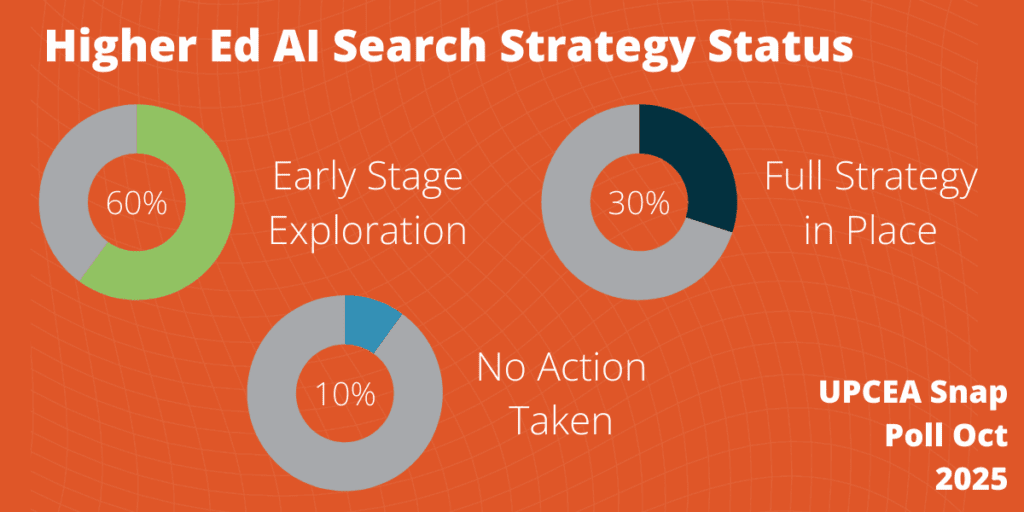
The biggest barriers to progress
Time, expertise, and clarity are slowing progress toward AI search adoption. 70% of surveyed UPCEA members cite competing priorities or limited bandwidth, 36.67% lack in-house expertise or training, and 26.67% point to unclear ROI, uncertainty about AI search mechanics, or lack of leadership buy-in.
These challenges are familiar. Most digital transformations in higher ed, and across industries in general, have historically begun with similar friction. The difference is speed. AI search is evolving faster than any channel before it, and the barrier isn’t belief. It’s clarity: who owns the AI search strategy, how to measure success, and what outcomes leadership should expect.
Visibility tracking is inconsistent
More than half of surveyed members say their site has appeared in AI-generated results, but few can measure that consistently. 56.7% say “yes” (in response to whether AI has cited their institution), 26.7% say “maybe,” and 13.3% are unsure. Only 64.29% of those tracking use formal tools.
Tracking AI visibility requires the same rigor as traditional SEO does, with tools, benchmarks, and periodic reviews. The difference is what’s being measured: citations, accuracy, and brand mentions within AI-generated content, not just rankings and clicks.
Why some teams act and others wait
When asked why they’re investing in AI search, UPCEA members cited two leading motivations: 59.26% want to ensure accurate and trustworthy information appears in AI tools, and 48.15% want to increase visibility and stay competitive.
Still, 22.22% say other priorities take precedence, and 14.81% admit they’re “waiting to see how AI evolves.” Unfortunately, the problem with waiting is that while you wait, AI models are learning, and they’re learning from the institutions already visible.
Data Source: AI Search Strategy in Higher Education – Snap Poll – October 2025
Why the Gap Matters
AI visibility compounds
The AI search gap isn’t a static problem. AI visibility builds on itself. The more often AI cites your programs, the more it learns to trust them. The less it sees your content, the more you fade from its knowledge base, which is what we call “visibility debt.”
Early adopters of AI search are building a head start in what may soon be a default search experience.
Visibility is the new enrollment funnel
Historically, traditional SEO has measured success in clicks and website sessions. AI search measures it in citations and credibility.
When a prospective learner sees your program referenced in an AI Overview, that’s awareness. When they verify it on your website, that’s consideration. The marketing funnel hasn’t disappeared, but it has moved up a layer. The enrollment journey now often begins inside generative AI, and visibility there determines whether a student ever reaches your site.
Learn why early AI visibility is becoming a long-term competitive advantage. →
How to Close the Gap
Adapting to AI search isn’t necessarily a technical overhaul as it is a strategic opportunity. With a little bit of leadership alignment and cross-functional coordination, higher ed marketing teams can build sustainable visibility across the platforms where students are already searching.
The key is to treat it like the institutional priority it is.
Step 1. Get leadership buy-in
Before any AI SEO strategy can take off, it must have executive support (obviously). Your institutional leaders need to understand that AI search isn’t just another SEO trend, but rather the next frontier for visibility and brand credibility in enrollment.
Decision-makers tend to respond to measurable outcomes, not the nitty-gritty tactics. When discussing investing in AI SEO, link the conversation to metrics they care about, such as inquiry volume, brand trust, and market competitiveness.
Use your own data to make the case. Half of students use AI tools weekly, yet 27% of institutions cite “unclear ROI” as a barrier. Reframe that question. It’s not “What’s the ROI of AI search?” — it’s “What’s the cost of being invisible where students are making decisions?”
Pro Tip: Propose a small pilot focused on three to five key programs. Track how those pages appear in AI Overviews and chat-based results. Quick, measurable wins help leadership see progress and open the door for longer-term investment.
Step 2. Formalize your AI search strategy
Once leadership is on board, turn initial interest into a structured plan of action. Define who owns AI search across marketing, IT, and communications, and establish how collaboration will work in practice.
Start with clear objectives. Are you trying to improve visibility in Google’s AI Overviews? Monitor accuracy in ChatGPT? Track how often Gemini or Perplexity references your programs? Most institutions will need to do all three, but prioritizing helps you focus limited resources where they’ll matter most.
Think of this stage as the “early SEO era” of AI visibility: foundational, fast-moving, and full of opportunity for early adopters. The institutions putting systems in place now will become the benchmarks others learn from later.
Pro Tip: Document your process. Create a short internal playbook outlining who’s responsible for updates, how often you’ll review AI citations, and what success looks like after six months. That consistency will make scaling smoother when AI visibility tracking becomes standard practice.
Step 3. Build AI-ready content
Strong visibility starts with strong site content. AI tools rely on structure, consistency, and clarity to identify credible sources, and your website is the foundation of that understanding.
Focus first on your highest-impact pages: degree programs, certificates, and areas that drive the most interest. Review them through an AI lens. Do they clearly outline key information,
like outcomes, duration, tuition, and requirements? Are those details consistent across catalog entries, landing pages, and external listings? Even small discrepancies can cause AI engines to overlook or misrepresent your programs.
Next, strengthen how information is presented:
- Use clear headings that mirror how prospective students search (for example, “What You’ll Learn,” “Program Requirements,” or “Cost and Financial Aid”).
- Add structured data, such as program, organization, and FAQ schema, so AI can easily verify facts.
- Reference official sources like accreditation bodies or institutional statistics to reinforce credibility.
- Keep content factual and concise. AI values clarity over creativity when determining which sources to trust.
Every correction or clarification you make strengthens your authority in both traditional and AI-driven search.
Pro Tip: Treat program pages as data assets, not just marketing copy. Clean, well-structured information is what gets cited, and cited content is what earns trust in AI search results.
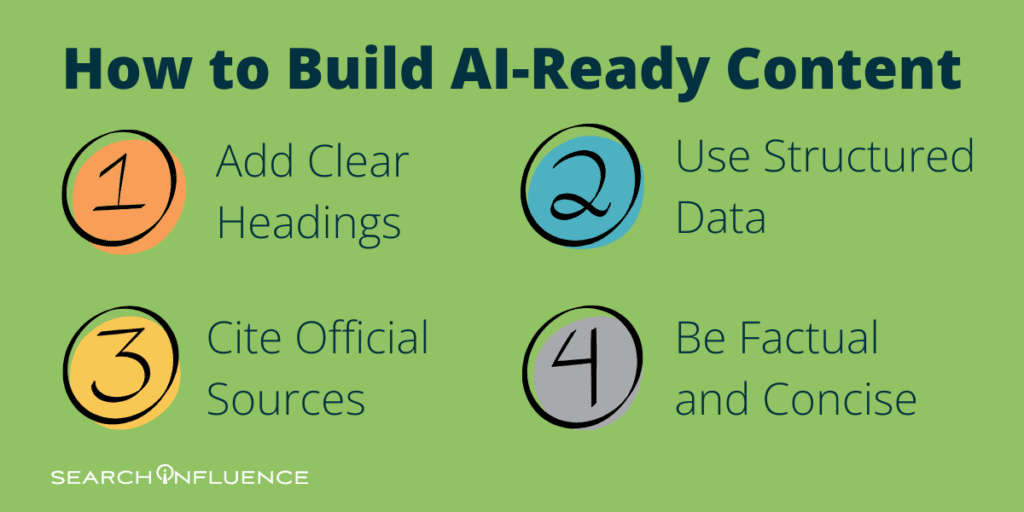
Step 4. Track and benchmark your visibility
Visibility is never static. It shifts as AI tools evolve. Tracking gives you the feedback loop you need to adapt and improve. Without it, you’re guessing where your institution stands in the conversation.
Start by identifying where your institution appears in AI-generated results across AI Overviews, ChatGPT, Gemini, and Perplexity. Then, benchmark three areas:
- Frequency: How often your programs are cited
- Accuracy: Whether AI summaries reflect your offerings correctly.
- Sentiment: The tone and context surrounding your mentions.
Use these insights to guide content updates and corrections. AI SEO tracking tools can help automate tracking, monitor citation accuracy, and benchmark performance across AI-powered search engines, offering the same kind of data discipline that keyword rankings do for traditional SEO.
Pro Tip: Treat AI visibility reviews like SEO reports. Quarterly benchmarking through AI SEO tools helps you spot trends, measure progress, and show leadership tangible proof that your AI search strategy is working.
Get the full data set and start closing your AI search gap. →
FAQs About AI Search in Higher Education
What does “AI search” mean for higher ed marketers?
“AI search” in higher education refers to how generative tools like Google’s AI Overviews, ChatGPT, Gemini, and Perplexity discover and summarize information about institutions and academic programs. Think of it as the next layer of SEO visibility, one that favors trustworthy, well-structured, and citeable content written for both humans and machines.
Is AI search replacing SEO?
No, SEO is still the foundation. AI tools depend on structured, high-quality web content to generate summaries. Strong foundational SEO gives AI engines the signals they need to find, understand, and cite your programs accurately.
How can institutions appear in AI Overviews or chat-based answers?
Focus on clarity and credibility. Keep program pages updated, use schema markup, and ensure facts are consistent across your site and external listings. AI tools favor sources that present verified, well-structured information.
What should we measure to track AI visibility?
Start with where your institution appears, how often, and what’s being said. Research some tools that can identify citations in AI-generated results, monitor accuracy, and compare your
presence against peers. Over time, these insights inform which content updates drive the biggest gains.
Get the Full AI Search Picture
AI search isn’t on the horizon. It’s happening now.
The question is whether your institution is showing up where students already are.
Download the UPCEA x Search Influence AI Search in Higher Education Research Study to see the full data set: how prospective learners use AI tools, which signals build trust, and what institutions can do to stay visible in this new era of search.
Jeanne Lobman is Director of Operations at Search Influence, a leading AI SEO and digital marketing agency serving higher education. Backed by more than 15 years of experience in digital strategy, operational management, and data analytics, she leads the systems, workflows, and campaign operations that support institutions such as Maine College of Art & Design, Tulane School of Professional Advancement, and Tufts University College. Known for her analytical rigor, Jeanne specializes in building scalable, data-driven processes and marketing programs that transform complex challenges into measurable results—optimizing efficiency, improving decision-making, and driving inquiries and applications.