
Pedagogy, Andragogy, and Now Heutagogy
Online: Trending Now #142
Teaching adults is not the same as teaching children; done well, it affords the adults a level of autonomy, even including the opportunity to determine and direct their learning.
Regrettably, we still find university instructors who teach their students as if they were in 19th or 20th century elementary or high school classrooms. They slavishly follow fact-filled text books, offer tedious objective quizzes to drill the facts into student minds (ignoring that the answers are just a click away), and never climb a Bloom’s Digital Taxonomy pyramid or Depth of Knowledge chart) beyond “recall/reproduction” or “remembering and understanding.”
Bloom’s Digital Taxonomy Pyramid
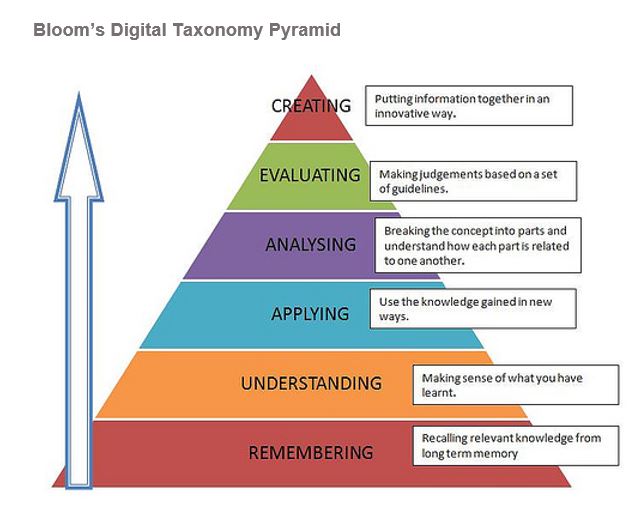
Creative Commons Attribution-Share Alike 2.0 Generic License by nist6dh
Yet, research shows us that as we seek to build deeper knowledge in this digital age, we should strive to climb the taxonomy pyramid to encourage students to apply, analyze, evaluate, and create. In this way we build higher order learning that affords adaptability and flexibility. Educational theorist Malcolm Knowles proposed four principles of andragogy (the teaching of adults).
- Adults need to be involved in the planning and evaluation of their instruction.
- Experience (including mistakes) provides the basis for the learning activities.
- Adults are most interested in learning subjects that have immediate relevance and impact to their job or personal life.
- Adult learning is problem-centered rather than content-oriented.
The next step in working with motivated, adult learners is heutagogy: “a student-centric teaching and learning strategy where the learning is determined by the learner.” As we apply heutagogical principles, we encourage self-directed learning. In doing so it might seem that we are giving up the job of teaching, but instead we are enabling our learners to define their needs and outcomes:
Of course, one of the hallmarks of self-directed learning is that it requires instructors to turn control of the learning experience over to the learners themselves. While this may mean less planning on the part of the instructor, it also often means more time working with learners individually to establish their goals, or else creating a wider range of content so that learners can choose what to study.
A few ways to encourage self-directed learning include:
- Letting learners set their own completion dates for assignments.
- Allowing learners multiple completion attempts.
- Having learners design their own course projects.
- Organizing modules so that learners can start with whatever interests them most.
By letting go of rigid control of the learning, we respect our adult professionals to build and direct their own learning. Our role becomes one of encouragement and support including such techniques as Socratic questioning to help the students refine their learning experience.
This approach is uniquely applicable to the field of professional continuing education. It is how we will most effectively teach professionals.
Self-directed learning respects the motivation and competency of professionals seeking to improve and expand their knowledge and skills. It is especially effective online, using the plethora of Web-based resources and tools to enlighten and update the areas of study. We should encourage our faculty members and instructional designers to consider these effective approaches to teaching the adult, motivated and professional students.
Of course, I will continue to track the developments in emerging trends, technologies, pedagogies and practices, Continuing and Online Education Update blog by UPCEA. You can have the updates sent directly to your email each morning– no advertising, no spam!
Best,
Ray Schroeder Founding Director
National Council for Online Education
Authored by

Ray Schroeder is Professor Emeritus, Associate Vice Chancellor for Online Learning at the University of Illinois Springfield (UIS) and Senior Fellow at UPCEA. Each year, Ray publishes and presents nationally on emerging topics in online and technology-enhanced learning. Ray’s social media publications daily reach more than 12,000 professionals. He is the inaugural recipient of the A. Frank Mayadas Online Leadership Award, recipient of the University of Illinois Distinguished Service Award, the United States Distance Learning Association Hall of Fame Award, and the American Journal of Distance Education/University of Wisconsin Wedemeyer Excellence in Distance Education Award 2016.
Other UPCEA Updates + Blogs
Whether you need benchmarking studies, or market research for a new program, UPCEA Consulting is the right choice.
We know you. We know the challenges you face and we have the solutions you need. We speak your language and have been serving leaders like you for more than 100 years. UPCEA consultants are current or former continuing and online higher education professionals who are experts in the industry—put our expertise to work for you.
UPCEA is dedicated to advancing quality online learning at the institutional level. UPCEA is uniquely focused on excellence at the highest levels – leadership, administration, strategy – applying a macro lens to the online teaching and learning enterprise. Its engaged members include the stewards of online learning at most of the leading universities in the nation.
We offers a variety of custom research options through a variable pricing model.